2.10 Optimizing Parameters and Special Experiments
01-999162-00 C0402 VNMR 6.1C User Guide: Solid-State NMR
42
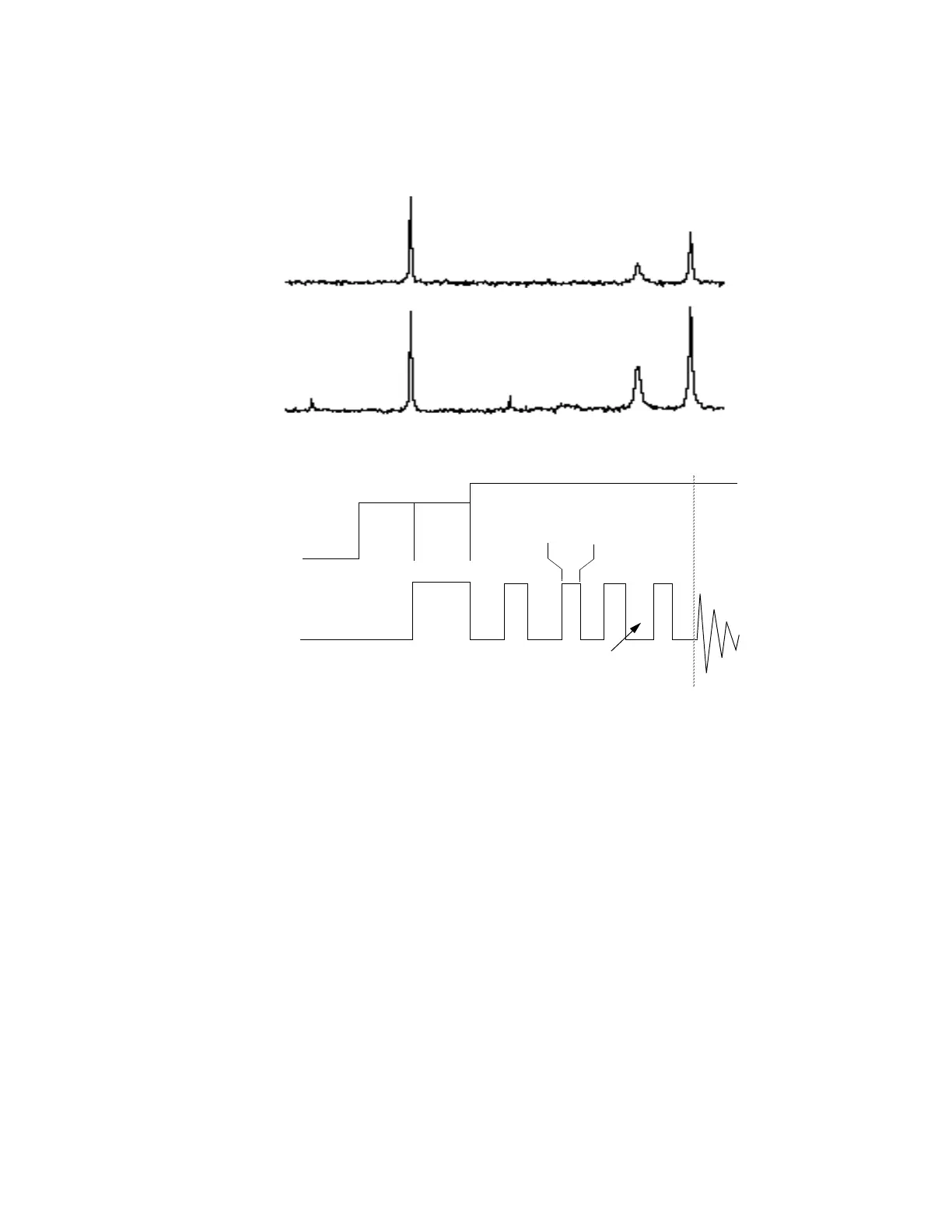
TOSS is less effective at high spinning speeds. Note that if suppression is not complete,
check that srate is correct. TOSS uses 180
° pulses based on pwx. It may be necessary to
adjust pwx to optimize the TOSS experiment.
Suppressing Protonated Carbon (Interrupted Decoupling)
Off-resonance decoupling and related experiments in which J-coupling is involved are not
routinely possible in solids because dipolar coupling as well as J-coupling is present. One
experiment exists, however, that is used in solids to discriminate between carbon types, and
that is the protonated carbon suppression experiment of Opella and Fry. In this experiment,
the decoupler is turned off for 40 to 100
µs before acquisition to dephase the protonated
carbons.
The technique is effective primarily for non-mobile carbons; mobile carbons, like methyl
groups, are typically not suppressed as well. Figure 13 shows a typical protonated carbon
suppression experiment on alanine, obtained by setting pdp (protonated dephasing) equal
to 'y', setting srate to the spinning speed, and entering appropriate values for pdpd2
(in
µs), the dephasing time.
13
C
1
H
d1
pw
(crossp)
cntct
Delay recipe
including srate
dipolr
xpol='y' toss='y'
toss='n'
toss='y'
Figure 12. TOSS Experiment on Alanine (Spectrum and Sequence)
cnctct
(tpwrm)
2*pwx



 To Next Page