2.9 XPOLAR1—Cross-Polarization
01-999162-00 C0402 VNMR 6.1C User Guide: Solid-State NMR
38
The transmitter is placed in the center of the spectrum.
3. Enter ga.
4. Put the cursor on the tall methyl line and type nl rl(17.43p) ga.
The reference (reffrq) is
set only after you use the rl
command to reference. If you
change tn without using rl
the chemical shift scale and
reference will be that of the
previous nucleus. The new
reference (reffrq) is saved
with the data only after you
type ga. If you do not acquire
a new spectrum you will
reference only the display
(rfl and rfp) in the current
experiment.
5. Save the HMB data set and use it as the starting point for all solids spectra until you
re-reference.
The frequency of re-referencing depends upon the drift rate of your magnet. A drift rate of
10 Hz per hour is 2.5 Hz per hour for
13
C. A typical
13
C linewidth of a solid is between 30
Hz and 300 Hz.
For most purposes, this procedure should be followed only at the time the probe is installed.
The
13
C chemical shifts of a few reference materials are given in Table 5.
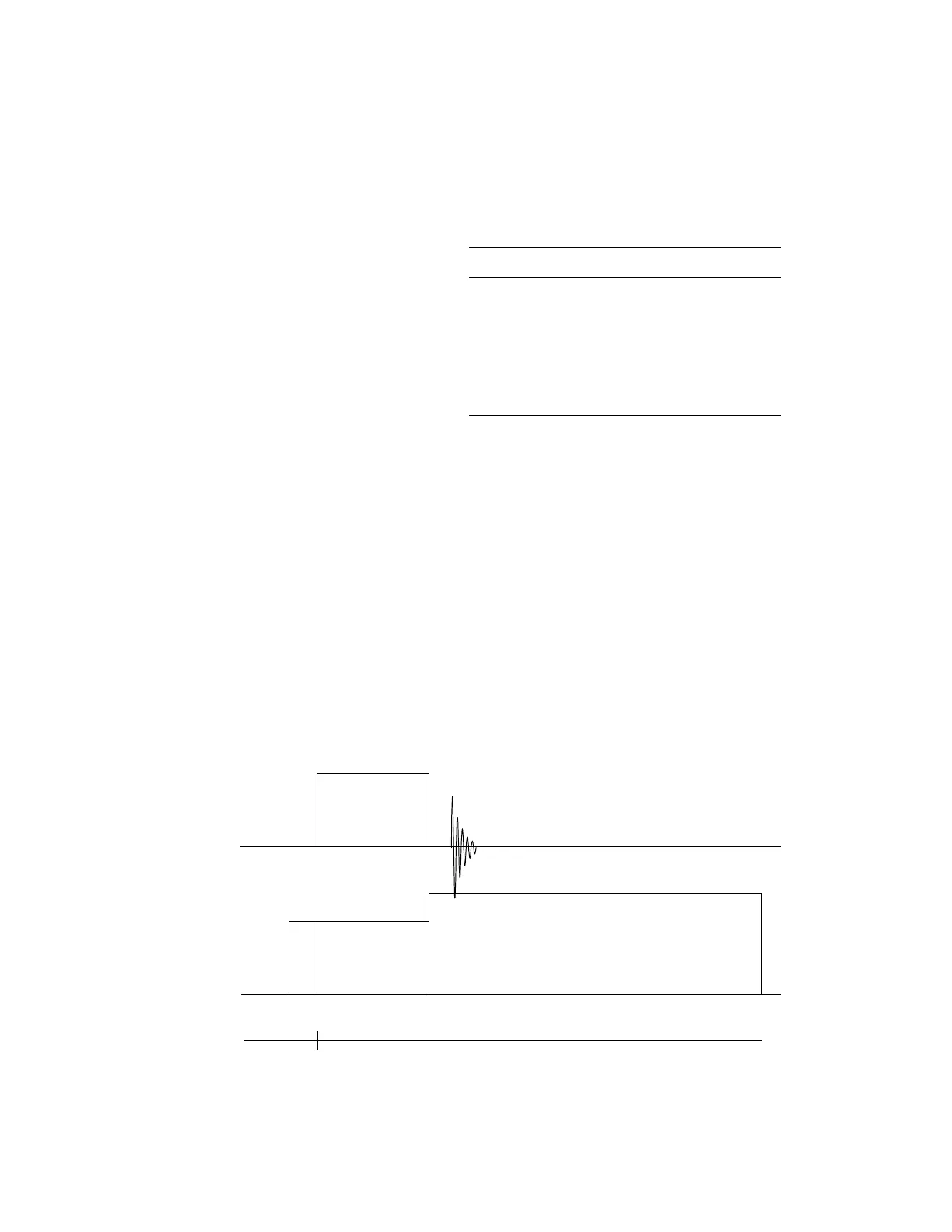
2.9 XPOLAR1—Cross-Polarization
XPOLAR1 is applicable to MERCURYplus, MERCURY-VX,
UNITY
INOVA, UNITYplus, and
newer UNITY systems. The parameters that control the attenuators and linear modulators
are shown in the diagram of XPOLAR1, see Figure 10.
Table 5. Reference Materials and
C Chemical
Shifts
Substance Chemical shift (ppm)
adamantane 29.2, 38.3
delrin 88.5
glycine 43.6, 176.4
hexamethylbenzene 17.3, 132.1
poly(methyl methacrylate) 19, 45, 51, 176
talc (
29
Si) –90
Figure 10. XPOLAR1 Pulse Sequence
pw
cntct
cntct
(tpwrm)
(crossp)
(dipolr)
Tx
Dec
at
d1
AC



 To Next Page