Chapter 6. Solid-State NMR Experiments
125
VNMR 6.1C User Guide: Solid-State NMR 01-999162-00 C0402
The particular example used here is the simultaneous observation of
27
Al and
2
H. For this
experiment, a triple-resonance probe was used with the coil doubly tuned to
27
Al (referred
to as the high frequency) and
2
H (referred to as the low frequency). Both NMR frequencies
were picked off the high-frequency port. It was possible to observe the
2
H signal due to the
imperfect isolation between the two channels.
By coding a pulse sequence using the offset pulse sequence statement in conjunction with
large values of tof (in MHz), two FIDs, one at
27
Al and the other at
2
H, were collected in
37 milliseconds, of which 20 milliseconds is the acquisition time of the two FIDs. By
adding a loop statement and setting the value if nf (number of FIDs) is greater than one, a
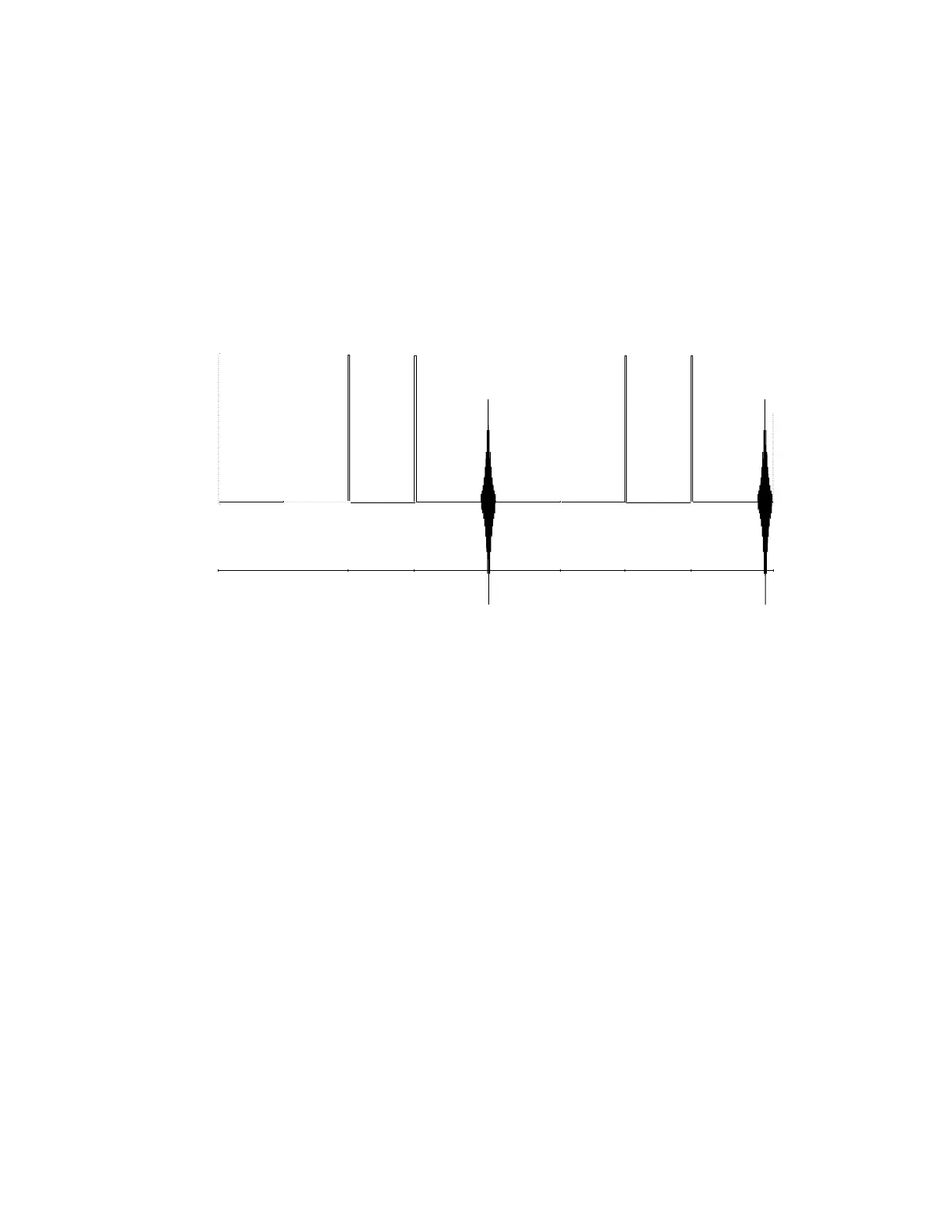
series of alternating multinuclear FIDs can be collected. Figure 59 is a diagram of the fast
acquisition pulse sequence, called FASTACQ.
Macro
The macro fastacq recalls the FASTACQ sequence and a modified parameter set.
Parameters
nf is the number of FIDs to be collected.
tof is the offset, in Hz, to be used for the low-frequency nucleus.
freqout is the difference, in MHz, between the high frequency nucleus, defined by tn,
and the low frequency nucleus.
Processing and Display
Data is processed by the command wft('nf'). This allows the data to be transformed in
the form of an arrayed experiment. All the data can be displayed with the dssh command.
Portions of the data can be displayed with the standard arguments of the command dssh.
6.31 NUTATE—Solids 2D Nutation
NUTATE is a two-dimensional solids nutation experiment patterned after that of Lippmaa
and coworkers. The experiment illustrates the effect of pulse width on the spectra obtained.
Figure 59. FASTACQ Pulse Sequence
Tx
2.0e-3 d1
A
p1 d2
B
pw
1.0/(beta*fb)
2.0e-3
C
d1
A
p1 d2
B
pw
1.0/(beta*fb)
C
2.0m 0.0u 0.0u 138.4u 2.0m 0.0u 0.0u 138.4u
0.0u 1.0u
16.0m 16.0m
0.0u 1.0u



 To Next Page