6.1 XPOLAR—Cross-Polarization, UNITY
01-999162-00 C0402 VNMR 6.1C User Guide: Solid-State NMR
82
two processes happen simultaneously, the magnetization buildup from cross-polarization
and the magnetization loss from rotating-frame relaxation. A time exists for which an
optimum in the magnetization occurs. The rising and falling exponential intensities can be
analyzed with the contact_time macro, which calculates both T
CH
and
1
H T
1ρ
.
Applicability
XPOLAR is available on all systems.
Suppressing Spinning Sidebands
NMR spectra at high magnetic fields often have significant spinning sidebands. While these
spinning sidebands contain information about the chemical shift anisotropy, they can
complicate the interpretation of complex spectra. The sidebands can be eliminated using
the TOSS (TOtal Sideband Suppression) technique. The TOSS pulse sequence is selected
by setting toss='y'. Note that the parameter srate should be set to the spinning speed
in Hz. TOSS uses 180
° pulses based on the parameter pw. It may be necessary to adjust pw
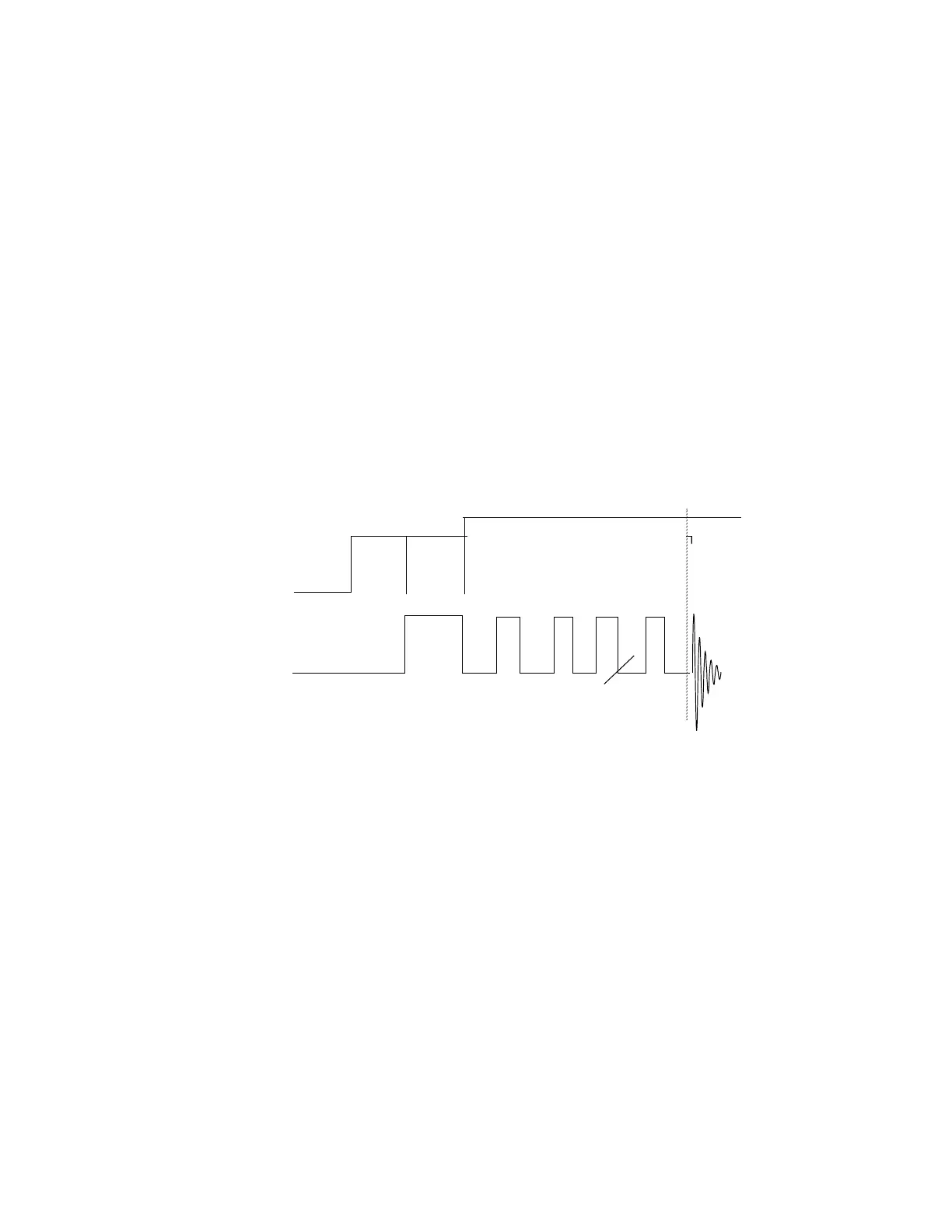
to optimize the TOSS experiment. Figure 30 shows the pulse sequence diagram for cross-
polarization with TOSS.
Suppression of Protonated Carbons (Interrupted Decoupling)
Off-resonance decoupling and related experiments, such as DEPT, in which J-coupling is
involved are not usually possible in solids because through-space dipolar coupling as well
as J-coupling is present. An experiment exists, however, that can be used to discriminate
between protonated and nonprotonated carbons—this is the protonated carbon suppression
experiment of Opella and Fry. In this experiment, the decoupler is turned off before
acquisition to dephase the protonated carbons.
The technique is effective for non-mobile carbons. Mobile carbons, like methyl groups, are
typically not suppressed as well. The experiment is run by setting pdp='y', setting
srate to the spinning speed and entering appropriate values for the dephasing time d2 (in
seconds). Figure 31 shows the pulse sequence diagram for cross-polarization with
interrupted decoupling.
Figure 30. TOSS Pulse Sequence
13
C
1
H
d1
pw
level1
p2
Delay recipe
including
srate
level2
xpol='y' toss='y'



 To Next Page