Chapter 6. Solid-State NMR Experiments
97
VNMR 6.1C User Guide: Solid-State NMR 01-999162-00 C0402
References
Hediger, S.; Meier, B. H.; Ernst, R. R. Chem. Phys. Lett. 1993, 213, 627.
6.10 VACP—Variable Amplitude Cross-Polarization
As typical field strengths and rotor speeds used for CP/MAS increase, a problem that
develops is the rotor speed dependence of cross-polarization. Usually signal-to-noise drops
and the zero-speed Hartmann-Hahn match splits into a set of sidebands.
A straight-forward solution is to vary the pulse amplitude during the contact time of the
cross-polarization. A set of alternating amplitudes with an increasing difference during the
contact time is quite effective in removing the spinning speed dependence of cross-
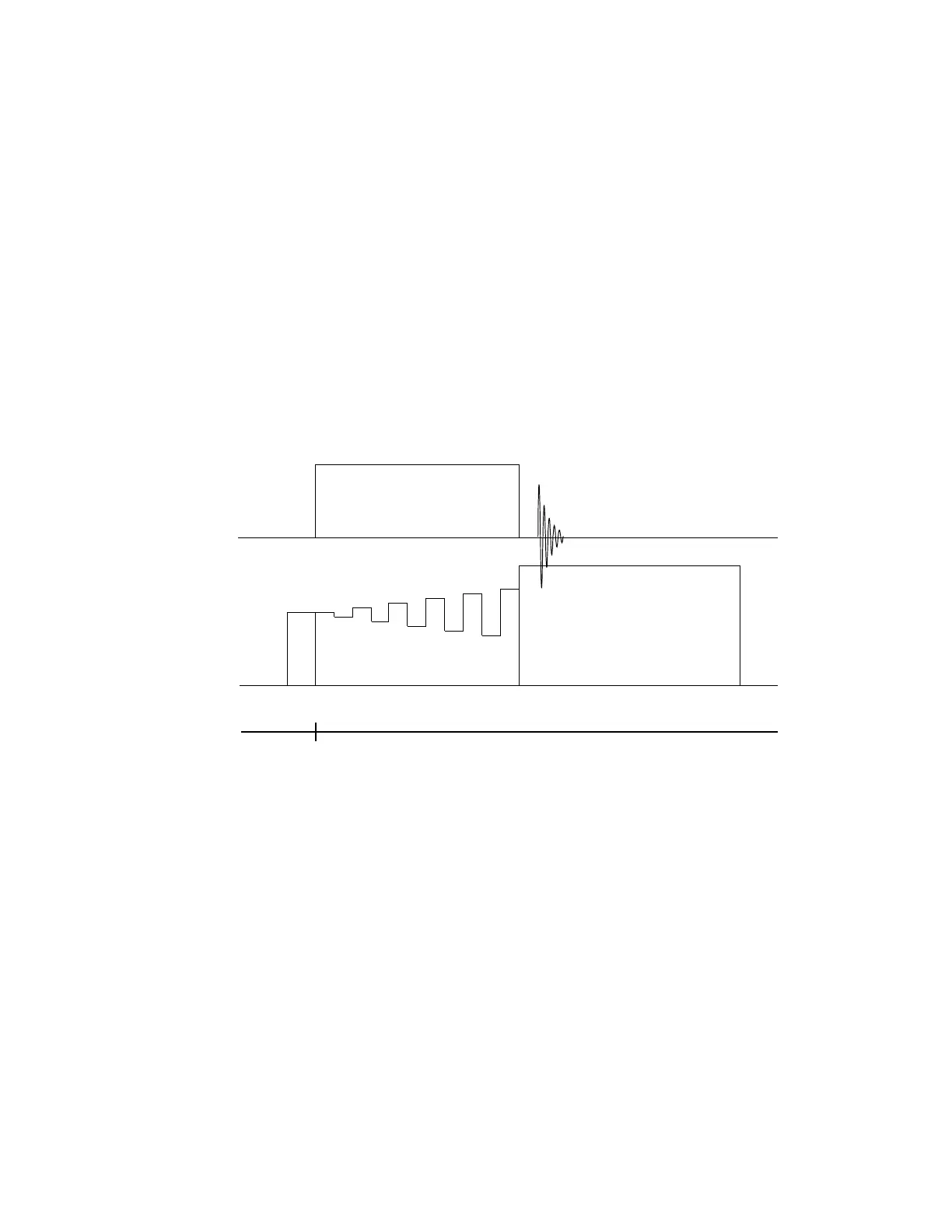
polarization. In the VACP sequence, during the contact time,
1
H power is varied among 11
levels with the appropriate amplitudes. The difference between the maximum and
minimum values of
γB
2
(in Hz) should be at least twice the maximum rotor speed to be
used. Figure 39 is a diagram of the VACP sequence.
Applicability
VACP is available on
UNITY
INOVA, UNITYplus, and UNITY. It is found in userlib.
Macro
The vacp macro sets up parameters for the VACP pulse sequence and can take two or three
arguments. vacp sets default levels for the arrayed parameter vacp. Units are the same as
crossp. vacp[0]=crossp, vacp[n]–vacp[n–1]=500, and n=11. Syntax is as
follows: vacp<(<<<vacp[n]–vacp[n–1],vacp[0]>,n>)>. The vacplist
macro lists VACP levels and resets array='' (two single quotes).
Figure 39. VACP Pulse Sequence
pw
cntct
(tpwrm)
Tx
Dec
at
d1
AC
(dipolr)
(vacp[11])
cntct



 To Next Page