6.20 REDOR1—Rotational Echo Double Resonance
01-999162-00 C0402 VNMR 6.1C User Guide: Solid-State NMR
112
Applicability
REDOR1 is available only on
UNITY
INOVA and UNITYplus systems.
Macro
The macro redor1 converts a parameter set, obtained with XPOLAR or XPOLAR1, for
the REDOR experiment with xy8
π pulses on the observe channel. Observe and decoupler
power levels and the proton 90
° pulse width are retained. Third channel power levels and
pulse width must be calibrated (see p1 below). Default parameters yield an array of spectra
for 2 to 32 rotor cycles. Alternate spectra are obtained without and with third channel
π
pulses. For best results, adjust tof and dof2 (see dof2 below) so that the peak of interest
is on-resonance.
Parameters
redor1 uses
UNITY
INOVA and UNITYplus parameters tpwr, tpwrm, dpwr, cppwr,
dipolr, crossp, dblvl2, pw, and cntct. See page 85 for a description of these
parameters.
rdflag is set to 'y' to apply
π pulses to both the observe and third channel and thus
obtain REDOR modulation of the peak intensity. rdflag is set to 'n' to apply
π pulses
only to the observe channel and thus obtain observe peak intensity without REDOR
modulation. Typically, the array rdflag='n','y' is used.
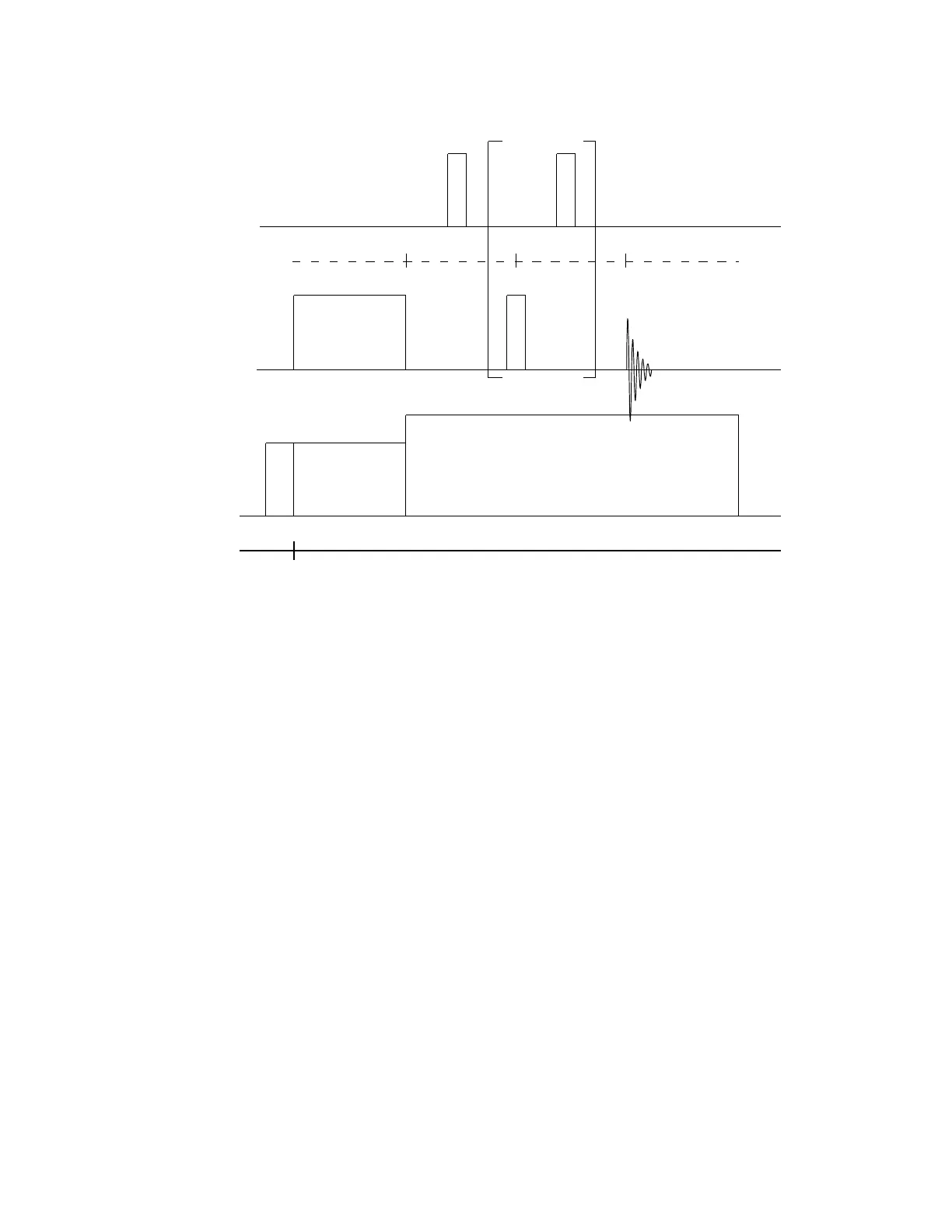
Figure 49. REDOR1 Pulse Sequence
'cycles' - 1 times
pw cntct
(crossp)
(dipolr)
cntct 2*pw
(tpwrm)
p1p1
<if rdflag = 'y'>
Tx
Dec2
Dec
n*(1/srate)
d1
CA



 To Next Page