Chapter 4. CRAMPS/Multipulse Module Operation
65
VNMR 6.1C User Guide: Solid-State NMR 01-999162-00 C0402
12. Set the spin rate at < 2 kHz.
13. Set d1=5 for glycine and d1=60 for adipic acid.
14. Type nt=2 ga
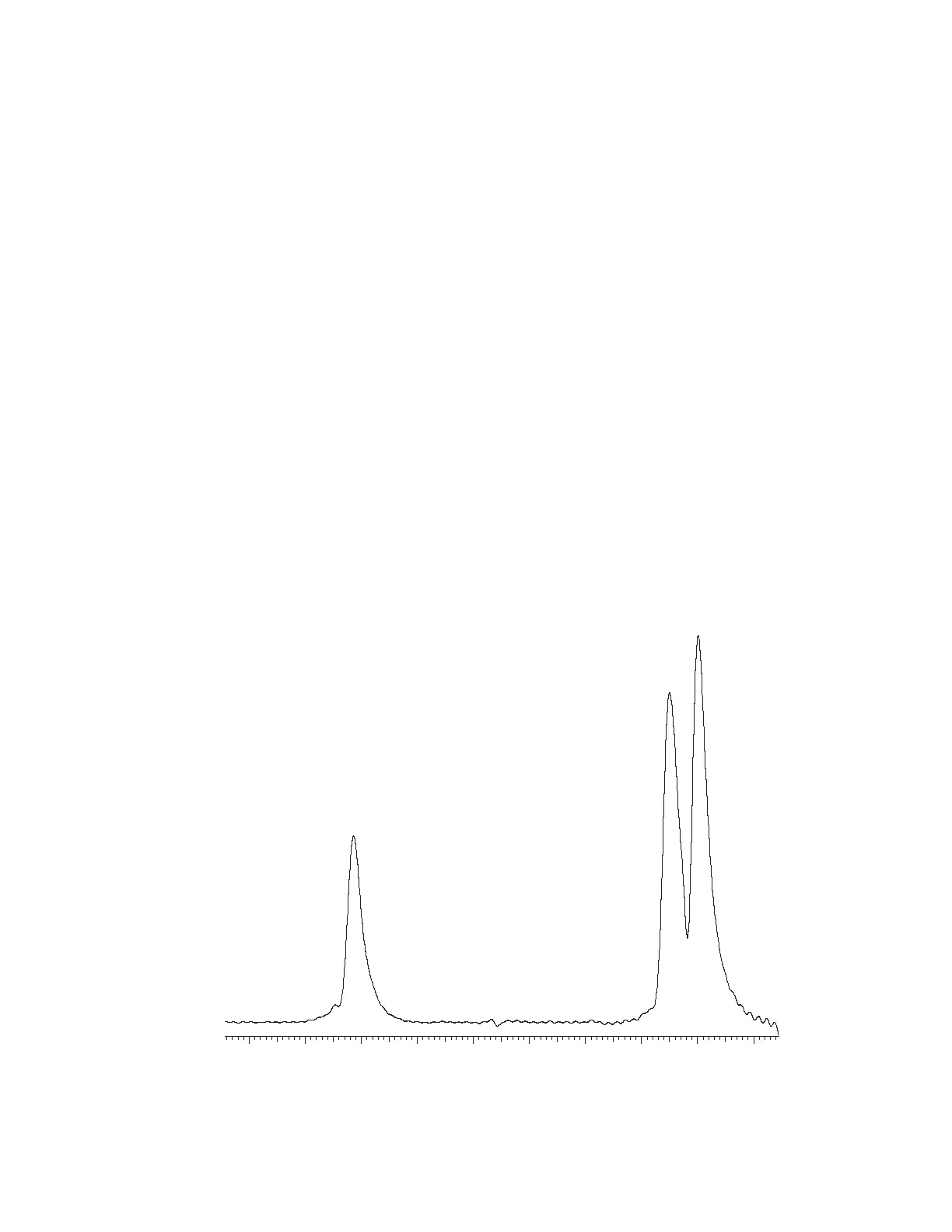
The result for adipic acid should be similar to Figure 21.
15. Scale the spectrum.
a. Place two cursors on the two upfield lines of adipic acid or glycine.
b. Type scalesw=sfrq/delta.
16. Reference the spectrum.
a. Place a cursor on the upfield of the two lines
b. Type rl(sfrq*2.0/scalesw) to reference this line at 2.0 ppm.
c. The chemical shift scale and reference are now correct and an additional line
should be present at 13 to 14 ppm.
17. Run the experimental sample with the same data set and tuning.
4.6 How to Obtain Good CRAMPS Spectra
MREV8 and BR24 pulse sequences must be used with slow spinning so that the length of
a rotor cycle, tr, greater than one multiple-pulse cycle, tauc. Interference between these
two cycles will negate the narrowing effects. Typical spinning speeds for
1
H CRAMPS are
less than 2 kHz, and at these speeds the multiple-pulse cycle does all the narrowing of
1
H-
1
H dipolar interactions.
ppm (sc)24681012141618
Figure 21. Adipic Acid Spectrum



 To Next Page