6.19 SEDRA2—Simple Excitation of Dephasing Rotational-Echo Amplitudes
01-999162-00 C0402 VNMR 6.1C User Guide: Solid-State NMR
110
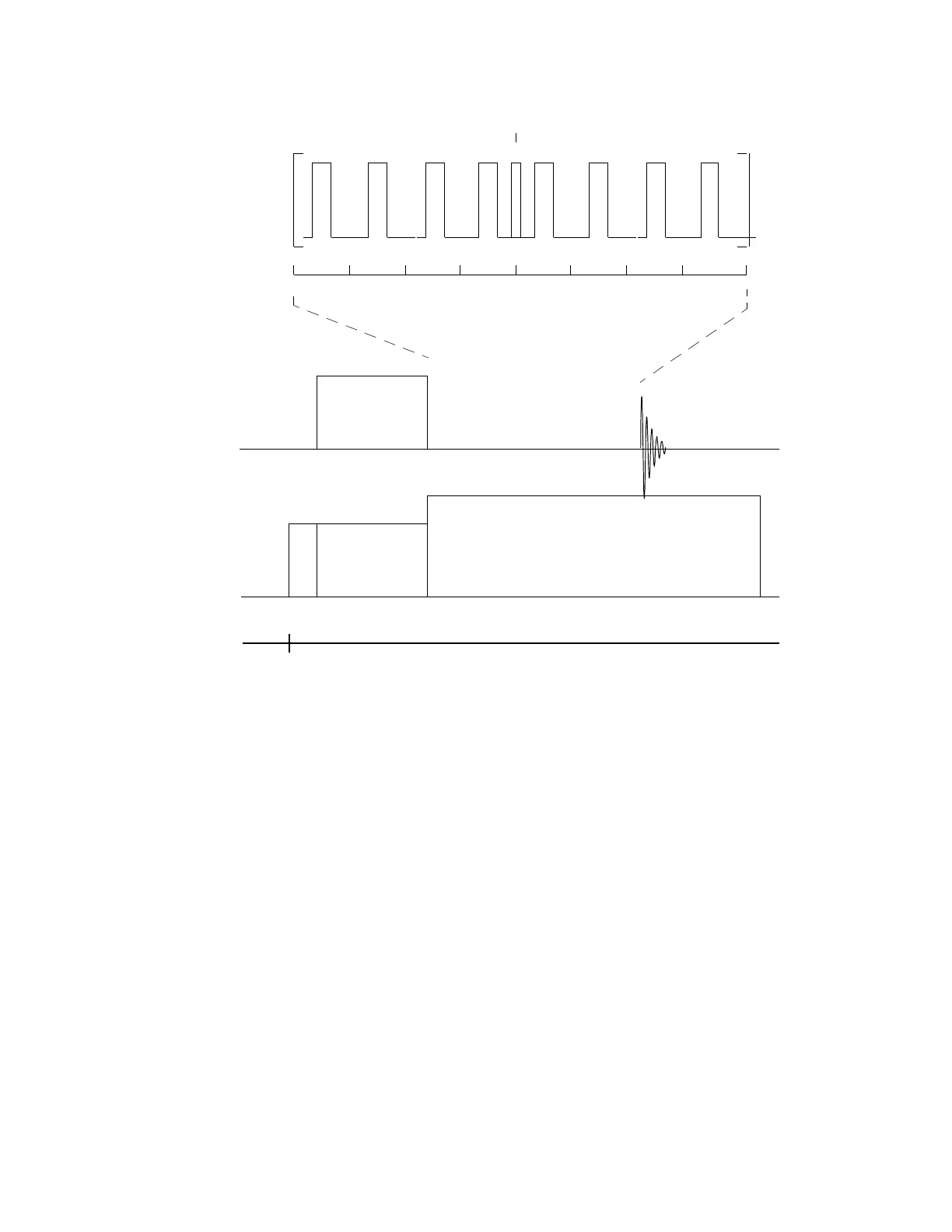
SEDRA is applied after cross-polarization and consists of a train of π pulses synchronized
with the middle of each rotor period. Acquisition follows at the next rotor period and proton
decoupling is maintained throughout. SEDRA pulses reintroduce the dipolar interaction
and cause a diminution of the intensity. Typically, plots of spectral intensity versus the
number of rotor cycles are generated and the internuclear distance can be determined by
simulation of the resulting curve. A
π/2 pulse placed every 8 cycles cancels the effect of
SEDRA and provides a control experiment.
Applicability
SEDRA2, found in userlib, is available only on
UNITY
INOVA and UNITYplus.
Macro
The macro sedra2 converts a parameter set, obtained with XPOLAR or XPOLAR1, for
the transverse SEDRA experiment of Guillion and Vega. Power levels and the proton 90
°
pulse width are retained. The value of pwx must be calibrated (use XPWXCAL).
Figure 48. SEDRA2 Pulse Sequence
pwx
X YY X X Y
Y
X
'cycles' times
(2*pwx)
pw
cntct
cntct
(tpwrm)
(crossp)
(dipolr)
Tx
Dec
<if sedrlflg='n'>
n*(1/srate)
at
d1
AC



 To Next Page