Chapter 4. CRAMPS/Multipulse Module Operation
63
VNMR 6.1C User Guide: Solid-State NMR 01-999162-00 C0402
The RF homogeneity can be enhanced by reducing the sample size and by using care
to center the sample in the coil. Data similar to Figure 18 is suitable for most
CRAMPS experiments. Probes with a strong
1
H background (typically the Vespel,
modules of Chemagnetics CP/MAS probes) will show an initial offset of all the
points, that decays to zero. Probe background is subtracted by the BR24 experiment
and can usually be ignored.
Remove phase transient (FLIPFLOP or X-X)
1. Type phase2=2.
This changes the experiment to FLIPLOP or X-X.
2. Type gf and then acqi.
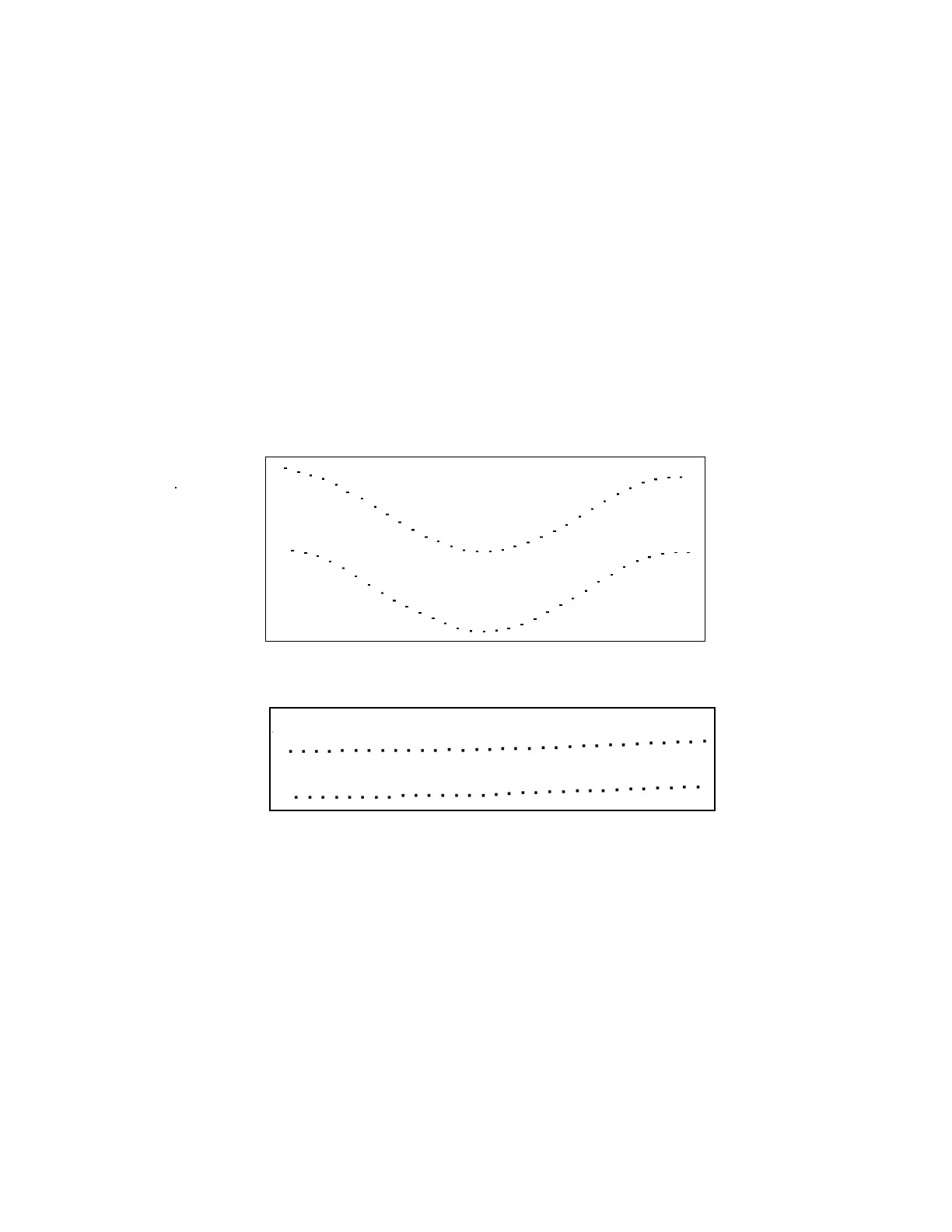
The result should be a parallel set of points similar to Figure 19 or Figure 20. The
transmitter must be on resonance to correctly run X-X.
3. Adjust the system tuning (see “System Tuning,” page 63) to remove the curvature of
Figure 19. and obtain a result similar to Figure 20.
System Tuning
The ideal signal pattern is (1.0,0.0)N. Curvature similar to Figure 19 results from phase
transient or phase “glitch”. Phase transient is a small shift, f(t) in phase during the rise and
fall times of the pulse. Asymmetric phase transient (
φ(τ) during the rise time is not equal to
-
φ(τ) during the fall time) causes a net phase shift with each pulse of X-X. This shift causes
a frequency offset of the entire pattern. The same effect will occur in the CRAMPS
experiment.
Phase transient can be removed or balanced by adjusting tuning of the duplex circuit
containing probe, amplifier, quarter-wave cable and preamplifier. A small adjustment of the
probe tuning capacitor is often quite effective. In this case record the value of the reflected
Figure 19. FLIPFLOP “Tram Tracks”
Figure 20. FLIPFLOP Desired FID



 To Next Page