6.3 XPWXCAL—Observe-Pulse Calibration with Cross-Polarization
01-999162-00 C0402 VNMR 6.1C User Guide: Solid-State NMR
88
polarization is used for preparation, XPWXCAL can be run in less time than XPOLAR1
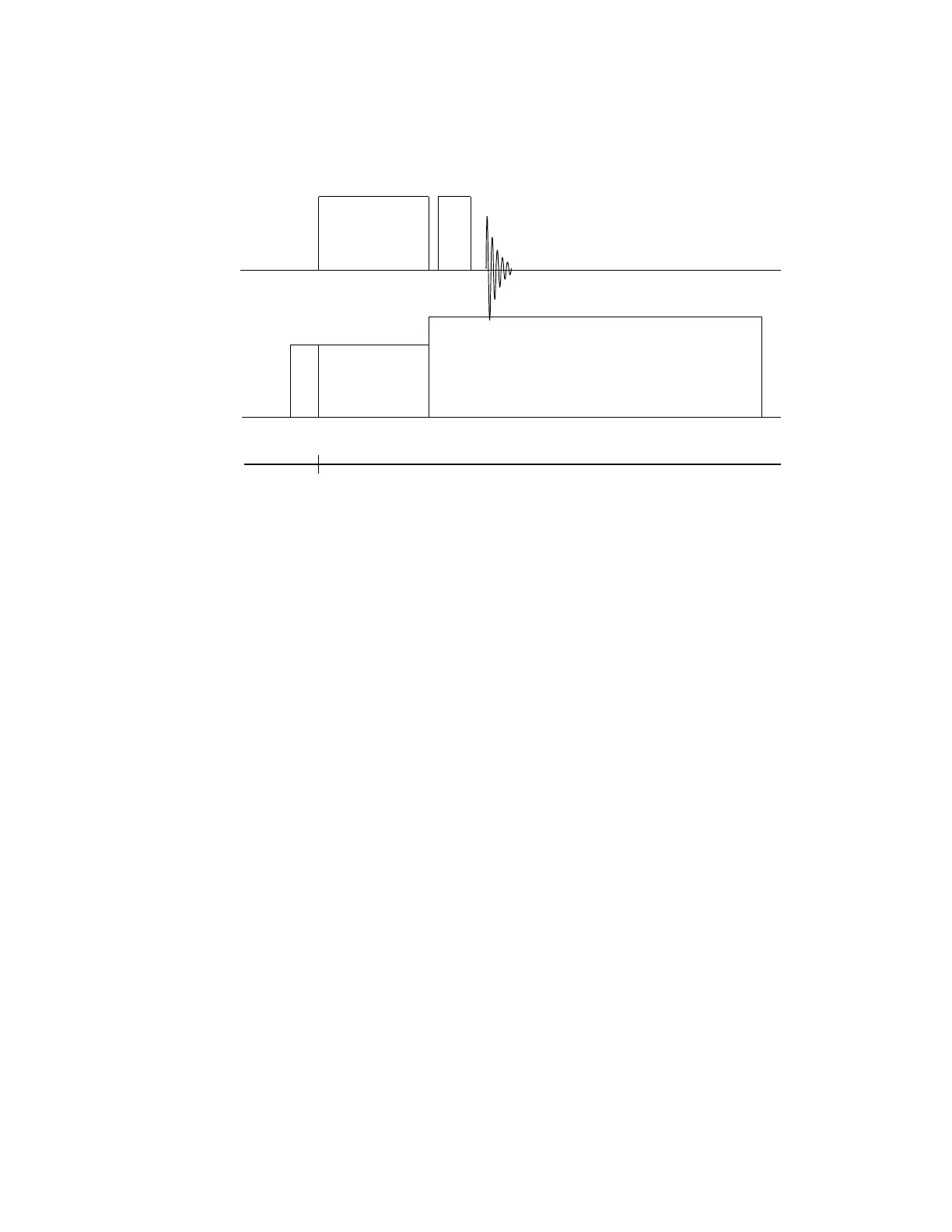
with xpol='n'. Figure 35 is a diagram of the sequence.
Applicability
XPWXCAL is available only on
UNITY
INOVA and UNITYplus. It is found in userlib.
Macro
The macro xpwxcal converts a parameter set, obtained with XPOLAR or XPOLAR1, for
the XPWXCAL experiment. Power levels and the proton 90°
° pulse width are retained. By
default, pwx=pw and phase=2.
Parameters
xpwxcal uses the
UNITY
INOVA and UNITYplus parameters tpwr, tpwrm, dpwr,
cppwr, dipolr, crossp, dblvl2, pw, and cntct. See page 85 for a description of
these parameters.
pwx is the observe 90°
° pulse length. pwx follows the contact time and, when set to 90°,
rotates the observe magnetization to the minus z axis and nulls the NMR signal. Array pwx
between the 0
° and 360° pulse. The first null is the observe 90° pulse. The signal is negative
for 180
°, null for 270°, and positive for 360°.
When the Hartmann-Hahn condition is matched for a non-spinning sample, the proton 90
°
pulse pw equals pwx. In the presence of spinning, a match that causes maximum spectral
intensity will be offset in power above or below the true Hartmann-Hahn condition. If
observe pulses are used explicitly in a sequence (TOSS, REDOR1, HETCORCP1, etc.)
pwx must be measured separately, and it is usually present as a separate parameter. For
HETCORCP1, pwx must be set to pw (by adjusting tpwrm), and pw is used for both
observe and proton pulses.
Figure 35. XPWXCAL Pulse Sequence
pw
cntct
cntct
(tpwrm)
(crossp)
(dipolr)
Tx
Dec
at
d1
AC
d2
pwx
YX
<if phase=2>



 To Next Page