Chapter 6. Solid-State NMR Experiments
85
VNMR 6.1C User Guide: Solid-State NMR 01-999162-00 C0402
maximum level of 255, or linear, with a maximum of 63. 0 is the minimum power on
UNITY systems and –16 is the minimum on
UNITY
INOVA and UNITYplus systems.
level1f and level2f are only active for linear attenuators and they give an additional
6 dB range for UNITY systems and 60 dB range for
UNITY
INOVA and UNITYplus systems,
divided into 4095 steps. level1 and level2 override dpwr.
References
Cross-Polarization Technique
Pines, A.; Gibby, M. G.; Waugh, J. S. J. Chem. Phys. 1973, 59, 569.
Stejskal, E. O.; Schaefer, J.; Waugh, J. S. J. Magn. Reson. 1977, 28, 105.
Spinning Sidebands
Herzfeld, J.; Berger, A. E. J. Chem. Phys. 1980, 73, 6021.
Dixon, W. T. J. Magn. Reson. 1981, 44, 220.
Dixon, W. T. J. Magn. Reson. 1982, 49, 341.
Dixon, W. T. J. Magn. Reson. 1985, 64, 332.
Protonated Carbon Suppression
Opella, S. J.; Fry, M. H. J. Am. Chem. Soc. 1979, 101, 5856.
Relaxation Times
Schaefer, J.; Stejskal, E. O.; Buchdahl, R. Macromolecules 1077, 10, 384.
6.2 XPOLAR1—Cross-Polarization
XPOLAR1 is applicable to MERCURYplus, MERCURY-VX,
UNITY
INOVA, UNITYplus, and
newer UNITY systems. The parameters that control the attenuators and linear modulators
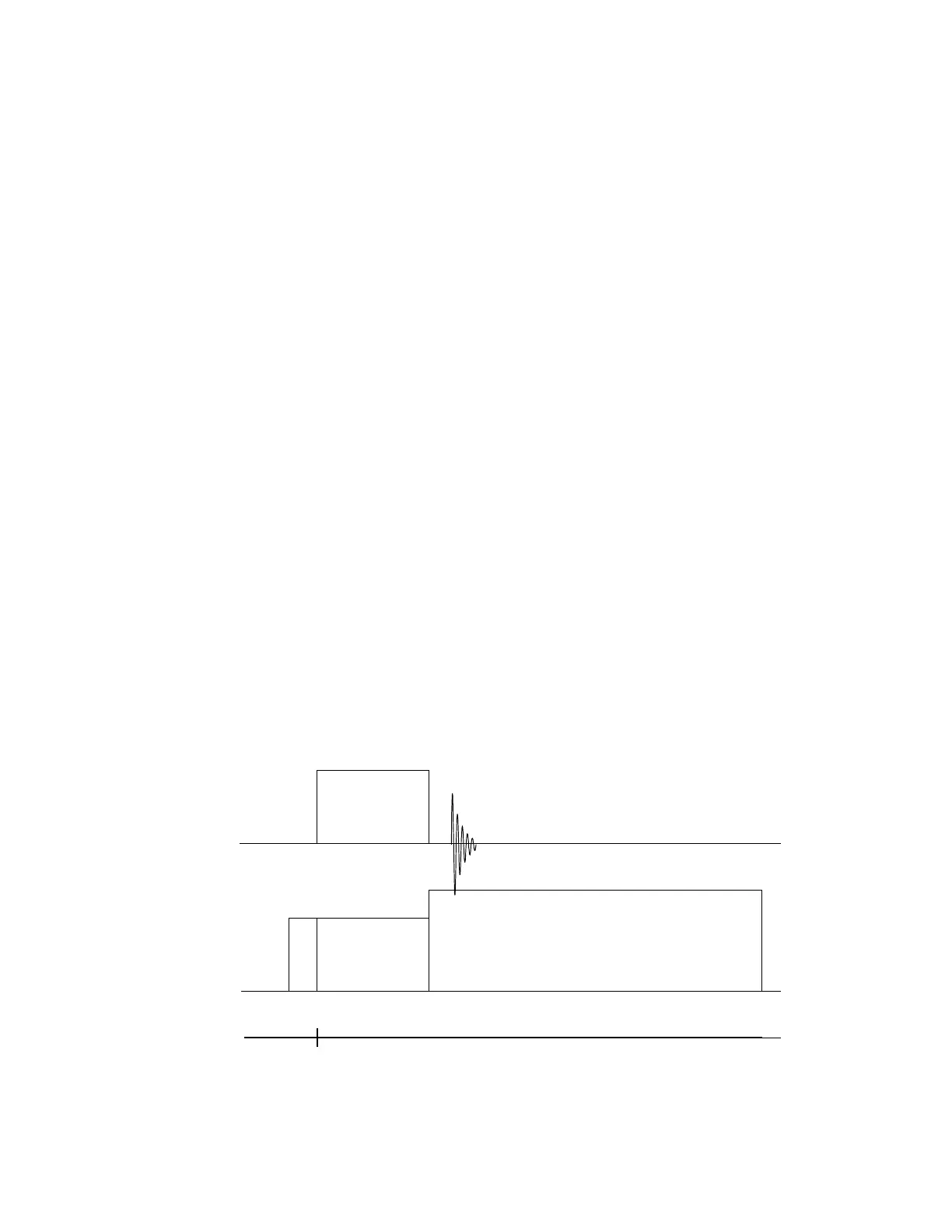
are shown in the diagram of XPOLAR1, see Figure 34.
Figure 34. XPOLAR1 Pulse Sequence
pw
cntct
cntct
(tpwrm)
(crossp)
(dipolr)
Tx
Dec
at
d1
AC



 To Next Page