Vishay Micro-Measurements System 7000 Programmer’s Reference Manual
Page 23 of 142
3.9.2 Advanced Recording Options
3.9.2.1Recording Groups
The System 7000 is capable of assigning every channel on a card to one of four recording groups (A-D).
This may be used as a means to assign different recording rates and configurations to channels. In other
words, even though all channel data is being acquired at the same rate you are capable of storing the data
with a variety of different rates and methods. The default for all channels is an assignment to group A.
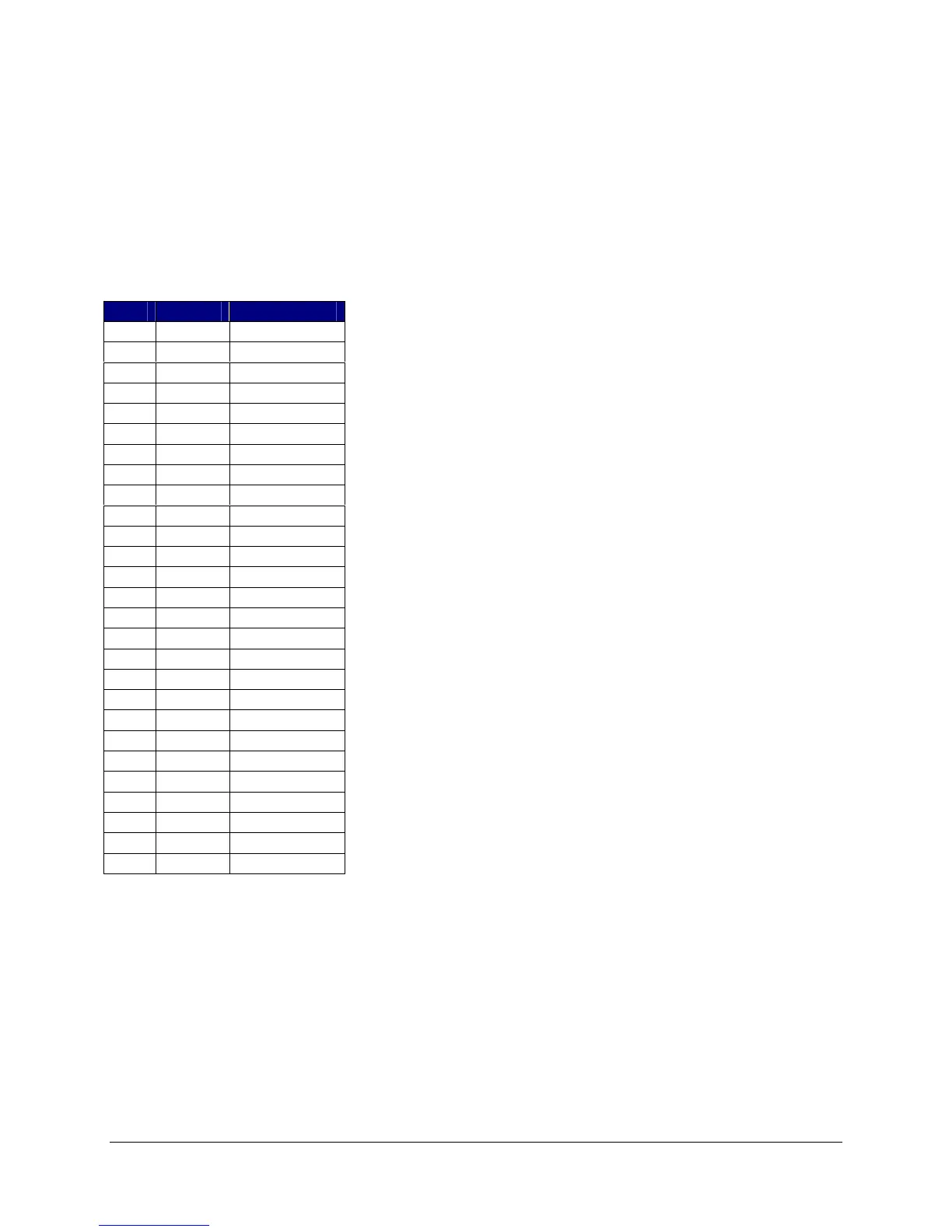
As an example, a scanner has three cards with the channels assigned
to groups as shown. Each channels assigned to group A is recording
at the scan rate (for example 1000 samples/sec). You may define all
the Group B channels to have a recording rate 0f 500 samples/sec,
Group C of 100 samples/sec, and Group D of 10 samples/sec.
It is recommended that you send the recording configuration for all
groups to all cards; if a card doesn’t have any channels in that group
then the configuration information isn’t used. In this way, all
channels in Group A share the same recording rate, all channels in
Group B share a rate, and so forth, regardless of card.
It is possible, but not recommended, to have the groups configured
differently on each card. This manual assumes that each recording
group is configured identically across all cards. All examples and
discussion are based on this assumption.
Because your scan rate is selected based upon the inputs with the highest rate of change, you may wish to
use multiple recording groups if you have some inputs that change more slowly. This reduces the amount
of data that is stored and improves system performance. A common scenario is when a system has
thermocouple inputs used to monitor the ambient temperature in addition to strain gage inputs. Because
temperatures may only change 2-3 degrees per hour the thermocouple inputs may be recorded at a slower
rate than the strain gage inputs.
In the figure below four traces are shown, each representing a unique record rate. For simplicity,
assume that only time-based recording is selected. Each point represents a recorded scan.
Card Channel
Group
1
1 A
2 A
3 A
4 A
5 B
6 B
7 B
8 B
2
1 A
2 B
3 C
4 D
5 A
6 B
7 C
8 D
3
1 C
2 C
3 C
4 C
5 D
6 D
7 D
8 D
Table 5


 To Next Page