STARTING AND DRIVING
}}
* Option/accessory.
401
Brake functions
The car's brakes are used to reduce the speed
or prevent the car from rolling.
Besides the foot brake and parking brake, the car
is equipped with several automatic brake assist
functions. These can assist the driver by not
needing to keep his/her foot on the brake pedal
when stationary at a traffic light, when starting on
an uphill gradient or when driving on a downhill
gradient.
Depending on the car's equipment, the following
auto braking functions are available:
•
Automatic braking when stationary (Auto
Hold)
•
Hill start assist (Hill Start Assist)
•
Auto braking after a collision
•
City Safety
•
Hill descent control (Hill Descent Control)*
Related information
•
Foot brake (p. 401)
•
Parking brake (p. 403)
•
Automatic braking when stationary (p. 407)
•
Auto braking after a collision (p. 408)
•
Help when starting on a hill (p. 408)
•
City Safety™ (p. 325)
•
Hill descent control* (p. 426)
Foot brake
The foot brake is part of the brake system.
The car is equipped with two brake circuits. If a
brake circuit is damaged, the brake pedal will
engage deeper. Higher pressure on the pedal will
therefore be needed to produce the normal brak-
ing effect.
The driver's brake pedal pressure is assisted by a
brake servo.
WARNING
The brake servo only works when the engine
is running.
If the foot brake is used when the engine is
switched off then the pedal will feel stiff and a
higher pedal pressure must be used to brake the
car.
In very hilly terrain or when driving with a heavy
load the brakes should be relieved by using
engine braking in manual gearshift mode. Engine
braking is most efficiently used if the same gear
is used downhill as up. Use drive mode Off Road*
for increased engine braking while driving on
steep downhill gradients at low speeds.
Anti-lock braking system
The car has anti-lock brakes, Anti-lock Braking
System (ABS), which can prevent the wheels
from locking while braking and allows maintained
steering control. Vibration may be felt in the
brake pedal when this is engaged and this is nor-
mal.
A short test of the ABS system is made automat-
ically after the car has been started when the
driver releases the brake pedal. A further auto-
matic test of the system may be made at low
speed. The test may be felt as pulses in the
brake pedal.
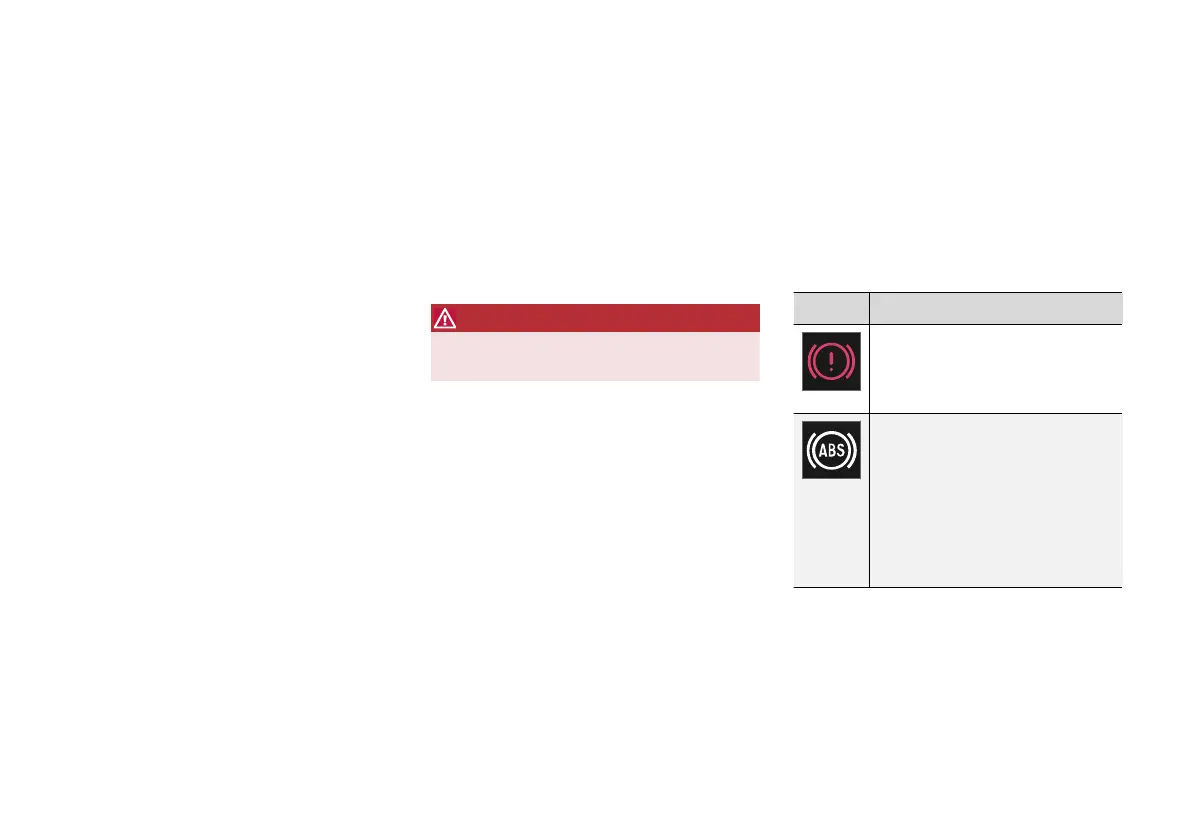
Symbols in the driver display
Symbol Specification
Check the brake fluid level. If the
level is low, fill with brake fluid and
check for the cause of the brake
fluid loss.
Constant glow for 2 seconds when
the engine is started: Automatic
function check.
Constant glow for more than 2
seconds: Fault in the ABS system.
The car's normal brake system is
still working, but without the ABS
function.



 To Next Page