18 | CFW501
Installation and Connection
English
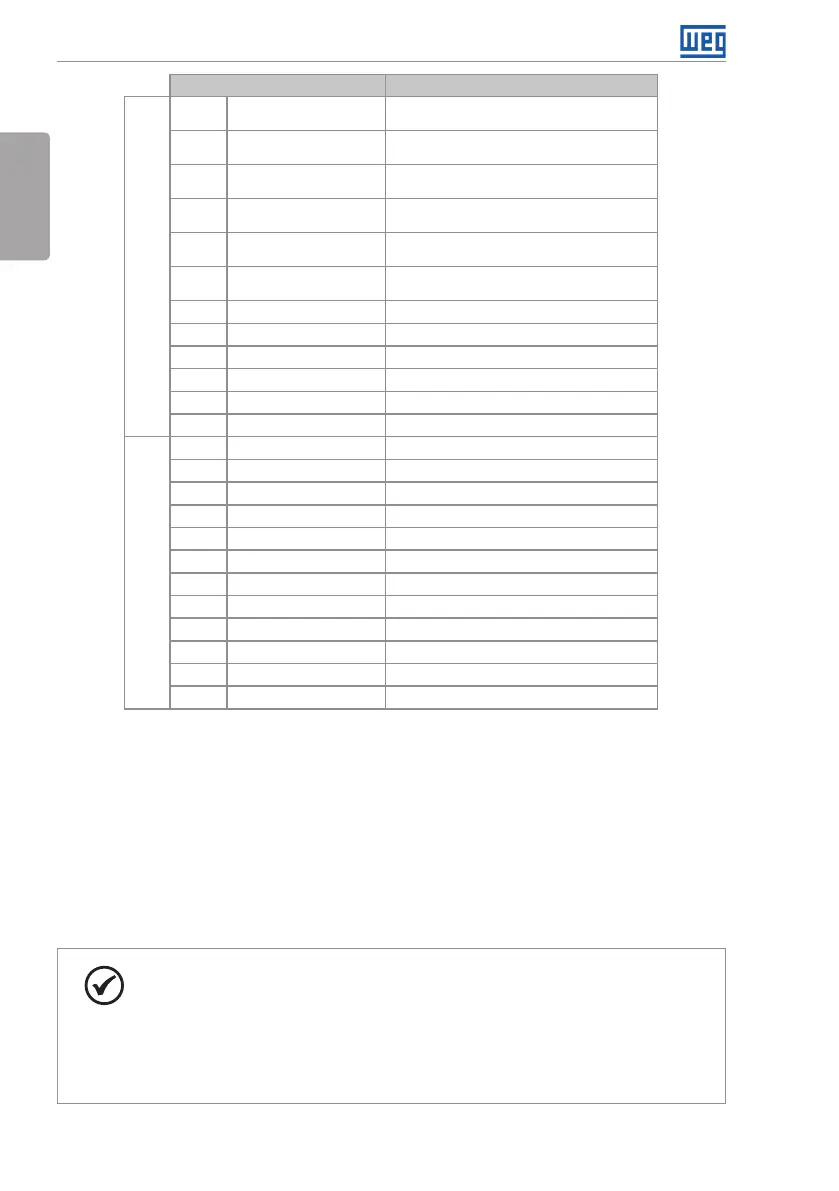
Connector Description (**)
Top connection
1 D O1-R L- N O
Digital output 1
(NA Contact of relay 1)
3 DO1-R L- C
Digital output 1
(Common point of relay 1)
5 DO1-RL-NC
Digital output 1
(NF Contact of relay 1)
7 DO3-RL-NO
Digital output 3
(NA Contact of relay 2)
9 DO3-RL-C
Digital output 3
(Common point of relay 2)
11 DO3-RL-NC
Digital output 3
(NF Contact of relay 2)
13 NC Not connected
15 +24 V Power supply +24 Vcc
17 DI1 Digital input 1
19 DI2 Digital input 2 (*)
21 DI3 Digital input 3
23 DI4 Digital input 4
Bottom connection
2 AO1 Analog output 1
4 GND Reference 0 V
6 AI1 Analog input 1
8 +10 V Reference +10 Vcc for potentiometer
10 DO2-TR Digital output 2 (transistor)
12 RS485 - A RS485 (Terminal A)
14 RS485 - B RS485 (Terminal B)
16 GND Reference 0 V
18 AI2 Analog input 2
20 RS485 – A(2) RS485 (Terminal A2)
22 RS485 – B(2) RS485 (Terminal B2)
24 GND Reference 0 V
(*) The digital input 2 (DI2) can also be used as input in frequency (FI). For further details refer to the
programming manual of the CFW501.
(**) For further information, refer to the detailed specification in section 8.2 Electronic/General Data.
Figure 3.4 (b): Signals of the connector of the CFW500-CRS485 plug-in module
The location of the plug-in module and DIP-switches to select the type of analog input
and output signal and the termination of the RS485 network is shown in figure A.2.
The CFW501 inverters are supplied with the digital inputs configured as active low (NPN),
analog input and output configured for signal in voltage 0...10 V and with termination
resistor of the RS485 OFF.
NOTE!
To use the analog inputs and/or outputs with signal in current, you must
set the switches S1 and S2 and the related parameters as per table 3.2.
For further information, refer to the CFW501 programming manual.
To modify the digital inputs from active low to active high, check the
use of parameter P0271 in the CFW501 programming manual.


 To Next Page