
 Need help?
Do you have a question about the ABB PQFM and is the answer not in the manual?
Identifies the target audience for this manual and their expected knowledge.
Details the compatibility of the manual with different PQFM-Manager software versions.
Lists related ABB documentation for further information.
Procedures for inspecting the equipment upon delivery.
Guidelines for safe lifting and transport of the filter.
Information regarding the filter's identification nameplate.
Recommendations for storing the filter equipment.
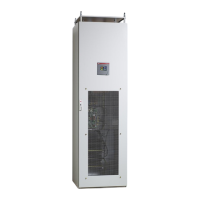
Explanation of the filter panel's main components and layout.
Description of the power circuit and components of a PQFM unit.
Details the tasks and functions of the main controller.
Explains user interaction through the PQF-Manager.
Identifies the physical locations of key filter components.
Specifies the necessary environmental and site conditions for installation.
Details the airflow and cooling needs for proper operation.
Procedures for mounting IP00 versions and the PQF-Manager.
Steps for mechanically connecting multiple PQFM cubicles.
Procedure for checking insulation and earth resistance.
Guidelines for Electromagnetic Compatibility (EMC) compliance.
Recommended earthing procedures and connection points.
Steps to determine the correct power cable section.
Protection mechanisms for power cables and filter input.
Procedures for connecting the filter to the electrical network.
Criteria for selecting appropriate current transformers (CTs).
Guidelines and rules for installing current transformers.
Procedures for electrically connecting filter cubicles and plates.
Details electrical connections for the PQF-Manager interface.
Description of the touch-screen interface and user interaction.
Explains user interaction and navigation within the PQF-Manager.
Explanation of icons and elements displayed on the main screen.
Menu for monitoring filter variables like voltage, current, and spectra.
Access to customer, commissioning, installation, and language settings.
Configuring user requirements like harmonics, alarms, and I/O.
Configuring harmonic, reactive power, and filter modes.
Configuring alarms, warnings, and digital input/output.
Setting core installation parameters and user requirements.
Entering and configuring current transformer ratios and positions.
Configuring advanced functions like auto restart and system clock.
Monitoring filter load, warnings, faults, and operating status.
Accessing basic filter data and configuring the interface.
Settings for Modbus, Ethernet, MAC, and IP addresses.
Displaying and changing the PQF-Manager IP address.
Performing thorough visual and installation checks.
Setting up network characteristics and filter synchronization.
Procedures for detecting and setting up current transformers.
Procedure for starting the filter using the PQF-Manager.
Configuring harmonic filtration and reactive power settings.
Procedures for starting and stopping the filter.
Step-by-step guide to start the filter via PQF-Manager.
Step-by-step guide to stop the filter via PQF-Manager.
Changing customer settings for harmonics, alarms, and I/O.
Understanding filter behavior during faults and errors.
Step-by-step procedure for standard filter maintenance.
Instructions for replacing cooling fans.
Information on DC capacitor replacement and service life.
Procedure for handling non-critical and critical faults.
Checking PQF-Manager status and system LEDs for troubleshooting.
Step-by-step fault tracing for power supply issues.
Detailed technical data including installation, dimensions, and voltage ratings.
 General
| Brand | ABB |
|---|---|
| Model | PQFM |
| Category | Water Filtration Systems |
| Language | English |

 To Next Page