A96G174/A96S174 User’s manual Development tools
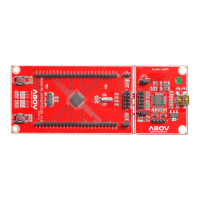
18.3 OCD (On-chip debugger) emulator and debugger
Microcontrollers with 8051 cores have an OCD (On-Chip Debugger), a debug emulation block. The
OCD is connected to a target microcontroller using two lines such as DSCL and DSDA. The DSCL is
used for clock signal and the DSDA is used for bi-directional data.
The two lines work for the core management and control by doing register management and execution,
step execution, break point and watch functions. In addition, they control and monitor the internal
memory and the device by reading and writing.
Table 43. Debug Feature by Series
Max. number of breakpoints
The OCD 2 applied to the 94-series and 97-series provides the RTM (Real Time Monitoring) function
that monitors internal memory and I/O status without stopping the debugging. In addition, the OCD 2
provides the breakpoint function (RAM Break Function) for the IDATA, SFR, and XDATA.
The following functions have been extended from the OCD 2:
Emulation Time can be measured in OCD mode (using the Run Flag port)
CODE, XDATA, and IDATA are updated during the Run Time (Real Time Monitoring available).
IDATA, SFR, and XDATA break are added (RAM Break support).


 To Next Page