13
Overview
A
A
A Overview
1. Introduction
Over 95% of current biological assays are based on optical detection (e.g., uorescent
and optical detection in a uorescence plate reader, optical microscopy, FACS analyzer,
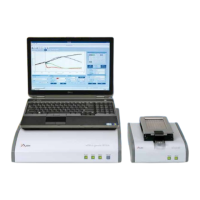
uorescence scanner). In contrast, the new RTCA SP Instrument developed by ACEA
Biosciences is based on electronic detection of biological assay processes, thereby integrating
molecular and cell biology with microelectronics.
e presence, absence, or change in properties of cells or molecules a ects the passage
of electrons and ions on sensor surfaces. Measuring the electronic properties of sensor
surfaces provides important information about the biological status of cells (or proteins)
present on the sensors. When changes occur in the biological status of cells or proteins,
the RTCA SP Instrument automatically measures the corresponding changes in the elec-
tronic properties of the sensors near the cells. ese analog electronic readout signals are
then converted to digital signals for processing and analysis. e major advantages of the
RTCA SP Instrument for biological assays over conventional approaches include:
Label-free detection
Non-invasive, real-time monitoring
Automated measurement
Easy set-up, operation and control
High information content
High sensitivity and accuracy
Broad range of applications
is new microelectronic sensing system represents one of the rst integrations of
electronic methodology and cell-based assays.
Introduction


 To Next Page