14
RTCA SP Instrument Operator’s Manual
A
A
1.1 RTCA SP Instrument
e new RTCA SP (Single Plate) Instrument is a proprietary microelectronic biosensor
system for cell-based assays. e core of the system is the microelectronic cell sensor
arrays that are integrated into the bottom of 96-well plates (E-Plate 96). Measuring the
electronic impedance of these sensor electrodes allows changes in cells on the electrodes
to be detected and monitored. Cell viability, cell number, cell morphology, and degree of
adhesion all a ect electrode impedance.
Impedance measured between electrodes in an individual well depends on electrode
geometry, ionic concentration in the well and whether cells are attached to the electrodes.
In the absence of cells, electrode impedance depends mainly on the ionic environment
both at the electrode/solution interface and in the bulk solution. In the presence of cells,
cells attached to the electrode sensor surfaces will act as insulators and thereby alter the local
ionic environment at the electrode/solution interface, leading to an increase in impedance.
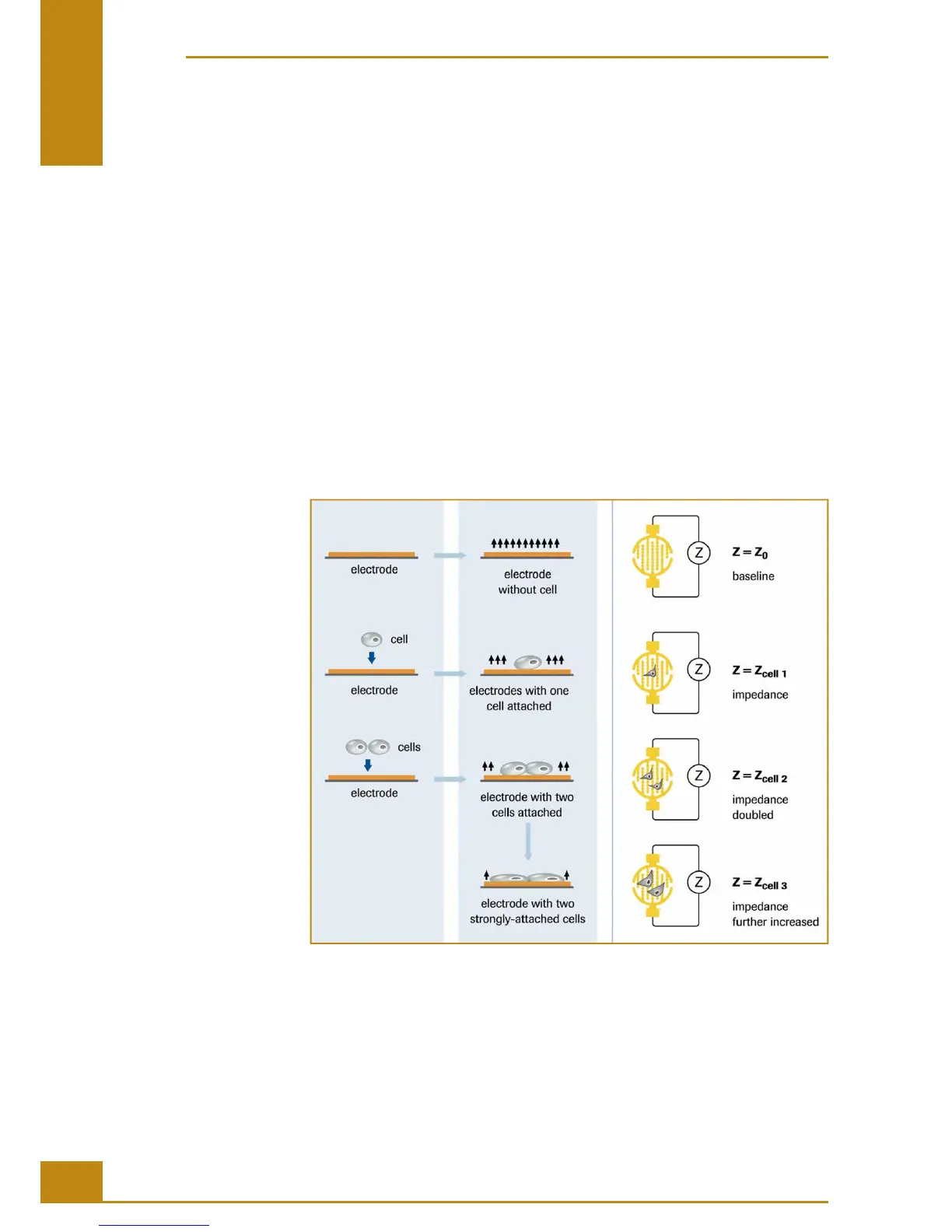
us, the more the cells there are on the electrodes, the larger the change in electrode
impedance (Figure 1).
Furthermore, the impedance change also depends on the extent to which cells attach to
the electrodes (Figure 1). For example, cell spreading resulting in a large cell/electrode
contact area leads to a large change in impedance.
Figure 1: Schematic illustration of the impedance measurement principle.
Introduction
RTCA SP Instrument


 To Next Page