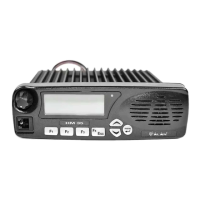
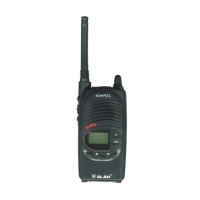
HM135 Service Manual
Preliminary version Page 8 of 13
2.6.c Mixer
The mixer LO frequency is 45.1 MHz above the desired receiver frequency. When the receiver frequency is
present, the mixer output will be a 45.1 MHz signal. The mixer output is peaked for 45.1 MHz by means of the
diplexer filter (L12, L15, C56, C46, C47, R31, R35 and R36) and the RF amplifier VT7, then signal is filtered by
crystal filters XF1A and XF1B and amplified by VT5 and VT4 before being applied to the input (pin 16) of the IF IC
DA2.
Inside DA2, the 45.1 MHz IF signal is sent to the input of the second mixer with a LO frequency of 44.645 MHz
(the frequency of the crystal X1 is 44.545 MHz, but it is 100 KHz shifted by means of the connected components
C68, C69 and C70, L17, R54 and R51). The output of the second mixer is sent from pin 3 of DA2 to the 455 KHz
ceramic filters CF2 (for 12,5 KHz bandwidth) or CF1 (for 25 KHz bandwidth) which filter the second mixer’s output,
then fed to the second IF signal input of DA2 (pin 5). The mixer’s output is then fed to the internal limiting amplifier
and then on to the FM decoder.
Note: the switching of the two filters CF2 or CF1 is accomplished by means of the line 12.5_25 coming from the pin 24 of
the microprocessor DD5 which drives, in sequence, the transistor VT10 and the switches DD1 and DD2.
2.6.d FM Detector and Squelch
The FM detector output (pin 9 of DA2) is used for squelch, decoding tones and audio output. The setting of the
squelch adjustment RP1 sets the input to the squelch amplifier.
The squelch amplifier is internal to DA2 and its output is fed to an internal rectifier and squelch detector.
The output on DA2 (pin 14) signals the microprocessor DD5 with a low level to unmute the radio. The audio is
unmuted by using the line RX_MUTE sent from the pin 50 of the microprocessor DD5 to the mute switch VT54
controlled by the transistor VT55.
2.6.e Audio routing
The detector’s audio output (line DETECTOR_AUDIO) is fed to DA13:A and DA13:B (3 KHz low-pass filter
deeply described in the next paragraph), then routed to the 300 Hz audio high-pass filter which consists of
DA12:A and DA12:B. The output of the audio high-pass filter feeds the AF de-emphasis (DA15:A) and AF pre-
amplifier (DA15:B), then the volume control provided by the IC DA16. The audio is then routed to Pin 1 and 9 of
the audio amplifier DA14.
VT61 is used to enable/disable the internal speaker and is controlled by VT52 by means of the signal
INT_SPEAKER_OFF sent by the pin 48 of the microprocessor DD5.
If the radio is in alert mode, the microprocessor DD5 generates an alert signal at its pin 38, this signal (line
ALERT) is injected in the low-pass filter (DA15:C) and routed at the input of the AF pre-amplifier DA15:B by
means of the resistor R269.
2.6.f CTCSS/DCS signal routing
Similarly to the audio routing the detector’s audio output (line DETECTOR_AUDIO) is fed to DA13:A and DA13:B
which make the tone (CTCSS and DCS) 3 KHz low-pass filter, however the output of the low-pass filter (line
TO_CTCSS_DATA_FILTER) is directly routed to the second stage tone filter which consists of DA17:A, DA17:B
and DA17:C. The output of this filter (line ADC_LO_SPEED_DATA_RX is then sent to the microprocessor DD5
(pin 60) in order to be decoded.
2.6.g Selcall signal routing
The Selcall signal follows the same routing of the audio one, but it’s picked up at the output (pin 1) of DA15:A (line
TO_CCIR_DATA_FILTER), then fed to DA17:D and sent (line ADC_HI_SPEED_DATA_RX) to the
microprocessor (pin 59) in order to be decoded.
2.7 Signaling
2.7.a General
The microprocessor is fitted with a ADC/DAC converter built-in, so it provides generating and decoding the tones
for selective calls, CTCSS and DCS. It can do that without using any other external I.C.s, but only by means of
some external circuitry. The deviation of the selective call can be adjusted by the trimmer IRV1.


 To Next Page