NOTES:
For best calibration results — compensation for all
measurement system uncertainties — ensure that the
Open/Short/Load (Short 1/Short 2/Load for
waveguide) is at the end of the test port or optional
extension cable; that is, at the same point that you will
connect the antenna or device to be tested.
For best results, use a phase stable Test Port Exten-
sion Cable (see Optional Accessories). If you use a
typical laboratory cable to extend the
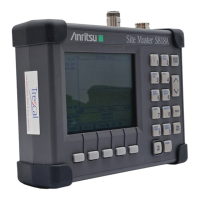
Site Master
test
port to the device-under-test, cable bending subse-
quent to the Open/ Short/Load calibration will cause
uncompensated phase reflections inside the cable.
Thus, cables which are NOT phase stable may cause
measurement errors that are more pronounced as the
test frequency increases.
For optimum calibration, ANRITSU recommends using
precision calibration components.
Making a Measurement
Step 10.
Connect the device-under-test to the Site Master
Test Port or the Test Port Extension Cable.
Step 11. Observe the displayed waveform.
Scaling the Display
Step 12. The display can be scaled using either of the follow-
ing methods:
q
Automatically scale the display using the AUTO
SCALE key (Figure 2-1, page 2-0).
q
Manually scale the display using the LIMIT key or
the SCALE soft key—from the Main Menu—and
the TOP and BOTTOM soft keys from the ensu-
ing soft key menu (page 2-12).
2-32
Chapter 2 Operation








 To Next Page