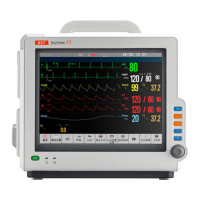
Patient monitor User’s manual
Chapter 9-10
then check the monitor and SpO
2
sensor. The following factors may influence
the accuracy of measurements:
——Incorrect sensor application or use;
——Significant levels of dysfunctional hemoglobins. (such as
carboxyhemoglobin or methemoglobin);
——Intravascular dyes such as indocyanine green or methylene blue;
——Exposure to excessive illumination, such as surgical lamps (especially
ones with a xenon light source), bilirubin lamps, fluorescent lights,
infrared heating lamps, or direct sunlight (exposure to excessive
illumination can be corrected by covering the sensor with a dark or
——Excessive patient movement;
——Placement of a sensor on an extremity with a blood pressure cuff,
arterial catheter, or intravascular line.
——Electromagnetic interference, such as MRI device;
The monitor can be used during defibrillation, but the readings may be
inaccurate for a short time
Loss of pulse signal can occur in any of the following situation:
——The sensor is too tight;
——There is excessive illumination from light sources such as a surgical
lamp, a brilirubin lamp, or sunlight;
——A blood pressure cuff is inflated on the same extremity as the one with
——The patient has hypotension, severe vasoconstriction, severe anemia,
——There is arterial occlusion proximal to the sensor.
——The patient is in cardiac arrest or is in shock.



 To Next Page