27
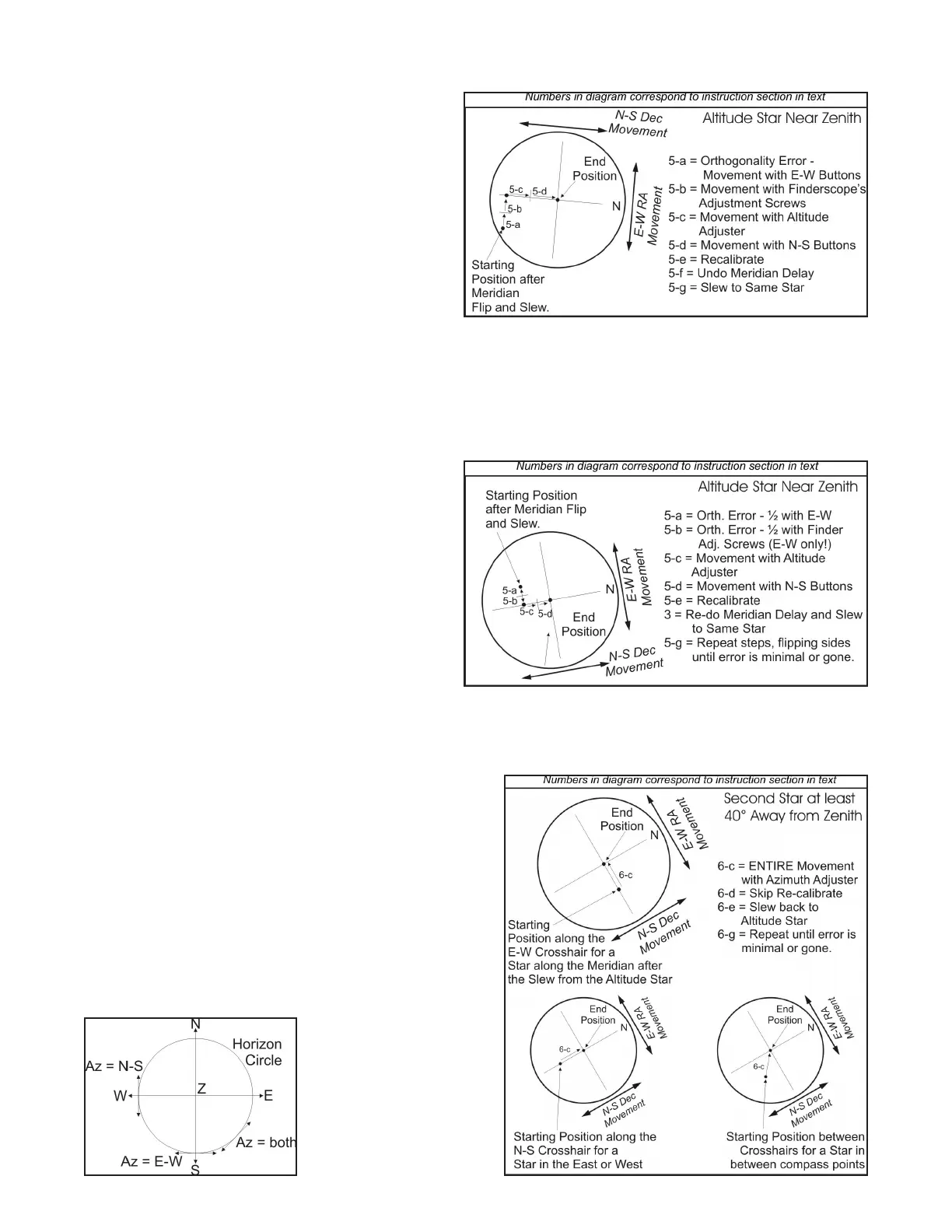
5. Make altitude adjustments.
a) The R.A. (east/west) error is a function of the
orthogonality of the nderscope. To make
the rest of the process easier, we will adjust this
out. Move one half of the E-W distance to the
N-S reticle with the “E” or “W” direction button.
b) Use the nerscope’s adjustment screws to
nish the movement onto the N-S reticle.
Try to only adjust the nder in the E-W direction.
Do not move it north or south.
c) Use the mount’s altitude adjustment to bring
the star half way toward the center of the
reticle in the N-S direction.
d) Center the star the rest of the way using the N-S buttons.
e) Press the “9=Recalibrate” again in the RA/DEC REV menu. You will hear a beep letting you know you re-cali-
brated. (Any time you use the Keypad’s direction buttons to center an object, it is a good idea to re-calibrate.)
f) Set the Meridian Delay display back to <0W>. Press MENU to return all the way back to the Objects Menu.
g) Enter the same star again and press GoTo.
The scope will again swap sides and acquire
the star on the reticles. Repeat the mechani-
cal alignment procedure until the star remains
on or close to the reticle. Each time you make
an adjustment, move half the distance with the
altitude adjuster (5-c) and half with the N-S but-
tons (5-d). Likewise for any remaining orthogo-
nality error – half with the buttons, half with
the nder’s adjustment screws. Then do the
re-calibration on the Keypad (5-e) before doing
the next meridian swap (3).
6. Make azimuth adjustments:
a) Pick a second star that is at least 40 degrees away from the rst star, and that is away from the pole.
Choose a star that is in the south, east, or west, if you are in the northern hemisphere; in the north, east or west if
you are in the southern hemisphere. You can choose this star from the table in Appendix I if you wish. If you have
not eliminated all of the orthogonality error, make sure
that your second star is on the same side of the merid-
ian as the rst star from the altitude adjustment portion
of the procedure. You do not want the telescope to
swap sides and introduce any remaining orthogonality
issues into the azimuth adjustment.
b) Use the GoTo to slew to the second star.
c) Make THE ENTIRE centering correction with the
azimuth adjuster. Note that this movement could be
along either reticle, or from a point in between depend-
ing on where in the sky you chose your second star.
As the Horizon Circle diagram at left shows, stars that
are in the east or west will result in azimuth adjust-
ments that are N-S. A star
along the meridian in the
south (or in the north if you
are in the southern hemi-
sphere) will result in azimuth
adjustments that are E-W.
A star chosen between the
cardinal compass points will
not parallel either reticle as
it is adjusted. Wherever you


 To Next Page