57
Why is the Sync command a potential problem if used incorrectly? There are two main reasons. The rst reason comes
from the fact that both axes of the mount are full 360° circles that are not restricted in their motion. The second comes
from the fact that the mount must rely on the information it is given: in particular, the date, time, daylight savings and
location data to know where the meridian is. As smart and sophisticated as these systems are, they cannot see the sky or
their own orientation and must rely on the operator to give them their proper start.
Let’s examine the rst issue. Why would the full circular
nature of the axes create a problem potential? First, if you
loosen your clutches, and then remove your telescope,
mounting hardware and counterweight shaft, you can simply
turn both axes round and round to your heart’s content.
Since the clutches were disengaged, the servo drive system
can not possibly have any idea where the axes are pointing
before you tell it by syncing the mount. This is a critical
problem because of the fact that for any location in the sky,
there would be two possible ways to point at it if there were
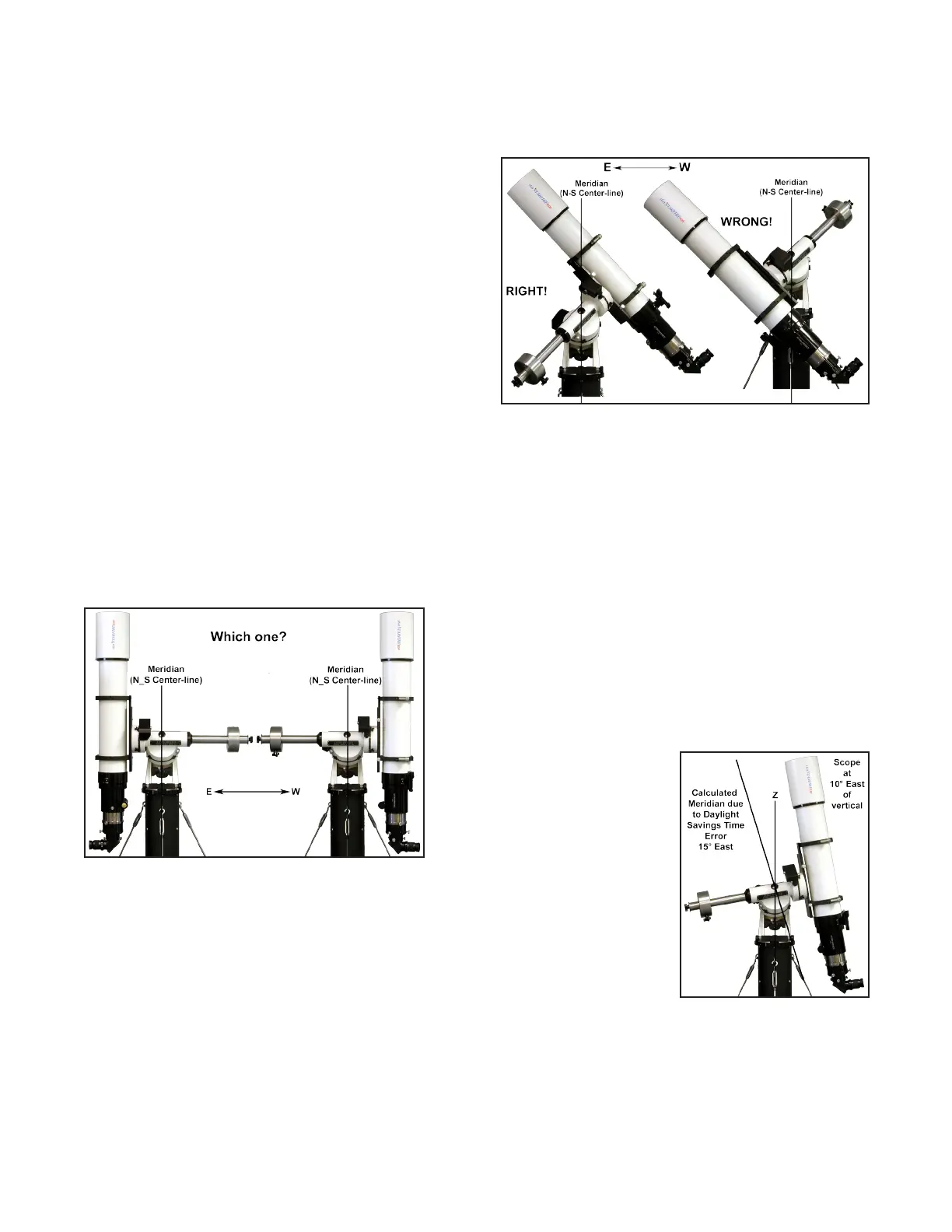
no obstructions (like a pier) in the way. See the illustration
at right. Both images show a telescope pointing at the same
object. The image on the right is obviously wrong, and no
experienced astronomer would position his or her mount like
this, but the mount cannot know which alternative has been
chosen. The software was therefore written to subsequently
slew the mount assuming the sync position was correct as shown on the left. It bases its assumption of where the
meridian is and where the pier is on the correct orientation of the system when it is synced.
Well, you might ask, if no one would be dumb enough to sync with their mount positioned like the one on the right in the
illustration above, why even bring it up? The reason is that things aren’t always as easy as the above illustration – it was
designed to make the point obvious. Take a look at the next illustration. Is it OK to use sync in either of these situations?
The answer is maybe, but I wouldn’t really advise it.
This brings us to the second main reason that sync can be a problem if used incorrectly. The illustration at left shows that
it can be difcult to tell which side of the meridian you are pointing at when pointing near the meridian. This assumes that
the meridian is where it’s supposed to be. Now wait a minute, you
say. We all know that the meridian is the north – south line that is
straight up: directly overhead. It goes through the zenith. It has to
be where it’s supposed to be! That is true, but the mount can’t see
like you and I can. It can’t look up and see the meridian; it has to
calculate the meridian based on the data we give it. That data is the
location, the date, the time and whether or not daylight savings is in
effect. Errors in this data will result in errors in the calculated position
of the meridian with respect to the
object being synced.
Daylight savings is an easy example
to understand. It changes our
clocks by one hour, forward each
spring, backward each fall. Each
hour is equivalent to 15° of sky.
Therefore, a simple mistake in the
entered value (off or on) for daylight savings will throw the calculated meridian off by a
whopping 15°. The next illustration at right shows this. The telescope is 10° east of the
true meridian. If syncing on a star with the telescope in this position, you would think that
everything is ne, but if you have your daylight savings turned off=0 (and it should be
on=1), the calculated meridian will be 5° too far to the east to sync! Likewise, just entering
the wrong location (i.e. your back yard location number instead of your darksite location
number) can throw you off by enough to make any sync close to the meridian worth
reconsidering.
Sync is a very important, handy and powerful command. Don’t be scared to use it, just follow these safe guidelines now
that you understand how it works:
1. Your mount MUST be polar aligned. Since sync establishes the mount’s orientation with respect to the telescope,
counterweight shaft and pier, polar alignment is a prerequisite.
2. NEVER sync if your counterweight shaft is pointing up. Avoid syncing if your counterweight shaft is close to horizontal.
Remember that the sync object and the telescope must be on opposite sides of the mount / meridian.


 To Next Page