In addion to the USCG regulaons, other local and/or internaonal law enforcement agencies may have
similar requirements. You should check with your local marine law enforcement agency regarding any such
requirements before boang.
Equipment requirements for coastal and inland waters dier. Check with local authories and/or the
USCG for further informaon about coastal water requirements.
The Federal Boat Safety Act of 1971 (FBSA/71) and the Naonal Recreaon Boang Safety Program
have established minimum safety standards for boats and associated equipment, specied by the USCG. In
addion, the American Boat and Yacht Council (ABYC) and the Naonal Marine Manufacturers Associaon
(NMMA) work with boat builders to develop voluntary standards that exceed the USCG requirements. The
included safety equipment on your boat meets or exceeds the standards of the USCG, ABYC and the NMMA.
Some required safety equipment, such as life jackets (PFDs), are not included with your boat. Your dealer
can help you choose the appropriate equipment.
Many states’ equipment requirements go beyond USCG
requirements. Contact your state boating oce for further
information.
Your boat is equipped with navigaonal lights. Recreaonal boats are required to display navigaonal
lights between sunset and sunrise and other periods of reduced visibility (fog, rain, haze, etc.). Navigaon
lights are provided to keep other boats informed of your presence and course. It is up to you to make sure
they are operaonal, displayed correctly, and turned on when required.
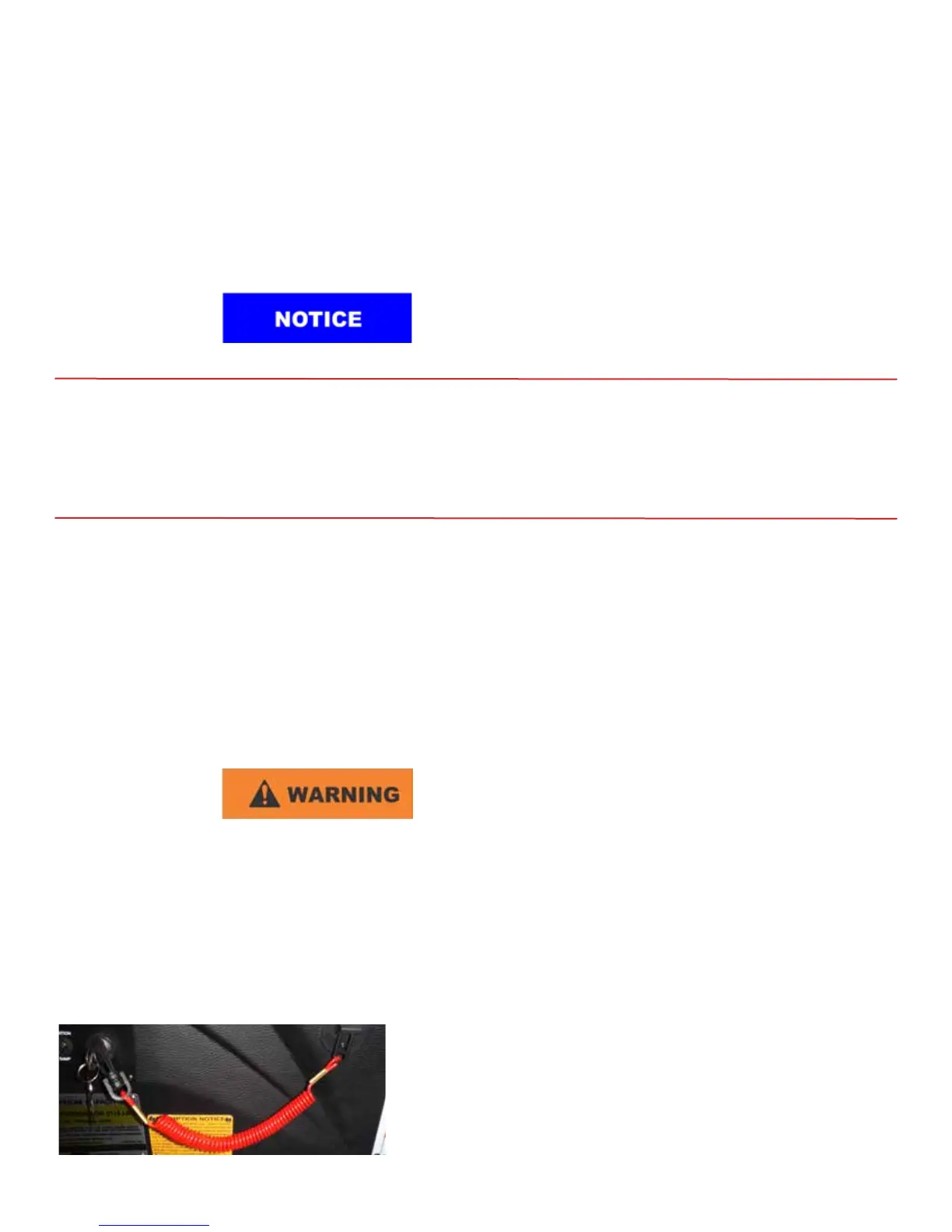
Your boat is equipped with an Emergency Safety Lanyard (cuto switch). We recommend that the
lanyard be secured to the operator and the lock plate aached to the emergency cuto switch prior to
starng the engine and anyme the engine is operang. The Emergency Safety Lanyard is designed to turn
o the engine whenever the operator moves far enough away from the helm to acvate the switch. The
purpose is to stop the engine, propeller, and boat in the event the operator leaves the helm locaon, falls
overboard, or is ejected from the boat. If the engine is stopped it will prevent the boat from becoming a
run-away, unmanned boat, which may cause injury or death to boat occupants who have fallen overboard or
been ejected, or to other nearby people. If the engine stops it will minimize the subsequent opportunity for
propeller contact with the operator or other persons in the water. If the engine and boat stop it will aord
opportunity for the operator or other persons who have fallen overboard to safely re-board the boat.
It is the recommended that you use the Emergency Safety
Lanyard system as failure to do so can cause death or serious
injury. DO NOT operate the boat if the Emergency Safety Lanyard
system does not function properly.
• Aach the Emergency Safety Lanyard to a secure place on your clothing, your arm or your leg while
operang.
• DO NOT aach the lanyard to clothing that could tear loose.
• DO NOT route the lanyard where it could become entangled, prevenng it from funconing.
• Avoid accidentally pulling the lanyard during normal operaon.
• Loss of engine power means loss of most steering control.
• Without engine power, the boat will decelerate rapidly. This could cause people in the boat to be thrown
forward or ejected overboard if they are not properly seated in the boat.
There are praccal limitaons to what the Emergency Safety Lanyard can do.
It can take several seconds for the engine and propeller to stop turning. The
boat can connue to coast for several hundred feet depending on the boat
speed at the me the switch is acvated. While the boat is coasng, it can
cause injury to anyone in its path. Accidental loss of power can be hazardous
parcularly when docking or in heavy seas, strong current, or high winds.
While at the dock or when the boat is not moving, periodically disconnect/
pull the Emergency Safety Lanyard out of the switch while the engine is running
to test for proper operaon. The engine should shut o when the lanyard is
NAVIGATION
LIGHTS
EMERGENCY
SAFETY
STOP
SWITCH
2016 Axis Wake Research Owner’s Manual . . . Page 1-8



 To Next Page