groundings. High bow up angles cause longer transion mes from displacement mode (slow velocity,
0 to 5 mph) to planing speeds (18 to 20 mph and above). During transion, it is important that the boat
operator pays aenon so that they are able to see forward and that the me in transion (or in the
“hump” speed region) is minimized.
• Excessive weight placed in the bow of the boat can lead to very at planing trim angles which may
lead the boat to turn aggressively, unpredictably, and without steer input. The phenomenon of yaw
instability is caused by heavy bow weights and running very at (bow down or at trim angles). This
can occur with excessive weight in the bow compared to weight in the stern of the boat. Another ill
eect of too much bow weight in comparison to stern weight is that with extremely heavy bow loads,
the boat’s bow may dive or submerge when coming o plane (decelerang rapidly, or encountering
waves/wakes at slow speed). If the bow submerges, then water will enter and ood your boat.
• When encountering condions which may lead to bow diving or bow submergence, it is
recommended to accelerate the boat before the wave/wake in order to help raise the
bow and get over the wave/wake.
• If the bow submerges, the recommended acon is to reduce throle to stop forward speed,
get passengers to move a, and turn on the bilge pump.
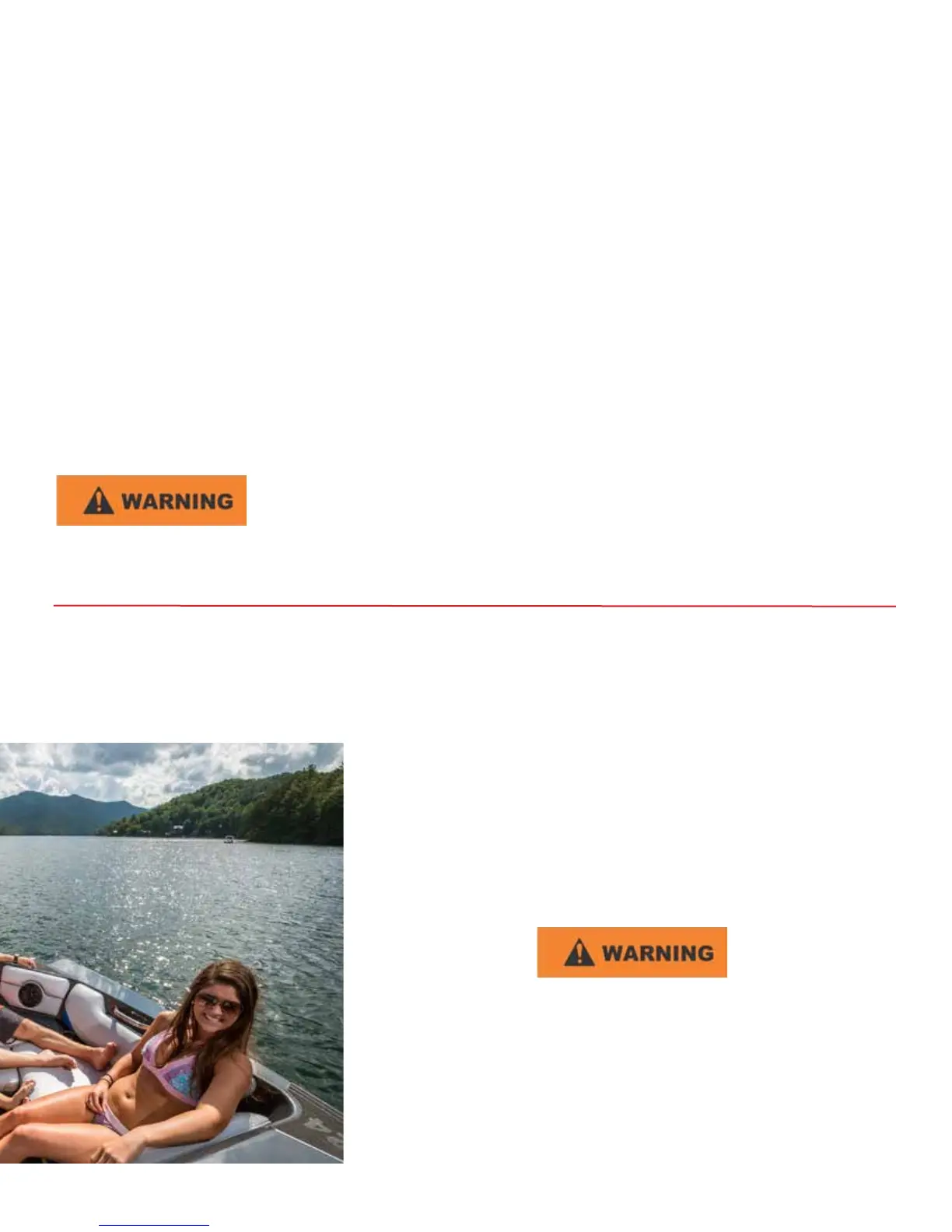
It is the boat operator’s responsibility to tell passengers to move to other seats on the boat, so as to
not overload the stern or bow of the boat, nor restrict the boat operator’s forward visibility. (See Get Ready
secon of this owner’s manual for addional informaon.) There is no single recommended seang or load
distribuon for all condions. Experience with your boat will allow you to determine where to properly
allow passengers and gear to be placed.
Excess and improper loading of bow area forward of windshield
may cause water influx, operating instability, and loss of control
resulting in injury or death. Bow Capacity Limit - X persons or
XXX lbs. person, gear and ballast. This is posted separately on
your boat but still included in overall capacity. Use good judgment when weighting your
boat for any towed water sports.
The operator of the boat is responsible, by law, to “maintain a proper lookout by sight and hearing.” The
operator must ensure that he/she has appropriate visibility for safe operaon. No passengers or equipment
should block the operator’s view, including the view of other boats, skier(s), rider(s), swimmer(s), or anyone
or anything else in the water. Even momentary interference can result in the driver’s inability to respond to
a situaon that requires avoidance of another vessel or submerged or parally-submerged object(s).
Look carefully before turning, especially when you are turning around to pick up a fallen skier/rider. Other
boats in your vicinity may not necessarily be following
the “Rules of the Road.” Be alert and keep a visual check
for other boats in and around your intended path. Do not
turn or maneuver your boat without rst checking that it
is clear to do so. Failure to look before turning can result
in an encounter with another boat where neither boat has
enough me to avoid a collision. This situaon can develop
very quickly if you fail to look rst and turn in front of
another oncoming boat.
Obstructed visibility
can cause death or
serious injury. The
operator must maintain
clear visibility at all times while operating the boat.
Arrange passengers and equipment appropriately
or designate a passenger to assist when visibility
is limited.
VISIBILITY
OF THE
OPERATOR
2016 Axis Wake Research Owner’s Manual . . . Page 1-15



 To Next Page