recommendaons and requirements of local jurisdicons and boang authories.
Axis recommends re exnguishing and suppression in excess of the minimum requirements. While an
automac re suppression system is highly eecve in most instances of an engine compartment re, it is
possible that a re could occur in another area of the boat. Therefore, Malibu recommends having at least
one (1) hand-held unit fully charged and on-board at all mes.
Models: (Automac re exnguisher in engine compartment) Oponal on all Wakeseers and
Response models.
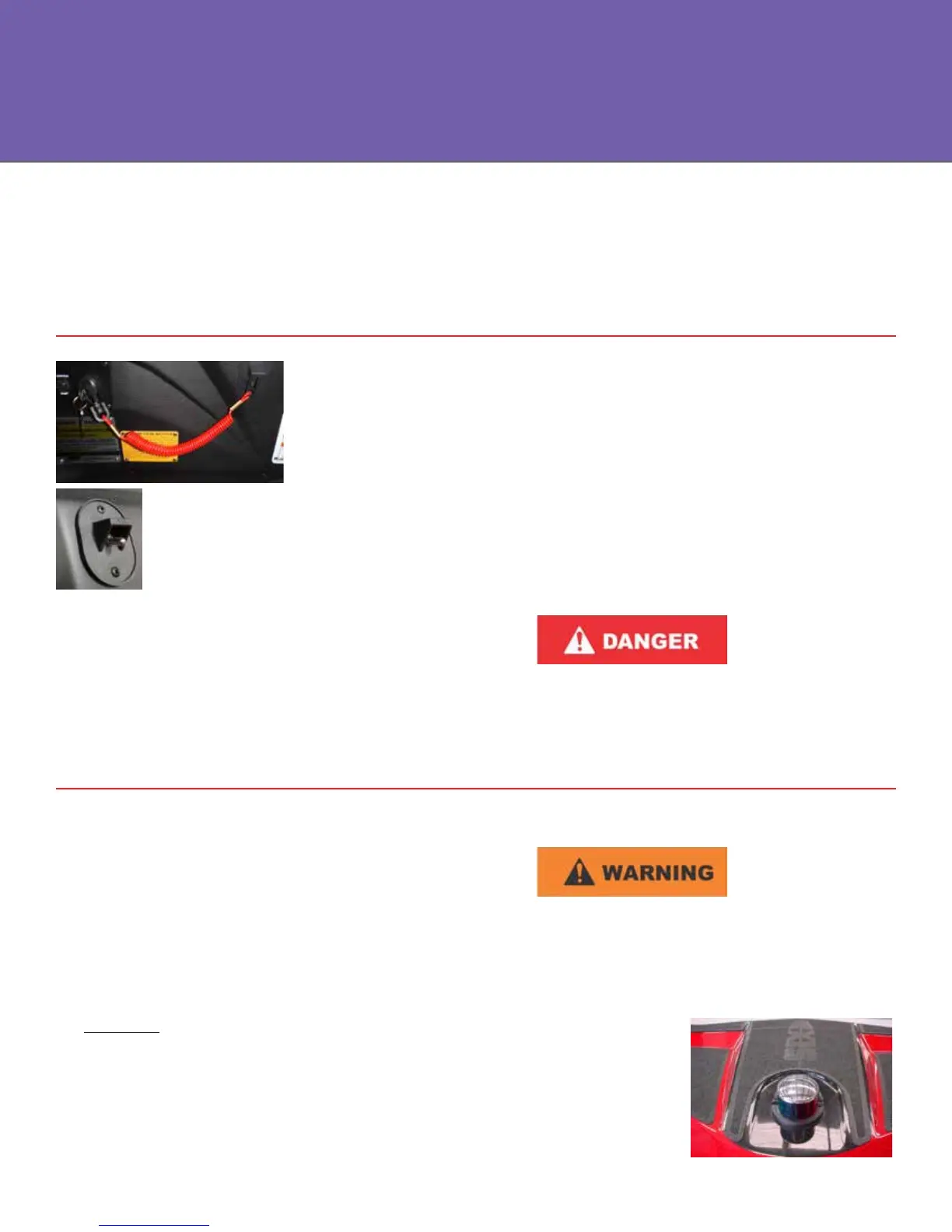
The Emergency Engine Stop Switch aaches to the boat operator
by way of a lanyard for the purpose of shung o the engine if the
operator, for any reason, moves or is moved away from the driver’s
helm.
The switch assembly consists of an ON-OFF switch and a switch/
lanyard clip. The engine will not run if the toggle is in the OFF posion.
Axis recommends the clip always be inserted in the toggle switch.
Connected to the operator, if (s)he moves away from the controls, the
clip will pull free, pulling the switch to the OFF posion. If the engine needs to be shut down
very quickly, it can be done so by pulling on the lanyard to release it from the switch.
To reset the switch aer acvaon, reinstall the lanyard clip and ip the switch to the UP
posion.
The emergency engine stop switch lanyard should always
be connected between the switch and the operator when the
engine is running. The purpose of the switch is to immediately
shut OFF the engine if the operator moves away from the
driver’s helm. Without the driver’s control, all on-board or other boaters in the area could
be subject to serious injury or ever death. Never operate the boat without the emergency
engine stop switch lanyard connected between the switch and the boat operator. Malibu
recommends the operator of the vessel always remain at the helm any time the engine is
running.
All Axis boats are equipped with mulple lights to assist boaters in low light situaons.
Boat outings should conclude prior to dark. Visual sighting is
critical to safe boating. In an emergency where the boat must
be operated in darkness, use the boat’s navigation/anchor
lighting in accordance with local law and ordinances which
may restrict the type of lighting to be used, plus sound signals, to alert anyone in the
area, and proceed slowly. After dark, it may be impossible to see other boats, submerged
hazards or the shoreline, which can result in damage to the boat that is not covered under
warranty, and serious injury or even death.
Bow Lights: As required by the U.S. Coast Guard and most marime authories, recreaonal
vessels should display navigaonal lights between sunset and sunrise, as well as other periods of
reduced visibility. These are available on most models either as a standard light that is on the deck,
or as an oponal pop-up light that pushes down into the deck and a chrome cover that sits ush with
the deck. To open the pop-up, push down on the chrome exterior and the light will pop open. To
close, push down on the light and it will fold into the deck casing.
Bow lights are located at the front of the bow. On a tradional bow, it is two-colored—red and
2016 Axis Wake Research Owner’s Manual . . . Page 2-27
WORKS
EMERGENCY
ENGINE
STOP
SWITCH
LIGHTING



 To Next Page