2016 Axis Wake Research Owner’s Manual . . . Page 1-24
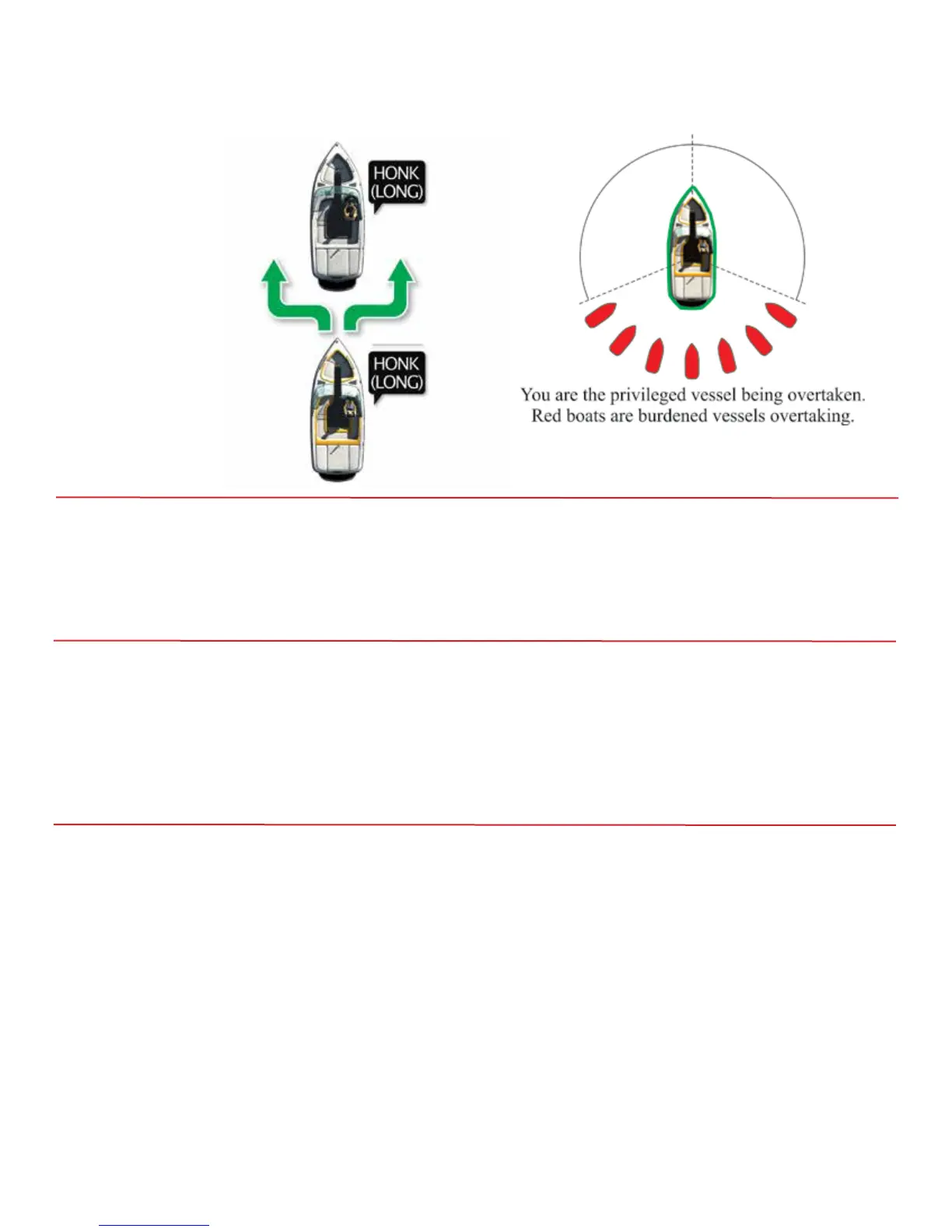
The boat that is overtaking one ahead of it is the burdened boat and must make any adjustments
necessary to keep out of the way of the privileged boat, unl the burdened boat is well ahead and clear of
the vessel being overtaken.
The General Prudenal Rule regarding right of way, is that if a collision appears unavoidable, neither
boat has right of way. As prescribed in the “Rules of the Road,” both boats must act to avoid collision.
Rule 2 in the Internaonal Rules says, “In construing and complying with these Rules due regard shall
be had to all dangers of navigaon and collision and to any special circumstances, including the limitaons of
the vessels involved, which may make a departure from these Rules necessary to avoid immediate danger.”
When navigang in narrow channels, you should keep to the right when it is safe and praccal to do
so. If the operator of a power-driven vessel is preparing to go around a bend that may obstruct the view
of other water vessels, the operator should sound a prolonged blast on the whistle or horn—four to six
seconds.
If another vessel is around the bend, it too should sound the whistle or horn. Even if no reply is heard,
however, the vessel should sll proceed around the bend with cauon.
If you navigate these type of waters, you should carry a portable air horn, which are available from local
marine supply stores.
Learn to recognize the dierent buoys and day markers; they are the signposts of the waterways. The
United States Aids to Navigaon System (USATONS) is the primary marking system used on inland water,
coastal waters and rivers in the United States. This system is maintained by the U.S. Coast Guard (USCG).
There are two primary marking systems in use in the U.S.: the Uniform State Waterway Marking System
(USWMS), used on inland waters and maintained by each state, and the Federal Waterway Marking System
(FWMS), used on coastal waters and rivers and maintained by the USCG. In addion, the FWMS has two
modied systems: the Western River Buoyage, and the Intracoastal Waterway Buoyage. Be sure to check
with local authories on the buoyage system in use in your boang region.
The type of hazard/warning buoys and markers depends on the area of jurisdicon. Check with local
boang authories.
USWMS System
In the USWMS Lateral System, well-dened channels are marked with red and black buoys, and the
boat should pass between them.
The USWMS Cardinal System is used when there is no well-dened channel or where an obstrucon
may be approached from more than one direcon. With the cardinal system:
OVERTAKING
THE
GENERAL
PRUDENTIAL
RULE
OTHER
RULES
OF THE
ROAD
AIDS TO
NAVIGATION



 To Next Page