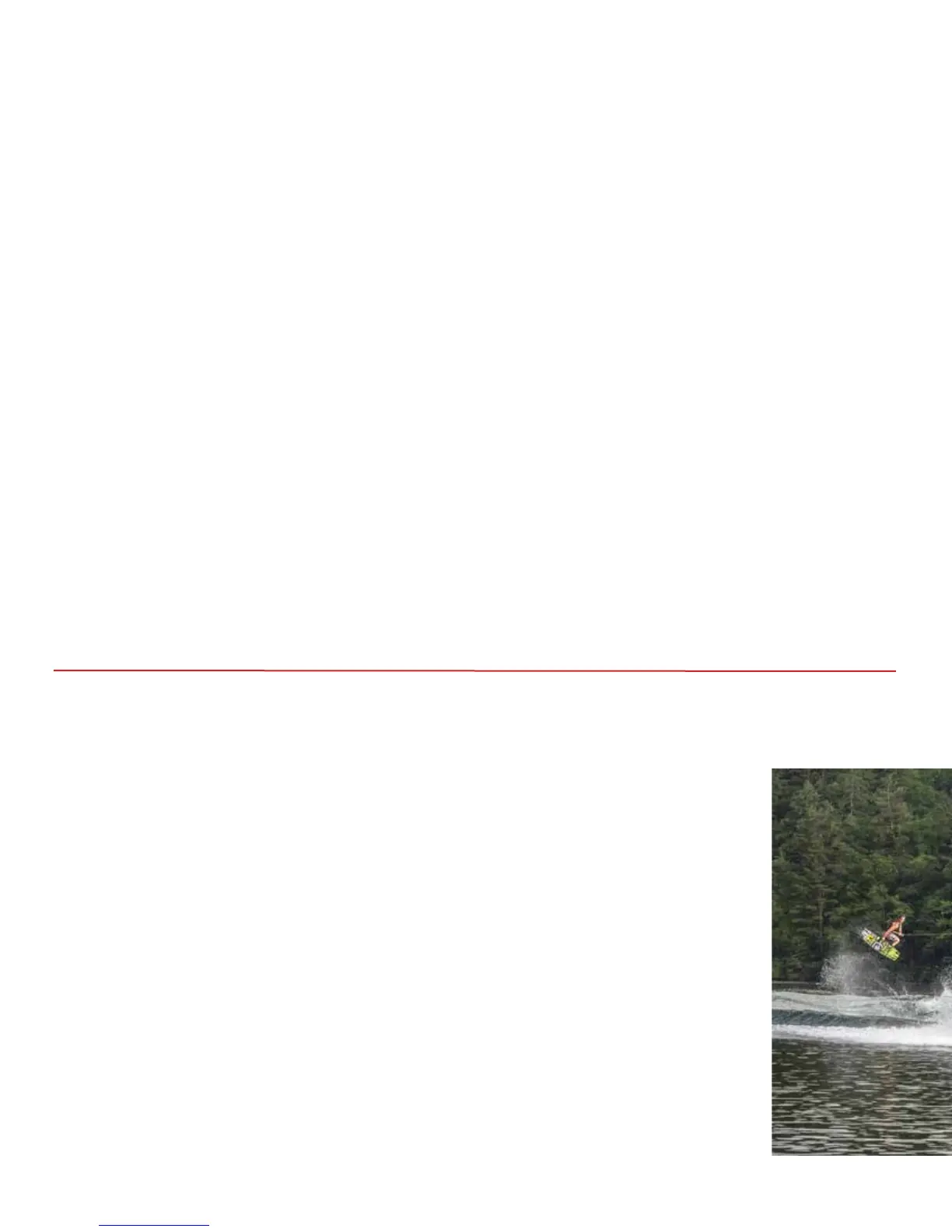
• Whentheskier/ridersignalsREADYandthereisnotracahead,takeoinastraightline.Adjustthe
speedaccordingtothesignalsgivenbytheskier/rider.
Skiing or Riding:Thewatercraandskier/ridershouldalwaysmaintainasucientdistancefromobstaclessoa
skier/riderfallingorcoasngand/orwatercrawillnotencounteranyobstacle.
• Donotuseinshallowwaterornearshore,docks,pilings,swimmers,otherwatercra,oranyotherobstacles.
• Useonlyonwater.
• Neveraemptlandordockstarts.Thiswillincreaseyourriskofinjuryordeath.
• Alwayswearaproperlyedlifejacket(PFD)approvedbyyourcountry’sagency,USCGTypeIII,ISO,etc.
• Thefasteryouskiorride,thegreateryourriskofinjury.
• Nevermakesharpturnsthatmaycauseaslingshoteectontheskier/rider’sspeed.
• Theskier/ridershouldbetowedatanappropriatespeedforhisorherabilitylevel.
Faller skier or rider:Fallingandinjuriesarecommoninskiingorriding.
• Circleafallenskier/riderslowlytoreturnthetowropehandleorpickupthefallenskier/rider.
• Turnotheenginewhennearafallenskier/rider.
• Alwayskeepthefallenskier/riderinviewandonthedriver’ssideofthewatercra.
• Displayaredororangeskier-downagtoalertothervesselsthataskier/riderisdownifrequiredbythestate
inwhichyouareoperang.
The Warnings and pracces in the Watersports Safety Code represent common risks encountered by users.
The code does not cover all instances of risk or danger. Please use common sense and good judgment.
EMERGENCY
PROCEDURES
Inanemergencysituaon,youmayhavetoresorttomeasureswhicharenotcommonlypracced.Always
assessthedangersofbeinginharm’swayversustheproteconofequipment.Keepasoundmindduringan
emergencyandalwaysusecommonsense.
Many boat res and explosions involve ammable liquids such as gas or oil, which are used in your boat’s
propulsion engine(s) and generator. Carefully follow all warning labels and safety precauons while handling
ammable substances. Many res in inboard boats start in the bilge area due to gasoline vapors. Gasoline
vapors are heavier than air and collect in the bilge of boats.
Explosion
• If explosion is imminent, put on PFDs, grab distress signals and survival gear, and
immediately abandon ship.
Fire
• Immediately turn o engines, generators, stoves and blowers.
• Exnguish smoking materials.
• A xed re suppression system, if equipped, has heat sensors that automacally
ood the machinery space with a re exnguishant. Allow exnguishant to “soak”
the compartment for at least 15 minutes to cool the hot metals or fuel before
cauously inspecng the re area. Have portable re exnguishers ready. Do not
breathe fumes or vapors caused by the re or exnguishant.
• If no xed re suppression system is installed and a re is in the engine compartment,
discharge portable re exnguishers through the engine compartment access plate,
if equipped. DO NOT open the engine hatch as this feeds oxygen to the re.
• If you have access to the re, direct the contents of the re exnguishers at the base
of ames, not at the top.
• Throw burning materials overboard if possible.
• Move anyone not needed for reghng operaons away from the ames.
• Signal for help.
2016 Axis Wake Research Owner’s Manual . . . Page 1-34
EXPLOSION
AND FIRE



 To Next Page