Index
A: PL120100.100
B: PL120100.100
E: 03.93 / T. Weiß
G: 06.93 / T. Weiß
Chapter: 10
Page: 2
Dieser Text dient nur
als Hintergrund. Das
Kapitel Stichwortver-
zeichnis und Glossar
zeigt Ihnen die ent-
sprechenden Seiten
im Text auf und ver-
A
C
B
Injection
The screw rotation stops after the plastification process. The
forward axial movement of the screw (in the direction of the
mould) transports (injects) the melted moulding material into
the mould cavity.
Injection cycle
The injection cycle consists of a series of processes, such as
times, pressures and strokes, which result in the production
of a formed piece.
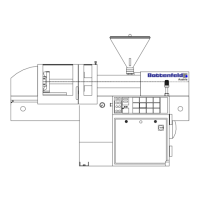
Injection moulding machine
An injection moulding machine processes synthetic material
to produce formed pieces. It consists of three main elements:
machine frame, closing unit and injection unit.
Injection pressure
In order to offset the contraction, the injection unit changes
from “Injection pressure” to “Dwell pressure”, which is active
until the material inside the mould has set (cooled off).
Injection unit
The injection unit meters, plastifies and injects the moulding
material into the mould. These processes are carried out both
simultaneously and subsequently, thus composing the
injection cycle.
Material funnel
The material funnel contains the granulated material. The
material must be easily pourable. The material funnel is
connected to the screw cylinder.
Metering
Metering is the transport of a certain quantity of moulding
material from the material funnel into the screw cylinder. This
is done through the rotation of the screw which functions as
a feed screw.
Nonreturn valve
The nonreturn valve prevents the backflow of moulding
material into the back screw volutions. It also improves the
piston action during injection.


 To Next Page