43
15.3 RInsu – Insulating resistance
Explanation
The purpose of this measurement is to determine whether the
insulation of the test sample has sufficiently high resistances. A
high insulating resistance ensures that no fault currents can flow
off.
The insulating resistance is measured between the following
points, depending on the test standard and protection class:
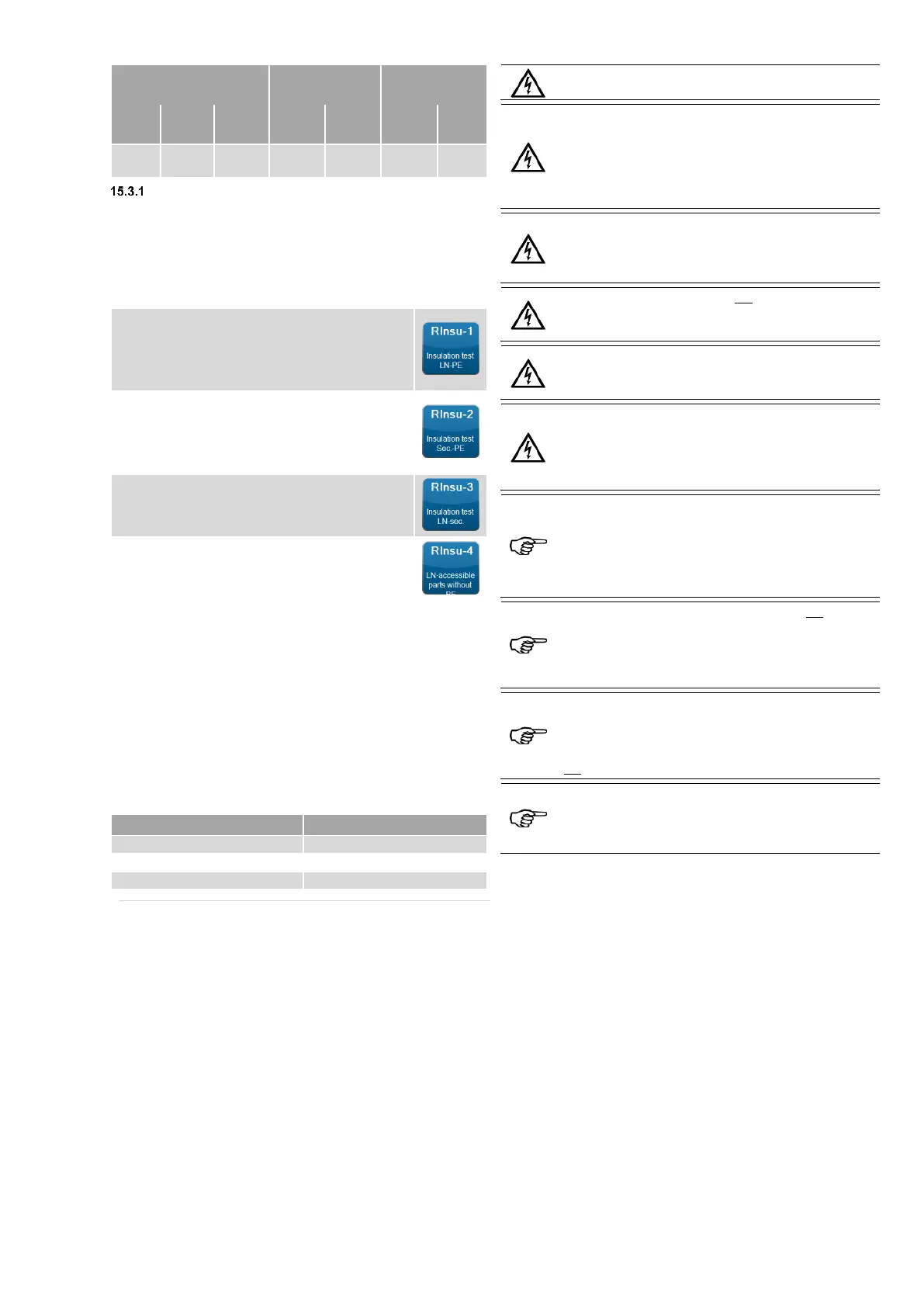
LN to PE and conductive,
accessible parts (Class I)
LN to test body (Class II)
Input to test body (Class III)
Sec. to PE and conductive,
accessible parts (Class I)
Sec. to test body (Class II)
Output to test body (Class III)
LN to sec. (Class I), (Class II)
Input to output (Class III)
LN to conductive, accessible parts
without PE connection (Class I)
For information devices and parts carrying SELV, testing of the
insulating resistance may be dispensed with if damage to the test
sample might occur as a result of the measurement.
According to VDE 0751-1, a measurement of the insulating
resistance is only necessary for medical devices if it is considered
to be appropriate and is not excluded by the manufacturer's
specifications in the accompanying documents.
The testing current is limited to 3.5 mA for each testing voltage.
You can go to "Limits" to manually change the applied DC testing
voltage in integers between 50 V DC and 1000 V DC.
The following values are preset in compliance with the test
standards:
The test sample must be disconnected from the mains.
If both measuring tips are accidentally touched or if the
testing voltage is carried over to other conductive parts
or these parts are touched, the resulting electric flow
might lead to shock and a subsequent accident.
The current limitation to 3.5 mA prevents a dangerous
electric flow.
The limitation of the testing current is intended for
safety in case the test person makes an accidental
contact between the measuring tips or the testing
voltage is carried over to other conductive parts.
The insulating resistance must not be tested if the
devices have exceeded the limit of the protective
conductor resistance.
Tapping the “Pause” button will stop the measurement.
During the pause, the test socket and the probe will
remain live!
Devices with electrically operated switching elements
can, if necessary, prevent all accessible, conductive
and active parts from being subjected to the testing
voltage. Such devices must be tested with special care
and at mains voltage.
Devices with magnetic, thermal, optical and other
switching elements can, if necessary, prevent all
accessible, conductive and active parts from being
subjected to the testing voltage. Such devices must be
tested with the contact of the switching element being
closed.
If the insulating resistance cannot or should not be
measured, the protective conductor current or contact
current must be measured using the direct current
measuring method or differential current measuring
method.
If for devices containing heating elements and a power
of P > 3.5 kW the value falls below the limit, the device
still shall be considered to be in proper condition as
long as the limit for the protective conductor current is
not exceeded.
In case of devices which are connected to each other
via fastenings or are galvanically isolated from each
other or have a common protective conductor, each
part should be tested individually.



 To Next Page