40
PLEASE NOTE:
• To sew the buttonholes 22 to 27, follow the same pro-
cedure as standard buttonhole (see pages 41 to - 42).
• The size of a buttonhole is automatically set by placing
a button in the rear of the buttonhole foot with slide R.
• The button holder of the foot takes a button size of up
to 1˝ (2.5 cm) in diameter.
• It is sometimes necessary to change buttonhole size
to match certain heavy or specific materials and
threads.
• Make a test buttonhole on an extra piece of the fabric
to check your setting.
• Place the button on the fabric and mark the top and
bottom to determine the position of the buttonhole on
the fabric.
• Use interfacing on stretch fabrics.
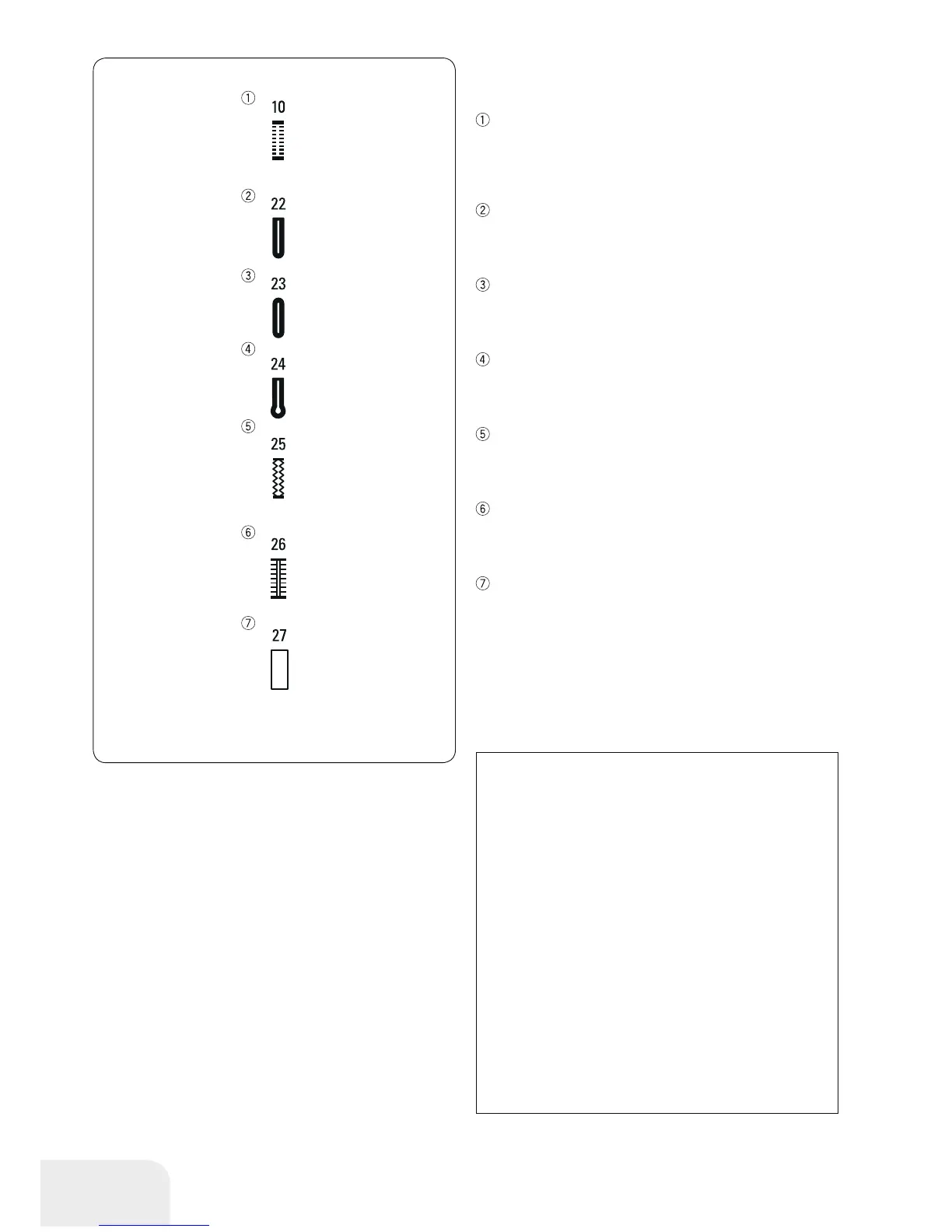
Various Kinds of Buttonholes and Their
Uses
Standard Buttenhole
This standard buttonhole is widely used on medium to heavy
fabrics. The buttonhole size is automatically determined by
placing a button in the buttonhole foot with slide.
Round-End Buttonhole
This buttonhole is used on fine to medium weight fabrics, espe-
cially for blouses and children’s clothes.
Fine fabric Buttonhole
This buttonhole is rounded at both ends and is used on fine,
delicate fabrics such as fine silk.
Keyhole Buttonhole
The keyhole buttonhole is widely used on medium to heavy
fabrics. It is also suitable for larger and thicker buttons.
Stretch Buttonhole
This buttonhole is suitable for knit fabrics. It can also be used
as a decorative buttonhole.
Antique Buttonhole
Resembles a “Hand Worked” buttonhole ideal on fine fabrics
featured in Heirloom sewing or for couture fashions.
Straight Stitch buttonhole
This buttonhole is for pocket openings, reinforcing buttonholes,
especially for buttonholes in leather and imitation leather.


 To Next Page