01/10 347 LB 444 K-40
2
2 Overview
The Potassium Meter LB 444 K-40 is designed for measurements of the concentration of
potassium in bulk materials, suspensions and solutions.
The concentration of potassium in bulk materials or liquid solutions is measured by
detecting gamma radiation of the natural isotope K-40. This isotope is contained in
natural potassium in a constant percentage (0.0119%). As the isotope K-40 decays, it
emits gamma radiation with an energy of 1.46 MeV.
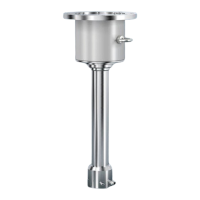
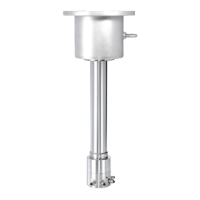
The detector LB 5430 detects radiation using an organic scintillator (PVT), the detector
LB 5402 using a NaI crystal. The radiation triggers tiny flashes of light in the scintillator
which are converted into electrical pulses by the photomultiplier. The count rate of this
radiation is a direct measure for the potassium concentration. In addition, the scintillation
detector responds to radiation emitted from the environment, for example, the walls and
the floor which are covered with a layer of potassium.
Further radiation is generated by incident cosmic rays at the location of the detector.
Background radiation remains more or less constant for each installation within a plant,
provided the location is not changed. To keep the statistical error of the measured result
as small as possible, the scintillation detector, fixed at the outside of a bunker or below a
belt conveyor, is shielded against background radiation by an additional lead shielding.
If the scintillation detector is inserted into bulk material, solutions or suspensions inside a
protection tube, the material itself is acting as a shielding against the background
radiation.
Potassium can be found predominantly in the form of KCl. However, to this day the unit K2O is
still used in many companies. The evaluation unit LB 444 K40 allows the calibration and
measurement in both units. Important: the calibration and measurement have must be
performed in the same unit. The following details for “K20” also apply for “KCI”.
There is a linear relationship between the count rate measured by the scintillation
detector and the potassium concentration.
This relationship can be expressed as follows:
K = a (N - N
0
) (1)
where:
N
0
= count rate measured by the scintillation detector if the bulk material or the
liquid contains 0% K
2
O.
“N” = count rate detected by the scintillation detector at a concentration “K” of K
2
O.
“K” = concentration of K
2
O.
“a” = reciprocal value of the count rate per % K
2
O.*
* This value can also be understood as the slope of the linear function. The term a x N
0
is the background expressed as a percentage of K
2
O.


 To Next Page