15SH-170-2 RUS
2.7 4-stufige Leistungsregelung
Diese Art der Leistungsregelung ist
besonders für Anlagen mit einer gros-
sen Trägheit geeignet, wie z. B. bei
indirekter Kühlung. Typische Anwen-
dungsfälle sind Flüssigkeits-Kühl-
sätze. Abbildung 5 zeigt die Ansteue-
rung der Magnetventile für die einzel-
nen Leistungsstufen.
Die Taktzeit des intermittierenden
Ventils CR4 wird vor Inbetriebnahme
auf etwa 10 sec eingestellt. Insbeson-
dere bei Systemen mit hoher Druck-
differenz können auch kürzere Zeit-
intervalle erforderlich sein. Deshalb
sollten hier einstellbare Zeitrelais ein-
gesetzt werden. Auch für diese Be-
triebsart empfiehlt sich, wie bei den in
Kapitel 2.6 beschriebenen Systemen,
eine Begrenzung der minimalen Käl-
teleistung auf ca. 50 %. Die
Steuerung erfolgt dann sinngemäß
mit den Ventilen CR4 (taktend) sowie
CR1 (75%) und CR2 (50%).
2.8 Schmieröl-Kreislauf
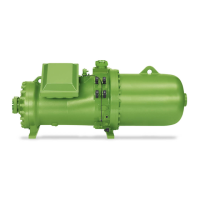
Der Ölkreislauf ist in der für Schrau-
benverdichter typischen Weise ausge-
führt. Allerdings ist bei dieser Bauart
auf der Hochdruck-Seite ein Behälter
direkt am Verdichter-Gehäuse ange-
flanscht. Darin ist der Ölvorrat unter-
gebracht. Der Behälter dient gleich-
zeitig als Ölabscheider.
Der Ölumlauf erfolgt durch die Druck-
differenz zur Einspritzstelle des Ver-
dichters, deren Druckniveau geringfü-
gig über Saugdruck liegt. Dabei ge-
langt das Öl über eine reichlich
dimensionierte Filterpatrone zur
Drosselstelle und weiter in die
Lagerkammern und Profilräume der
Rotoren. Der Ölstrom wird dann
zusammen mit dem angesaugten
Dampf in Verdichtungsrichtung geför-
dert. Das Öl übernimmt dabei, neben
2.7 4-step capacity control
This type of capacity control is parti-
cularly suited to systems with high
inertia – in connection with indirect
cooling, for example. Liquid chillers
are typical applications. Figure 5
shows the control of the solenoid
valves for the individual capacity
steps.
The cycle time of the intermitting
valve, CR4, should be adjusted to
about 10 seconds before commission-
ing. Even shorter intervals may be
necessary, particularly with systems
with high pressure differences.
Therefore, in this case adjustable time
relays should be used. For this type of
operation a restriction of minimum
refrigeration capacity to approx. 50%
is also recommended, as with the
systems described in chapter 2.6.
Control is then effected with the CR4
valve (intermittend) and with CR1
(75%) and CR2 (50%).
2.8 Oil circulation
The lubrication circuit is designed as
is typical for screw compressors. This
type of design, however, has a vessel
directly flanged-on to the compressor
housing at the high pressure side. It
contains the oil reservoir. The vessel
simultaneously serves as an oil
separator.
The oil circulation results from the
pressure difference to the oil injection
point, where the pressure level is
slightly above suction pressure. The
oil flows through a generously dimen-
sioned filter element to the throttle
point and subsequently to the bearing
chambers and the profile spaces of
the rotors. The oil is then transported
together with the refrigerant vapour in
the direction of compression. In addi-
tion to lubrication it also provides a
dynamic seal between the rotors and
2.7 4-х ступенчатoe регулирование
производительности
Этот способ регулирования холодопроиз-
водительности особенно пригоден для
систем с высокой степенью инертно-
сти изменения текущего значения
отслеживаемого параметра, например
в связи с опосредованным/ косвенным
охлаждением. Примером таких систем
являются водоохладители и прочие
жидкостные чиллеры. Схема
включения электромагнитных
клапанов на каждой ступени
регулирования производительности
показана на рис.5.
Время цикличности включения
электромагнитного клапана CR4
должно быть отрегулировано за 10
секунд перед запуском холодильной
установки. Иногда возникает
необходимость даже в ещё более
коротких интервалах включения,
особенно для систем, работающих на
высоких перепадах рабочих давлений.
Следовательно, в этом случае,
необходимо применять регулируемые
временные реле. Для такого режима
рекомендованная нижняя граница
регулирования производительности
ограничена до 50% от номинальной,
аналогично системам, описанным в
разделе 2.6. Регулирование произ-
водится периодическим включением
клапана CR4, а также клапаном CR1
(до 75%) и CR2 (до 50%).
2.8 Циркуляция масла
Система циркуляции масла организ-
ована типично для винтовых компрес-
соров. Однако, данная схема преду-
сматривает непосредственное
фланцевое соединение корпуса
маслоотделителя и компрессора со
стороны нагнетания.
Движение масла по системе прои-
зводится за счёт разности давлений в
точке впрыска масла, где его давление
немного выше давления всасываемых
паров. Масло протекает сквозь
фильтрующий элемент большой
площади фильтрации в горловину и
затем в масляные камеры подшипнико
в
и в полости ротора мотора. Затем
масло в смеси с парами хладагента
перемещается непосредственно в
компрессор. В дополнение к функции
смазывания, масло также обеспечивает
динамическое уплотнение зазоров


 To Next Page
 Loading...