29
• Zur raschen Aufheizung des Öl-
kreislaufs und Minderung des
Druckverlustes bei kaltem Öl ist ein
Öl-Bypass (ggf. auch Beheizung
des Kühlers bei Stillstand) unter
folgenden Voraussetzungen zwin-
gend erforderlich:
- sofern die Öltemperatur im Kühler
bei längerem Stillstand unter 20°C
absinken kann,
- bei Ölvolumen von Kühler und
Ölleitungen von mehr als der
Verdichter-Ölfüllung,
- bei Ölkühlern, die im
Verflüssigerpaket integriert sind.
• Das Bypass-Ventil sollte eine mo-
dulierende Steuerfunktion haben.
Der Einsatz eines Magnetventils
(intermittierende Steuerung) erfor-
dert höchste Ansprech-Empfindlich-
keit des Steuerthermostats und
minimale Schaltdifferenz (effektive
Temperaturschwankung < 10 K).
• Der ölseitige Druckabfall in Kühler
und Rohren sollte im Normal-
Betrieb 0,5 bar nicht überschreiten.
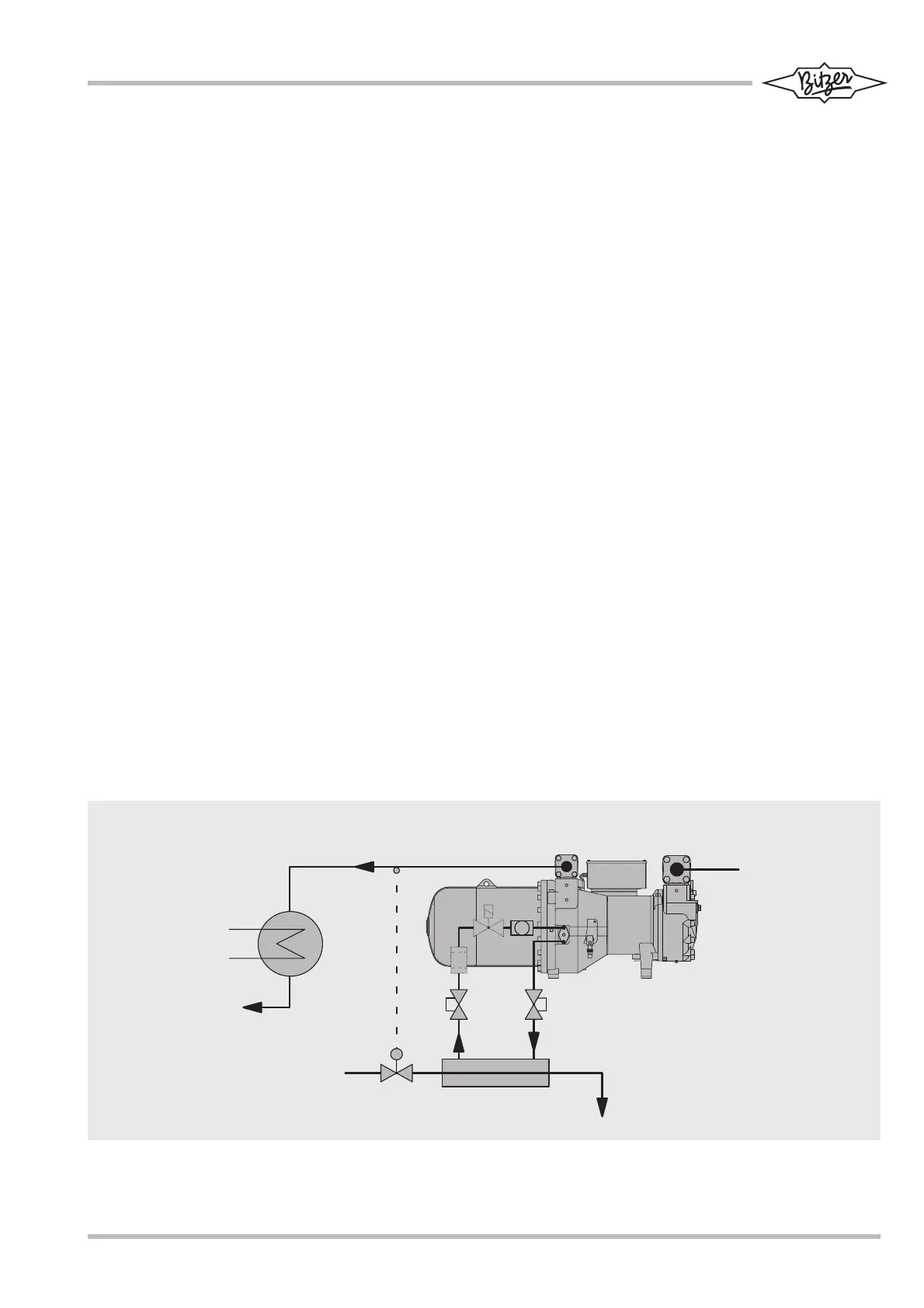
Wassergekühlte Ölkühler
Temperatur-Regelung durch thermos-
tatischen Wasserregler (Einstell-
Temperatur siehe Tabelle, zulässige
Fühlertemperatur = / > 120°C)
• For rapid heating of the oil circuit
and minimising the pressure drop
with cold oil an oil by-pass (or even
heating the cooler during standstill)
is mandatory under the following
conditions:
- the oil temperature in the cooler
drops below 20°C during stand-
still,
- the oil volume of cooler plus oil
piping exceeds the compressor's
oil charge,
- the oil cooler is an integral part of
the condenser coil
• The by-pass valve should have a
temperature responsive modulating
control function. The use of a
solenoid valve for intermittent con-
trol would require highest sensitivity
of the control thermostat and a
minimal switching differential
(effective temperature variation <
10 K).
• The oil side pressure drop during
normal operation should not
exceed 0.5 bar.
Water cooled oil cooler
Temperature control by thermostatic
water regulator (for set point see
table, admissible sensor temperature
= / > 120°C).
• Для быстрого нагрева циркулирующего
масла и минимизации потерь давления
с холодным маслом необходимо
устанавливать систему перепуска
масла (или даже нагрев
маслоохладителя во время остановок).
Особенно это необходимо при
следующих условиях эксплуатации:
- температура масла в охладителе
падает ниже 20°С во время остановок,
- объём масла в охладителе вместе с
объёмом масла в трубопроводах
превышают стандартный объём
масла в компрессоре,
- маслоохладитель встроен в конден-
сатор.
• Перепускной клапан должен
управляться системой управления,
отслеживающей температуру масла.
Использование электромагнитного
клапана для непрерывного контроля
требует очень высокой чувствительно-
сти управляющего термостата с
минимальным дифференциалом (допу-
стимое колебание температуры < 10 K).
• Падение давления в маслоохладителе
на стороне масла во время
нормального функционирования не
должна превышать 0,5 бар.
Маслоохладитель водяного охлаждения
Контроль температуры осуществляется
термостатом-регулятором расхода воды-
охладителя (установки приведены в
таблице, допустимая температура
датчика выше или равна 120°С).
SH-170-2 RUS
Abb. 11 Beispiel: wassergekühlter
Ölkühler
Fig. 11 Example: water cooled oil cooler


 To Next Page
 Loading...