1/05 | F01U002505B
EN | 6FPT-DACT | Operation & Installation Guide | 1.0 Overview
• Alarms initiated before the power loss might reset. If
the alarm conditions persist when power is restored,
new alarms can be generated.
• System time might reset to its default setting.
If a power loss occurs, programmed settings
such as input point configuration, telephone
numbers, and account number remain intact.
1.2.2 System Supervision
Watchdog: The FPT-DACT is supervised with a
hardware watchdog circuit. The failure of the control
program results in a hardware reset within 2 sec. The
trouble relay is released for the duration of the reset.
This relay is normally held energized.
Self Testing: Periodically, the dialer (DACT),
EEPROM memory, input points, and telephone lines
are automatically tested. The EEPROM checksum is
verified every 10 min. If the EEPROM checksum fails,
a trouble condition is locally annunciated and a Trouble
Report is sent.
1.2.3 Inputs
The FPT-DACT supports five inputs that can be
triggered by dry contact relays or open collector
outputs. The open collector outputs from the fire panel
must be below 1.3 VDC in alarm and must sink 5 mA
minimum. Refer to Table 2 for input point specifications.
1.2.4 Input Configuration
Initiating circuits or points can be configured for seven
types of conditions: Fire Alarm, Waterflow Alarm,
Supervisory, Monitor Alarm, System Fault, AC Failure,
and Low Battery. Refer to Section 4.2 Input Point
Operation on page 26 and 1: CONFIGURE in Section 5.0
Programming on page 33 for more information.
1.2.5 Trouble Output
The FPT-DACT has one Form “C” Relay rated 1 A at
30 VDC. The Form “C” Relay that is normally held
activated, deactivates for any trouble condition the FPT-
DACT detects. Refer to Section 4.3 Trouble Relay
Operation on page 23 for more information.
When the FPT-DACT is deployed on a ground start
network, the Form “C” Relay can be alternatively
programmed to serve as a ground start relay.
Ground start is not UL compliant.
1.2.6 User Interface
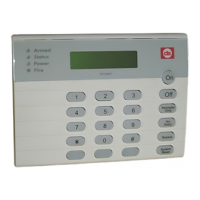
An FMR-DACT-KEYPAD connects to a five-pin
connector. It is used to program and troubleshoot the
FPT-DACT. This keypad can be set to any address from
1 to 15.
Only use the FMR-DACT-KEYPAD
to program the FPT-DACT. Temporarily
connect this keypad to the FPT-DACT for
programming only.
1.2.7 Communication
Formats
The FPT-DACT supports four protocols: Modem IIIa
2
,
Contact ID, SIA, and 4/2.
Report Routing
There are six different report groups that can be routed
to one of the following telephone settings:
• PHONE 1 ONLY: The report is sent to Phone #1
only.
• PHONE 2 ONLY: The report is sent to Phone #2
only.
• PHON 1 & 2: The report is sent to Phones #1 and
#2.
• PHN 2 BACKUP: The report is sent to Phone #1,
and then to Phone #2 if Phone #1 fails.
These reporting groups consist of non-supervisory
alarms (NONSUP ALRM), supervisory alarms
(SUPVSY ALRM), alarm restorals and resets (ALM
RSTR, RST), supervisory restorals (SUPVSY RSTR),
tests (TESTS), and troubles and trouble restorals (TBL,
TBL RSTR).
Refer to Section 4.1.4 Call Routing on page 20, 4: RPT
STEERING in Section 5.0 Programming on page 28, and
Appendix E on page 55 for more information about
report steering.
Reset Report
The Reset Report is issued when the FPT-DACT is reset
from any off normal condition.
Table 2: Input Point Specifications
Number of points
5
Circuit type Class “B”
EOL resistor
2.21 kΩ; UL Listed; Bosch
(P/N: 25899)
Alarm operation
Short to ground or voltage less
than 1.3 VDC
Minimum alarm voltage
Less than 1.3 VDC
Maximum line resistance
50 Ω
Response time 500 ms


 To Next Page