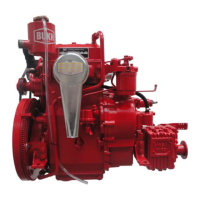
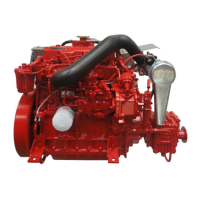
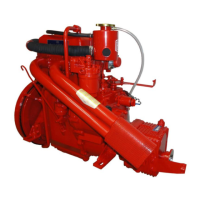
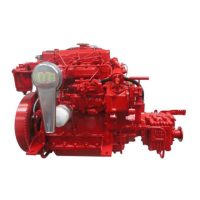
Compressor, oil
D4 D6
Oil volume 0.1 liters (0.2 US pint) 0.1 liters (0.2 US pint)
Oil grade Bukh, part no. 1141641 Bukh, part no. 1141641
Fuel System
General fuel requirements
The fuel quality is essential for engine function, durability and emission compliance. Only fuels meeting relevant
legal requirements and national and international standards shall be used; such as European EN590 diesel and
North American ASTM D975 diesel.
Usage of fuels or fuel blends that do not comply with the below specifications given in this document is
not allowed and Bukh will not accept warranty in case of fuel related engine damages.
Diesel fuel requirements
An insufficient cetane number (“ignitability”) leads to poor startability and increased exhaust emissions.
Requirement; cetane number min 45.
Insufficient density and viscosity will reduce the power and increase the fuel consumption.
Excessive density and viscosity will endanger the durability and function of the fuel injection equipment.
Requirement; viscosity 1.5-4.5 mm2/s (cSt at 40 °C and density 800-860 kg/m3 at 15 °C.
Sufficient fuel lubricity is essential to protect the fuel injection system against excessive wear.
Requirement; wear scar max 520 μm in the HFRR test (ISO 12156)
Excessive sulfur content will increase emissions and give engine corrosion and wear.
Requirement; The max allowed sulfur content is 5000 ppm, with the restriction that oil of quality VDS 3
must be used for sulfur content above 3000 ppm.
Water will give corrosion and wear of engine parts and enables microbial growth in the fuel tan
Organic contaminants (bacteria, fungi etc.) can block fuel filters and inorganic contaminants (dust, sand) can
cause severe damage to the fuel injection system.
Requirement; max allowed water content 200 ppm and max allowed total contaminant content 30 ppm.
Cold flow properties are determined by the cloud point (the temperature when wax crystals start to fall out) and
the CFPP (cold filter plugging point). The oil companies are always responsible for providing fuels with the correct
cold flow properties for any time of the year.
FAME (“biodiesel”)
Requirement; The max allowed FAME content is the same as for fuels EN 590 (at present 7% FAME that
complies with EN 14214) respectively ASTM D975 (at present 5% FAME that compies with ASTM D6751).
NOTICE! Other FAME types and higher FAME blends are allowed only after agreement with Bukh.
Paraffinic fuels (“Synthetic Diesel” — HVO GTL
HVO (Hydro-treated Vegetable Oil) are renewable, and GTL (Gas-To-Liquid) are fossil, paraffinic fuels. Usage of
paraffinic fuels will give lower emissions, but also marginally higher fuel consumption.
NOTICE! Bukh approves usage of neat HVO and GTL that complies with EN 15940, as well as HVO and GTL
blends into diesel fuels complying with the quality requirements above.
Kerosene (“Jet fuel”
Usage of kerosene is not allowed.
Technical Data
130 47708085 11-2016 © Bukh


 To Next Page