Chapter 2
2-4
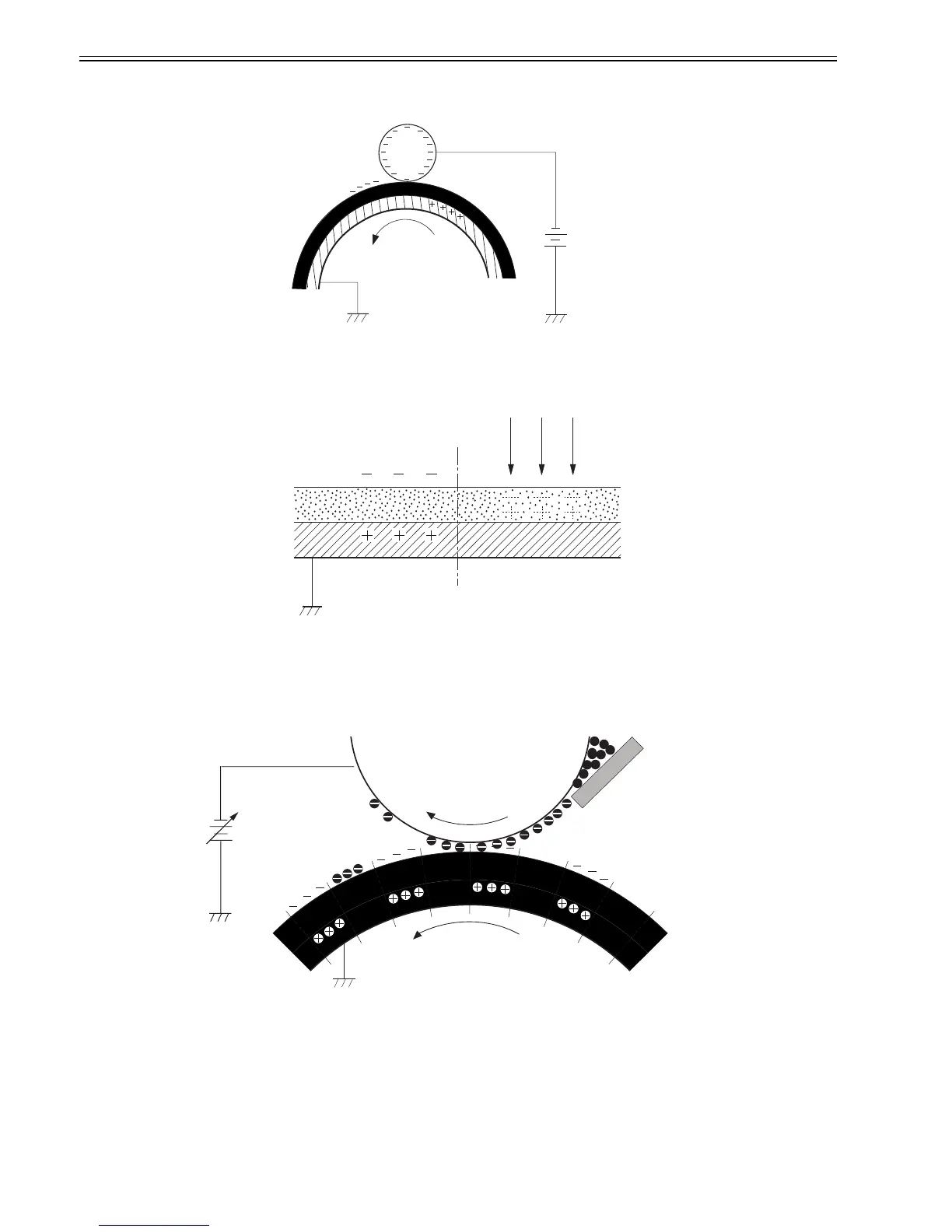
The primary charging roller charges the photosensitive drum directly. The DC negative bias is applied to the primary charging roller to keep a negative potential
on the drum surface.
F-2-5
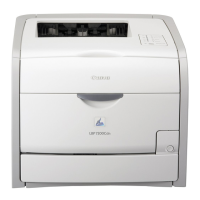
Step 2: Laser-beam exposure
The laser beam scans the photosensitive drum to neutralize the negative charge on portions of the drum surface. An electrostatic latent image forms where the
negative charge was neutralized.
F-2-6
2.4.1.4 Development block
0021-1309
Toner adheres to the electrostatic latent image on the photosensitive drum, which becomes visible.
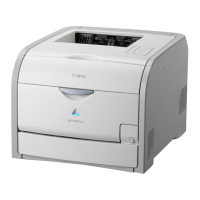
Step 3: Development
Toner acquires a negative charge from the friction that occurs when the developing cylinder rotates against the developing blade. When the negatively charged
toner comes in contact with the drum, it adheres to the latent image because the drum surface has a higher potential.
F-2-7
2.4.1.5 Transfer block
0021-1310
During the three steps that comprise this block, a toner image on the photosensitive drum is transferred to the print media through the ITB.
Step 4: Primary transfer
The toner image on the photosensitive drum is transferred to the ITB. The DC positive bias is applied to the primary transfer pad. The negatively charged toner
transfers to the ITB from the drum surface.
DC bias
Photosensitive drum
Primary charging roller
Laser beam
Unexposed area Exposed area
Developing blade
Developing cylinder
DC negative bias
Photosensitive drum
Unexposed area
Exposed area
Exposed area
Unexposed area



 To Next Page