CHAPTER 5 – WHEELS AND TIRES
5-4
Tire Pressure Check
WARNING: Do not inate the tires with am-
mable gases or with air from systems that use
alcohol injectors. This could cause explosion
and/or accidents.
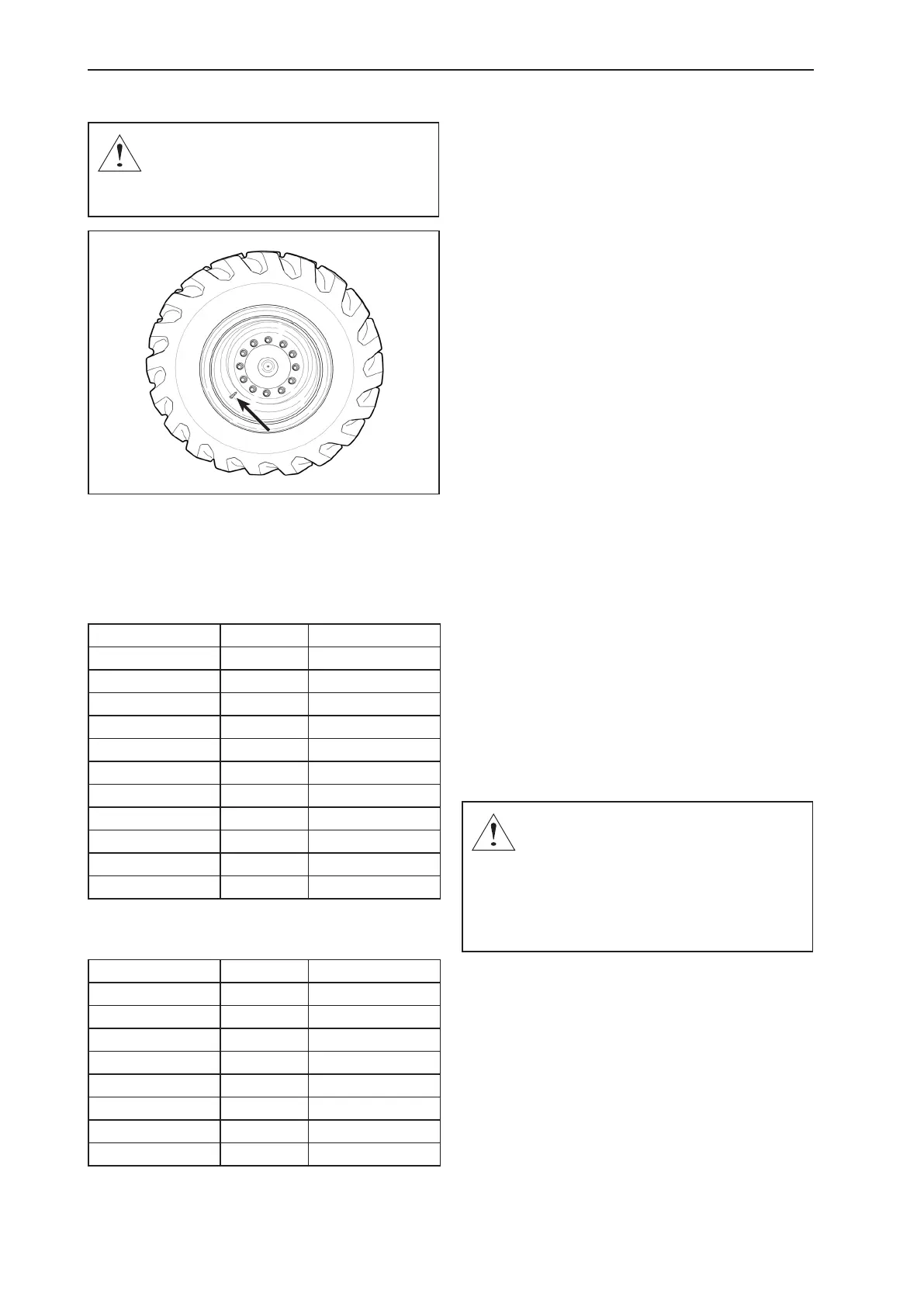
TIRE VALVE
Check the pressure with a tire pressure gauge. The nor-
mal pressure is:
845B / 865B MODELS
Tires Type Pressure
14,0 x 24-10 PR G2 33 psi (225 kPa)
13,0 x 24-12 PR G2 40 psi (275 kPa)
14,0 x 24-12 PR G2 36 psi (250 kPa)
14,0 x 24-16 PR G2 40 psi (275 kPa)
14,0 x 24 Snow plus L2 44 psi (300 kPa)
16,0 x 24-12 PR G2 33 psi (225 kPa)
17,5 x 25-12 PR L2 33 psi (225 kPa)
17,5 x 25-16 PR L3 51 psi (350 kPa)
17,5 x 25 XTLA 35 psi (240 kPa)
17,5 x 25 Snow plus L2 35 psi (240 kPa)
14,00 R24 XGLA 45 psi (310 kPa)
885B MODELS
Tires Type Pressure
14,0 x 24-12 PR G2 36 psi (250 kPa)
14,0 x 24-16 PR G2 40 psi (275 kPa)
14,0 x 24 Snow plus L2 44 psi (300 kPa)
16,0 x 24-12 PR G2 33 psi (225 kPa)
17,5 x 25-12 PR L2 33 psi (225 kPa)
17,5 x 25 XTLA 35 psi (240 kPa)
17,5 x 25 Snow plus L2 35 psi (240 kPa)
14,00 R24 XGLA 45 psi (310 kPa)
Do not stand directly in front of tire while performing main-
tenance. Always stand to one side and extend your arm
to ller valve.
Be sure tires are properly inated to the specied pressu-
re. Inspect for damage periodically.
Check tires only when the wheels and tires are cool to
avoid under ination. Do not use reworked wheel parts.
Improper welding, heating or brazing, weakens them and
can cause failure.
Always use an ination cage, safety cables or chains
when removing tire lock rings or inating tires. Always
deate tires before removing lock rings or objects from
tread, according to local or national requirements.
Never begin to inate a tapered bead tire unless bead
seat band is securely in place over the lock ring. Impro-
per ination is a large contributor to tire failures. Under
ination will cause damage to the cord body of the tire.
The repeated excessive exing of the sidewall area may
eventually cause a series of breaks and separation in the
cord fabric.
Over ination must also be avoided. For maximum ota-
tion in very soft footing, ination may be decreased.
If 24 hour operation does not permit checking ination
pressure on completely cooled tires, a correction factor
can be determined by experiment.
Check as many times as possible when “cold” and again
after two hours of operation. The average difference must
be added to the recommended pressure when checking
the tires during constant operation.
Continuous operation of equipment builds up heat and
accompanying higher pressure in the tire. These normal
increases are allowed for in the design of the tires.
WARNING: Travel pressures are recommen-
ded to optimize the performance of the ma-
chine during long transfer trips on open roads
with no load. Before putting the machine back
to work, it is imperative to reinate the tires to
working pressure to avoid damaging the tire
sidewalls.
NOTE: Never exceed the maximum pressure stamped
onto tire sidewalls.


 To Next Page