2828
trouBleShootIng
ClimateTalk
Fault Code
PCB LED
Display
Transmitted ClimateTalk
Message
Thermostat Fault Probable Causes Corrective Actions
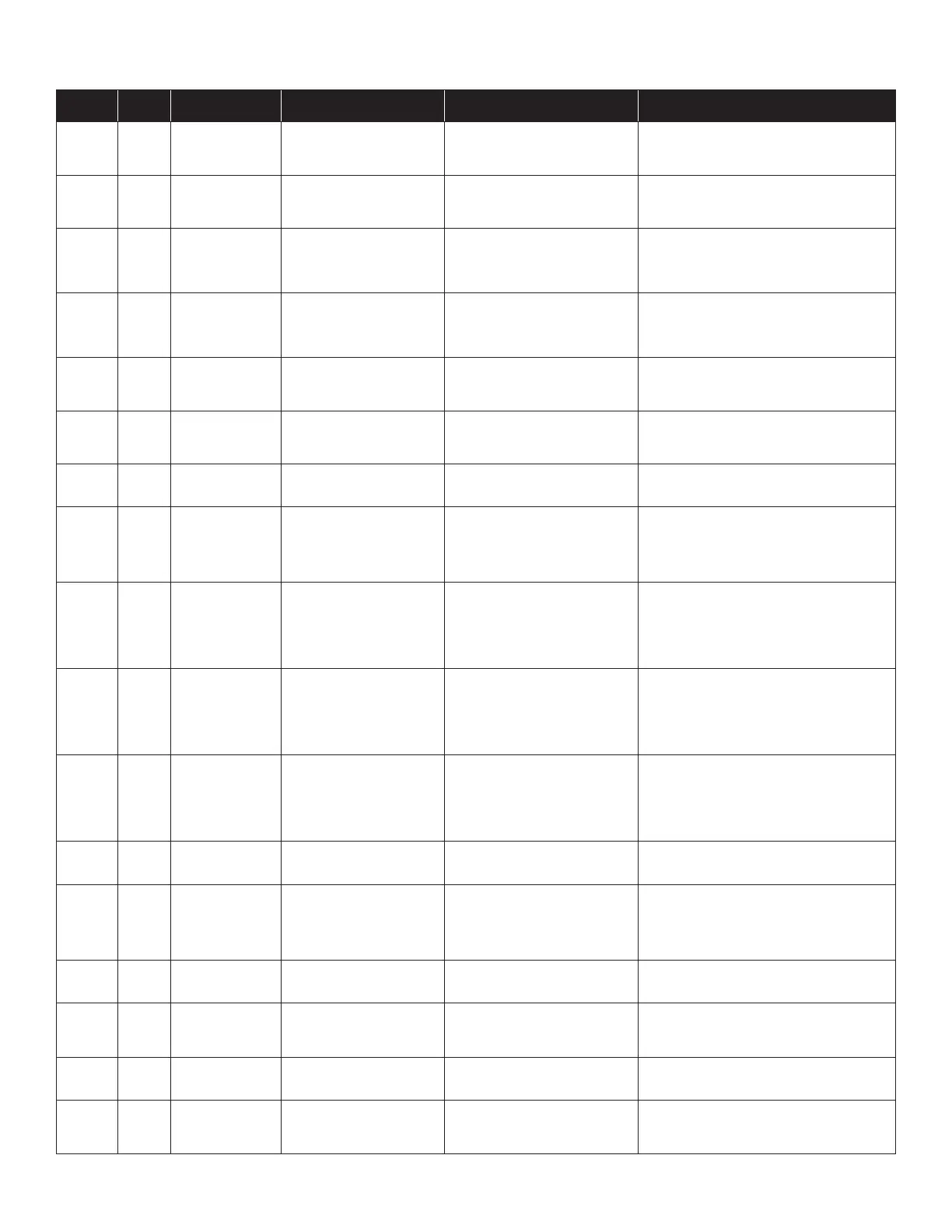
43 E43 HIGH LINE VOLT
Control detects a high power supply
voltage condition.
• High line voltage supply
• Verify unit is connected to power supply as specied on
rating plate
• Correct high line voltage condition; Contact local utility if
needed
44 E44 OP TEMP RANGE
The control detects the outdoor
temperature outside recommended
operational range. Unit may continue
to operate normally.
• Ambient air conditions too high or low
• Cycle power; re-try during usable ambient temperature
range
45 E45 NO COOLING TEST
The control is unable to start the
Cooling mode test because indoor
heat has been turned on by ther-
mostat. Please set thermostat to off
position.
• Heat provided by secondary heating
source
• Turn off Furnace or heater using thermostat before
operation
47 E47 NO SYS VER TEST
The control is unable to start the
System Verication test because
indoor heat has been turned on by
thermostat. Please set thermostat to
off position.
• Heat provided by secondary heating
source
• Turn off Furnace or heater using thermostat before
operation
49 E49 NO CHARGE MODE
The control is unable to enter
Charging Mode because indoor heat
has been turned on by thermostat.
Please set thermostat to off position.
• Heat provided by secondary heating
source
• Turn off heater using thermostat before operation
50 E50 LINE VOLT CTRL
This indicates there is a voltage
issue on the control board. See
service manual for troubleshooting
information.
• High or low voltage from supply voltage or
frequency
• Faulty control board
• Noise
• Correct low/high line voltage condition; Contact local utility
if needed
• Replace control board if necessary
• Contact local utility if needed
51 E51 OD COMM ERROR
This indicates potential communica-
tion issues have been detected by
the outdoor control board.
• Communication wiring disconnected • Check communication wiring; Repair as needed
52 - COMP FAIL MINOR
This error indicates the equipment is
experiencing frequent compres-
sor faults. Control has determined
continued operation is acceptable.
This indicates they may be a problem
with the equipment.
• Stop valve not completely open
• The compressor wire is lost phase
• Compressor motor failure
• Check the opening of stop valve, should be full open;
Repair/replace if needed
• Check the wire between control board and compressor
• Inspect compressor motor for proper function; Replace if
necessary
53 - PCB OR FAN MIN
This error indicates the equipment is
experiencing frequent outdoor control
board and/or motor faults. Control
has determined continued operation
is acceptable. This indicates they
may be a problem with the equip-
ment.
• Obstruction in fan rotation
• Outdoor fan motor not connected properly
• Outdoor fan not running
• Faulty control board
• Noise
• Check and clean grille of any debris
• Check wiring from Outdoor fan motor to control board;
Repair if needed
• Check outdoor fan motor & wiring; Repair/replace if
needed
• Replace control board if necessary
54 - EEV MINOR
This error indicates the equipment is
experiencing frequent low discharge
superheat faults.
Control has determined continued
operation is acceptable. This indi-
cates they may be a problem with the
equipment.
• Thermistors inoperable or improperly
connected
• Faulty indoor EEV or indoor EEV coil
• Faulty control board
• Check the connection to thermistors; Repair/replace if
needed
• Check indoor EEV; Replace if needed
• Check indoor EEV coil; Replace if needed
• Replace control board if necessary
55 - HI DIS TEMP MIN
This error indicates the equipment is
experiencing frequent high discharge
temperature faults. Control has
determined continued operation is
acceptable. This indicates they may
be a problem with the equipment.
• Discharge thermistor inoperable or improp-
erly connected
• Discharge thermistor is put in incorrect
position or off
• Low refrigerant charge
• Overcharge
• Faulty compressor
• Check discharge thermistor resistance and connections;
Repair/replace as needed
• Check discharge thermistor position
• Check refrigerant charge level; Adjust if needed
• Check the compressor; Repair/replace if needed
56 E56 SUCT TEMP FAIL
The control has detected if the
Outdoor Suction Temperature Sensor
is out of range.
• Suction thermistor inoperable or not prop-
erly connected
• Faulty reversing valve
• Check the connection to suction thermistor; Repair/re-
place if needed
• Check reversing valve; Replace if needed
57 - CL LOOP SWEAT
This indicates the control is sensing
sweating on the cooling loop.
<3.5 - 5.0 ton only>
• Refrigerant Leak
• Low refrigerant charge
• Faulty indoor EEV or indoor EEV coil
• Thermistors inoperable or improperly
connection
• Test for system leaks using leak test procedure
• Check refrigerant charge level; Adjust if needed
• Check indoor EEV; Replace if needed
• Check indoor EEV coil; Replace if needed
• Check the connection to thermistors; Repair/replace if
needed
58 E58 OL OPEN
The Overload Protection sensor for
Compressor is opened.
• Overload protection (OL) sensor inoper-
able
• Check resistance on OL sensor to verify operation;
Replace if needed.
• Check OL sensor position on compressor body.
59 E59 RV FAIL
This indicates the equipment is expe-
riencing reversing valve faults.
• Faulty reversing valve body or coil
• Low refrigerant charge
• Faulty pressure sensor
• Faulty control board
• Check reversing valve body or coil; Replace if needed
• Check refrigerant charge level; Adjust if needed
• Check pressure sensor; Replace if needed
• Replace control board if necessary
60 E60
NO HP HEAT
(WARM UP)
No heat pump heating.
Need warming up on compressor to
run properly.
• Need 2 hour power ON.
• Need heat up on compressor motor/oil.
• Wait for 2 hours after turn-on power on Outdoor unit.
• Use secondary heat source.
B0 Eb0 NO ID AIRFLOW
The estimated airow from indoor
subsystem is near to 0 CFM.
• Failed indoor blower motor
• Indoor fan motor not properly connected
• Too much static pressure
• Check ID fan motor wiring and connectors; Repair/replace
if needed
• Check ID fan motor; Replace if needed
• Check the obstruction inside duct work.



 To Next Page