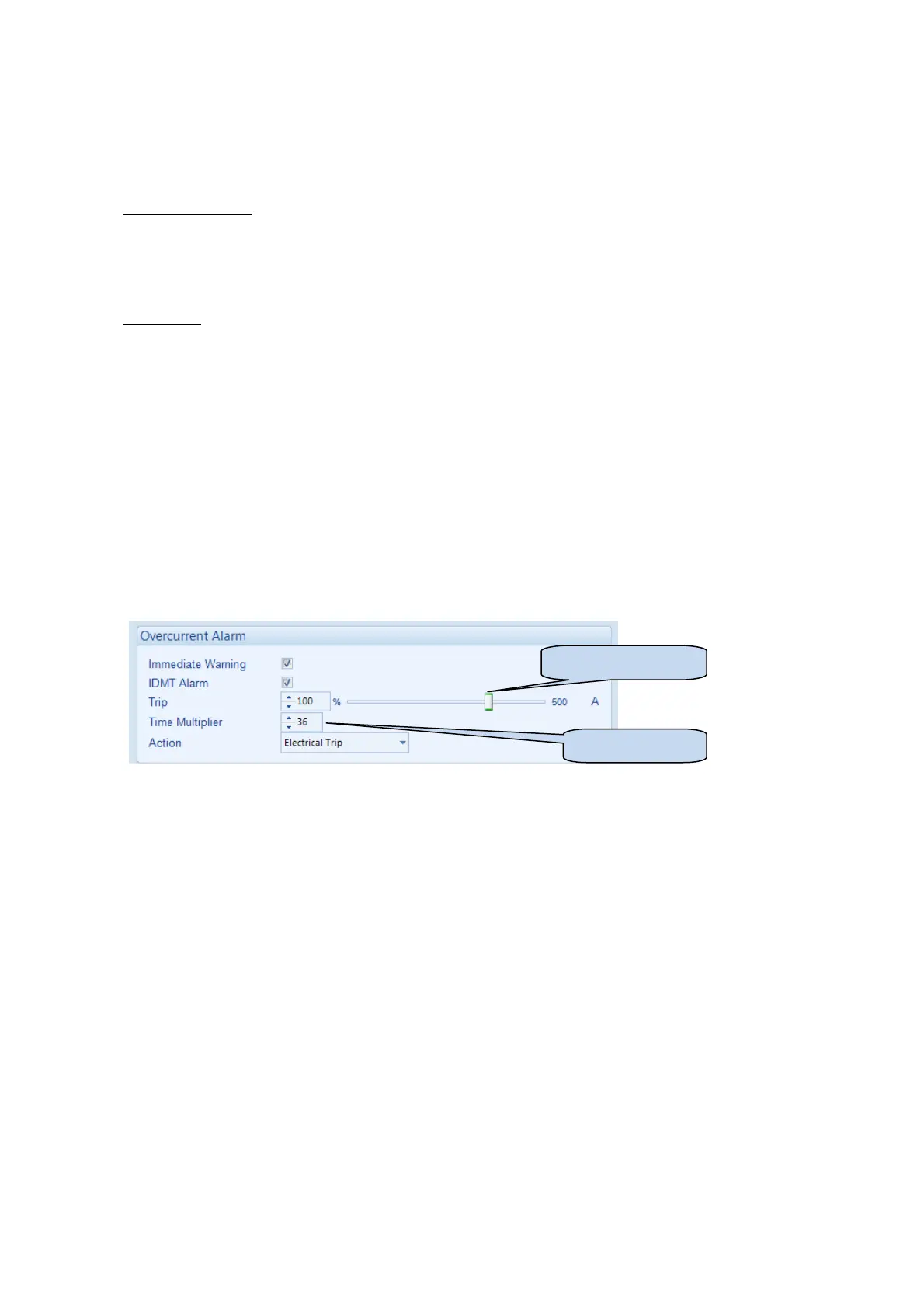
Edit Configuration - Mains
64
4.8.4.1 OVERCURRENT ALARM
The overcurrent alarm combines a simple warning trip level combined with a fully functioning IDMT curve for
thermal protection.
Immediate Warning
IEEE 37.2 -50 instantaneous overcurrent relay
If the current exceeds the Trip level the Immediate Warning activates.
IDMT Alarm
IEEE 37.2 -51 AC time overcurrent relay (shutdown / electrical trip)
If the IDMT Alarm is enabled, the controller follows the IDMT ‘curve’. If the Trip is surpassed for an excess
amount of time the IDMT Alarm triggers (Shutdown or Electric trip as selected in Action).
The higher the overload, the faster the trip. The speed of the trip is dependent upon the fixed formula :
T = t / ( ( I
A
/ I
T
) – 1 )
2
Where: T is the tripping time in seconds
I
A
is the actual current of the most highly loaded line (L1 or L2 or L3)
I
T
is the delayed over-current trip point
t is the time multiplier setting and also represents the tripping time in seconds at twice full load (when I
A
/I
T
=2).
Typical settings for the IDMT Alarm when used on a brushless alternator are:
These settings provide for normal use of the mains up to 100% full load. If full load is surpassed, the
Immediate Warning alarm is triggered, the mains continues to power the load.
The effect of an overload on the mains is that the supply cables and transformer windings begin to overheat,
the aim of the IDMT alarm is to prevent them being overloaded (heated) too much. The amount of time that
the cables can be safely overloaded is governed by how high the overload condition is.
See overleaf for details of the IDMT alarm factory settings and examples of different settings for the Time
Multiplier (t).
The IDMT alarm factory settings, allows for overload of the mains supply to the limits of typical supply cables
whereby 110% overload is permitted for 1 hour.
If the set load is reduced, the controller then follows a cooling curve. This means that a second overload
condition may trip much sooner than the first as the controller knows if the windings have not cooled
sufficiently.
For further details on the Thermal damage curve of your alternator, you are referred to your alternator
manufacturer.
I
T
(Trip setting value)
t
(time multiplier)



 To Next Page