© 2013 DHD Deubner Hoffmann Digital GmbH
12
Series 52 - 52/DX Compact Mixing Console Manual
Specifications and design are subject to change without notice. The content of this document is for information only. The information presented in this document does not form part
of any quotation or contract, is believed to be accurate and reliable and may be changed without notice. No liability will be accepted by the publisher for any consequence of its use.
Publication thereof does neither convey nor imply any license under patent rights or other industrial or intellectual property rights.
In the following table you can find the type and number of interfaces, which are available on each XC Analog I/O/GPIO
module 52-7223:
Please find a PDF file with pin assignments in the 52/DX list of modules on www.
dhd-audio.com.
6.2.5 DeviceLink
To exchange audio signals directly between two XS cores, you can connect them directly by a shielded CAT5 or CAT6
cable on an APC port on each XS core.
To use the DeviceLink, each XS Core requires an
XC/XS Core Audio Network
licence.
Each DeviceLink connection can send and receive 48 audio channels at the same time. This connection does not transmit
any control signals.
6.3 Control modules
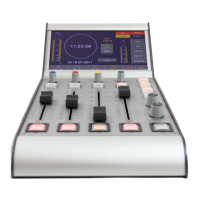
The control module is the interface between the user and the functions of the mixing system. The 52/DX control modules
has an integrated TFT Display. Due to it is sensitive to touch, you can design views with buttons to control functions via
the TFT displays.
For a comprehensive list of all 52/DX modules, please see the 52/DX List of
Modules.
The control module consists of control elements – such as faders, hardware keys, TFT buttons, rotary knobs – and status
indicators. These are for example LEDs inside the keys, or defined parts of TFT views. Some typical applications for
displaying information to the user are:
· LEDs showing the PFL status for a given channel.
· An alphanumeric display shown on the TFT shows, which input signal is selected for a given channel.
· LEDs inside the keys are switched on or off to indicate the state of the key.


 To Next Page