DIAGNOSIS AND TESTING
EXHAUST SYSTEM
EXHAUST SYSTEM DIAGNOSIS CHART
CONDITION POSSIBLE CAUSE CORRECTION
EXCESSIVE EXHAUST NOISE OR
LEAKING EXHAUST GASES
1. Leaks at pipe joints. 1. Tighten clamps/bolts to specified
torque at leaking joints.
2. Rusted or blown out muffler. 2. Replace muffler. Inspect exhaust
system.
3. Broken or rusted out exhaust
pipe.
3. Replace exhaust pipe.
4. Exhaust pipe leaking at manifold
flange.
4. Tighten/replace flange attaching
nuts/bolts.
5. Exhaust manifold cracked or
broken.
5. Replace exhaust manifold.
6. Leak between exhaust manifold
and cylinder head.
6. Tighten exhaust manifold to
cylinder head bolts.
7. Catalytic converter rusted or
blown out.
7. Replace catalytic converter assy.
8. Restriction in exhaust system. 8. Remove restriction, if possible.
Replace restricted part if necessary.
When servicing and replacing exhaust system components, disconnect the oxygen sensor connector(s). Allowing
the exhaust to hang by the oxygen sensor wires will damage the harness and/or sensor.
REMOVAL AND INSTALLATION
EXHAUST PIPE
CAUTION: When servicing or replacing exhaust
system components, disconnect the oxygen sensor
connector(s). Allowing the exhaust to hang by the
oxygen sensor wires will damage the harness
and/or sensor.
REMOVAL
(1) Raise and support the vehicle.
(2) Saturate the bolts and nuts with Mopart Rust
Penetrant. Allow 5 minutes for penetration.
(3) Disconnect the oxygen sensor(s).
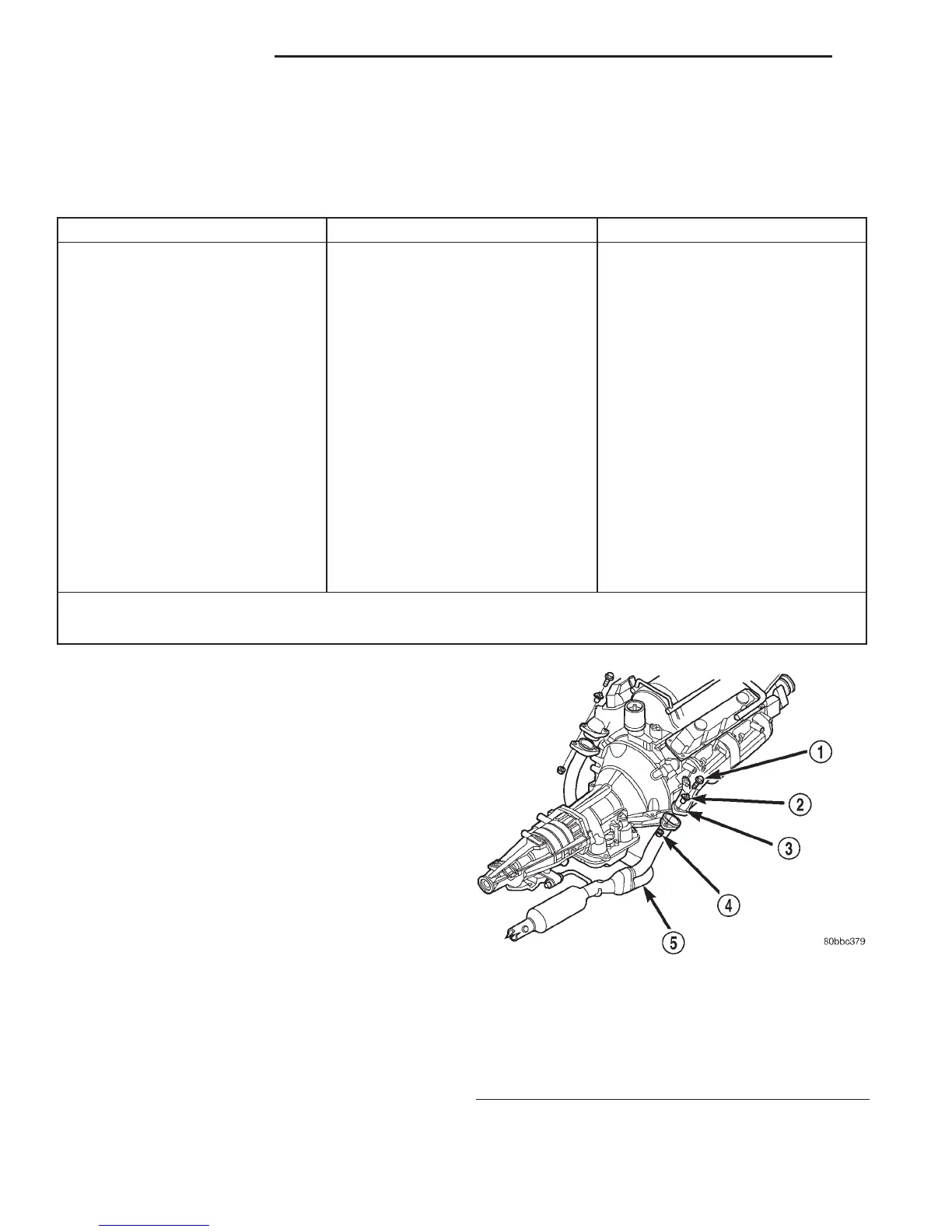
(4) Remove the exhaust manifold-to-exhaust pipe
nuts (Fig. 7) (Fig. 8) (Fig. 9).
(5) Remove exhaust pipe/converter to muffler
exhaust clamp.
(6) Disconnect the exhaust pipe/catalytic converter
from muffler.
(7) Remove the exhaust pipe.
Fig. 7 Exhaust Pipe to Manifold Connection—(5.2L
and 5.9L)
1 – BOLT
2 – RETAINER
3 – EXHAUST MANIFOLD
4 – NUT
5 – EXHAUST PIPE
11 - 4 EXHAUST SYSTEM DN












 To Next Page