DuraLabel.com | 800.788.5572
7.3 Merging Information, Sequencing Labels | 33
LABEL DESIGN
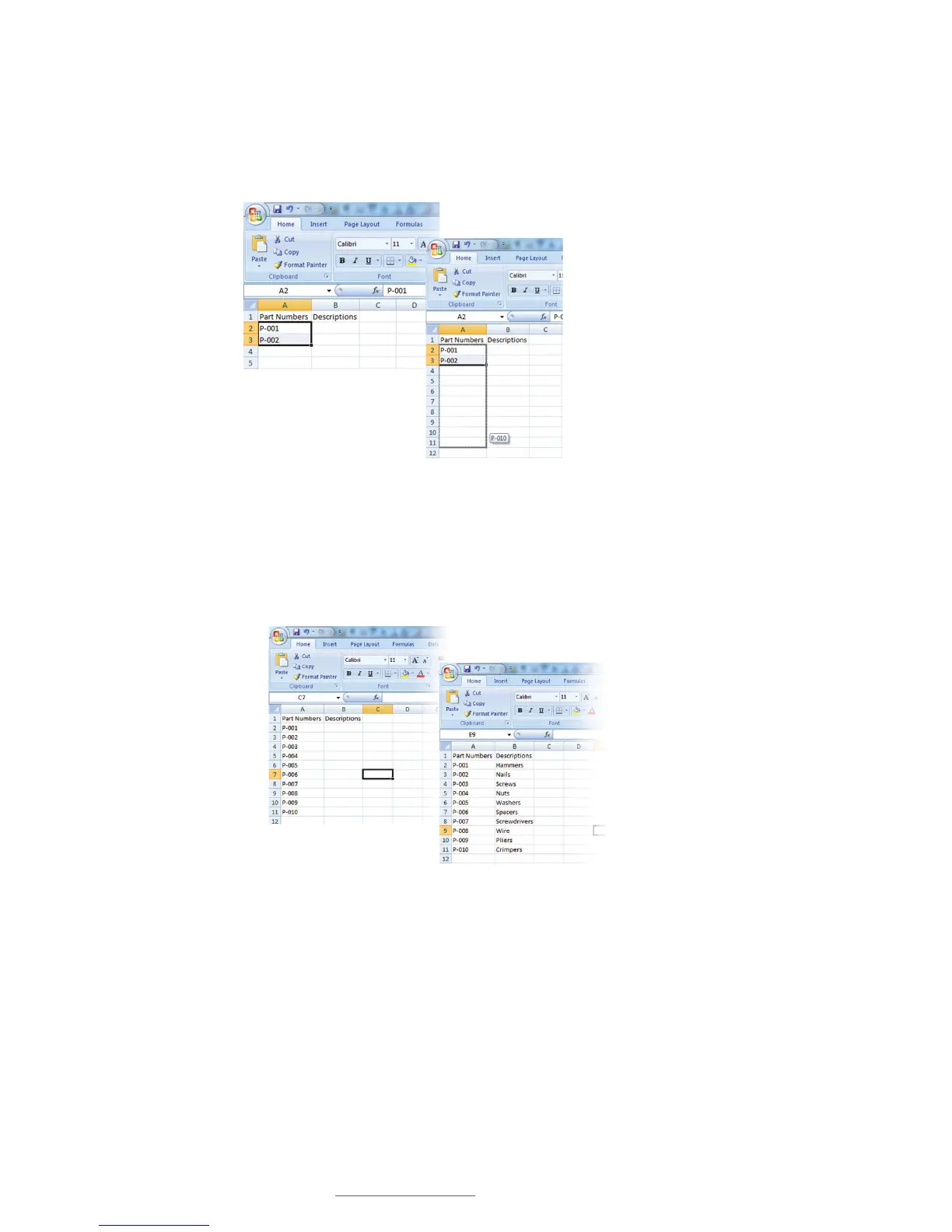
A. Enter your first two sequential numbers in cells A2 and A3 (Fig. 3). Select cells
A2 and A3 and place your cursor over the little box in the lower-right corner of the
selection. Your cursor becomes a “+.” Now click and drag the selection down the
number of cells equal to the number of labels in the sequence (Fig. 4).
B. All the column’s numbers will sequence the same as the sequence used in the first
two rows (Fig. 5). This example reflects 10 labels, with a sequence of 1.
C. Now enter the data for Column B, e.g., Descriptions, that relates to the data in
corresponding rows of Column A (Fig. 6).
D. When all your data has been entered in the Excel spreadsheet, name and save
your document in a location where you can easily find it. Consider placing it in a
folder with other project documents. Close your Excel document after naming and
saving it. You’ll come back to it shortly.
FIGURE 4 … then drag your
cursor the number of cells
equal to the total number of
labels in your sequence.
FIGURE 3 Enter two rows of
numbers …
FIGURE 5
The spreadsheet
reveals plans to
print 10 labels,
with Part Numbers
sequenced by 1
FIGURE 6 Enter data under
Column B that relates to the
data on the corresponding row of
Column A.


 To Next Page