Parameterisation
Page 36 of 45 MSM-BSM2G-BA-UK-001
6.2.4.2 Submenu Reporting Sequence
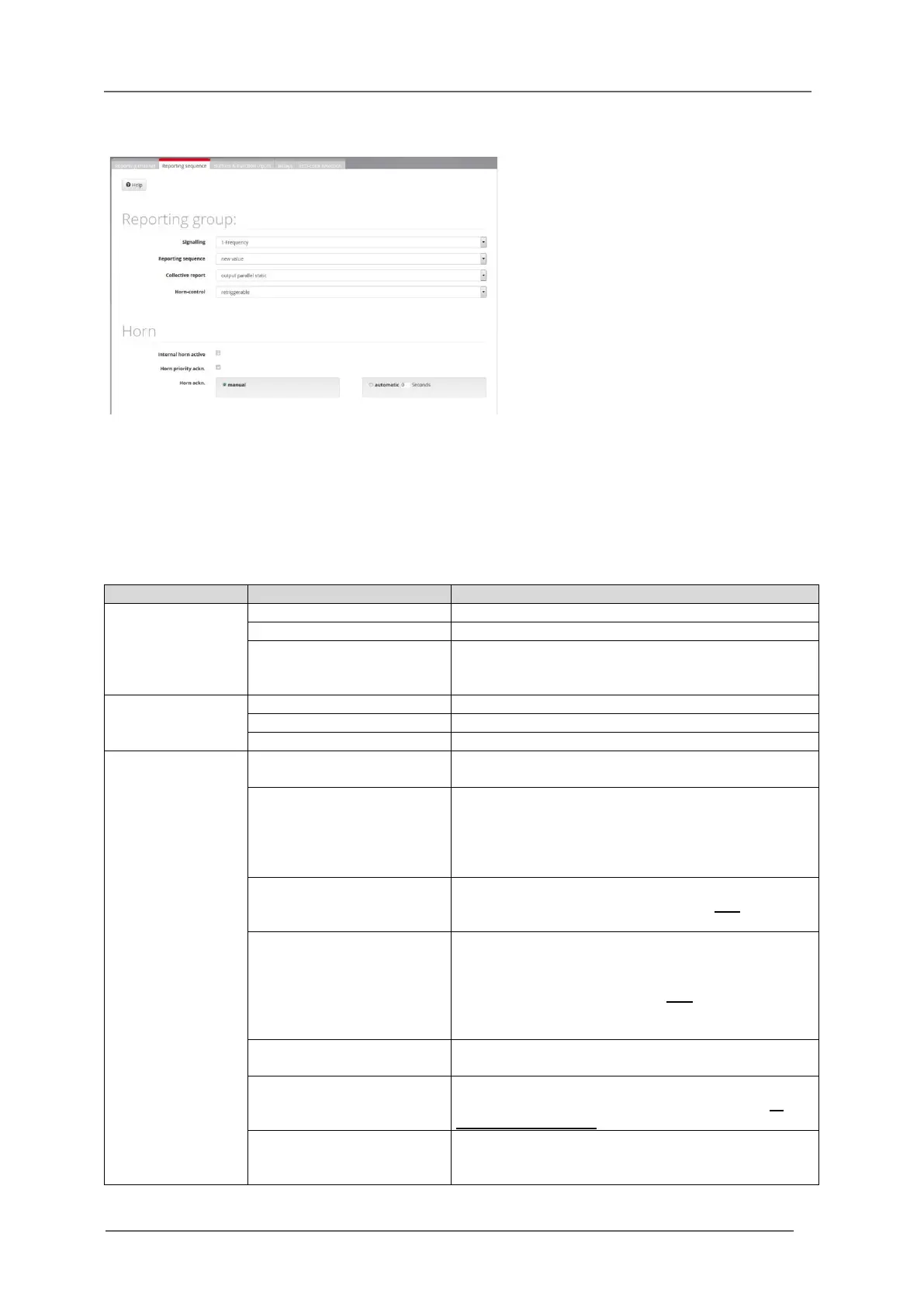
Fig. 6.15: Page Reporting sequence
In this sub-menu the reporting sequence and the horn triggering can be parameterised. To ensure a
flexible adaption of the sequence to the requirements, the reporting sequence is composed from
different components, which are explained in the following.
Reporting sequence
Self-acknowledging alarm: alarm is displayed as
acknowledged alarm and recedes, when the
corresponding input drops.
New value reporting (no-first-up)
Can only be chosen for 2-frequency flashing
The collective report is set with the first incoming
alarm and resets with the last receding alarm.
Input parallel static-dynamic
The collective report is set with the first incoming
alarm. For each subsequent alarm, the collective
report is reset for approx. 0.8 s and then set again.
Once all alarms have receded the collective report
is reset permanently.
The collective report is set with the first incoming
alarm. Once all alarms have receded and been
acknowledged the collective report is reset.
Output parallel static-
dynamic
The collective report is set with the first incoming
alarm. For each subsequent alarm, the collective
report is reset for approx. 0.8 s and then set again.
Once all alarms have receded and been
acknowledged the collective report is reset
permanently.
The collective report is activated for approx. 0.8 s
with each incoming alarm.
Input parallel static
acknowledgeable
The collective report is set with the first incoming
alarm and resets with the last receding alarm or
when acknowledged.
Output parallel static
acknowledgeable
The collective report is set with the first incoming
alarm and reset independently from the state of the
alarms by acknowledgement.


 To Next Page