The Elkron MP500/4N, MP500/8, and MP500/16 are wired intrusion alarm systems designed for small to mid-sized residential, industrial, and service settings. These modular systems are certified to Grade 3 according to EN50131 standards, with the specific grade depending on the system's construction and configuration. They offer remote controllability via landline, cell phone, text message, and the Internet.
Function Description
The control panels act as the "brain" of the system, interpreting signals from detectors and taking appropriate action, such as activating notification devices or ignoring signals when disarmed. They continuously check the functionality of all system devices, signal potential anomalies, and record all main events. The systems can manage up to 4, 8, or 16 distinct partitions for the MP500/4N, MP500/8, and MP500/16 respectively, allowing for flexible protection of different areas.
Keypads, readers, and expansions connect to the control panel microprocessor via a proprietary field bus, simplifying wiring. Detectors, sirens, and other signals connect to inputs and outputs on the control panels or bus-connected devices. All inputs are configurable for both type and specialization. Remote alarm notifications can be sent via vocal message, text message, or numerical protocol to alarm reception units.
Additional functions include:
- Programming via PC: Using Hi-Connect software (v3.60 or later).
- Program saving/transfer: Via USB pen drive for transferring programs between PCs and control panels or for backup.
- Firmware updates: Via USB interface with a pen drive.
- Technological signaling: Activated by non-intrusion events, capable of commanding specific actuations.
- Advanced vocal alarm calls: Specific alarm messages can be sent for individual partitions and/or inputs.
- Vocal message diffusion: System armed/disarmed and diagnostic information can be communicated via hands-free vocal messages through vocal keypads.
- Service vocal message: Users can issue memos via vocal keypads, which are reproduced locally until deactivation.
- Remote ambient listening: Enables users to hear environmental sounds via telephone, addressing up to 8 listening points through vocal keypads.
- Vocal help: Guides users with vocal messages for remote management.
- Door opener: Controls electric locks via customized outputs, limiting access to specific areas. Date, time, and user commands are recorded.
- Telephonic activation of an output without charge: Utilizes GSM telephone number recognition to generate commands on specific outputs and close communications after 3-4 rings.
- Advanced automation: A built-in timing programmer allows for weekly automatic and repetitive commands.
- Emergency response signal: Generates service signals when a dedicated button is activated or no movement is detected in a controlled environment (not EN50131 compliant).
- Fire alarm: Generates service signals from the control panel when fire detectors are installed (not EN50131 compliant).
Important Technical Specifications
Control Panels (MP500/4N, MP500/8, MP500/16):
- Nominal Power Voltage: 230 V~ +10% -15% 50/60 Hz (MP500/4N, MP500/8); 100-240 V~ -15/+10% 50/60 Hz (MP500/16).
- Max Absorption Power: 600 mA (MP500/4N, MP500/8); 1.3 A (MP500/16).
- Control Panel Operating Voltage: 10.5 V⎓ to 16 V⎓.
- Installable Battery: 12 V – 7.2 Ah (MP500/4N, MP500/8); 12 V – 18 Ah (MP500/16).
- Battery Charger Max Current: 350 mA (MP500/4N, MP500/8); 850 mA (MP500/16).
- Max Time for Recharging Battery to 80%: 24 hours.
- Battery Flat Threshold: 11.5 V.
- Battery Release Threshold: 10.5 V.
- Automatic Test Battery: Every 24 hours (with mains).
- Max Current for External Devices: 375 mA (MP500/4N); 135 mA (MP500/8 Grade 3, 30h autonomy); 365 mA (MP500/8 Grade 2, 12h autonomy); 175 mA (MP500/16 Grade 3, 60h autonomy); 435 mA (MP500/16 Grade 3, 30h autonomy); 1065 mA (MP500/16 Grade 2, 12h autonomy).
- Total Length of Control Panel-Peripheral Serial Bus Line: 400 m.
- Max Length of Audio Line: 300 m with twin telephone line.
- Max Length of Sensor/Actuator Connection: 500 m.
- Max Length of Fast Sensor Connection: 100 m.
- Certified Operating Temperature: -10°C to +40°C (Environmental Class II, general internal).
- Average Relative Humidity: 75%.
- Storage Temperature: -20°C to +60°C.
- Dimensions (W x H x D): 338 x 240 x 90 mm (MP500/4N, MP500/8); 435 x 320 x 93 mm (MP500/16).
- Weight (without battery): 1400 g (MP500/4N, MP500/8); 5600 g (MP500/16).
Keypads (KP500D/N, KP500DV/N, KP500DP/N, KP500D/ST):
- Nominal Power Voltage: 13.8 V⎓ (from bus).
- Operating Voltage: 9 V⎓ to 15 V⎓.
- Nominal Current Absorbed at 12 V⎓ (Stand-by): 20 mA (KP500D/N, KP500DV/N); 32 mA (KP500DP/N, KP500D/ST).
- Max Current Absorbed (Operative): Up to 200 mA (with level 4 backlighting or message listening).
- Auxiliary Inputs: 2 (KP500D/N, KP500DV/N, KP500DP/N, KP500D/ST).
- Protection: Against opening and removal.
- Certified Operating Temperature: -10°C to +40°C.
- Dimensions (W x H x D): 151 x 125 x 29 mm (KP500D/N, KP500DV/N); 160 x 130 x 23.5 mm (KP500DP/N, KP500D/ST).
Readers (DK500M-E, DK500M-P, DK510M-P):
- Nominal Power Voltage: 13.8 V⎓ (from bus).
- Operating Voltage: 9 V⎓ to 15 V⎓.
- Nominal Current Absorbed at 12 V⎓ (Stand-by): 6 mA (DK500M-E); 40 mA (DK500M-P, DK510M-P).
- Max Current Absorbed: 56 mA (DK500M-E); 68 mA (DK500M-P, DK510M-P).
- Auxiliary Inputs: 2.
- Protection: Against opening and removal (requires suitable tamper device).
- Certified Operating Temperature: -10°C to +40°C.
EP508 Expansion Module:
- Nominal Power Voltage: 13.8 V⎓ (from bus).
- Operating Voltage: 9 V⎓ to 15 V⎓.
- Nominal Current Absorbed at 12 V⎓ (Stand-by): 35 mA (with energised relay); 22 mA (with relay de-energised).
- Inputs: 8.
- Outputs: 3 (1 relay, 2 electric).
- Max Total Current Deliverable from +V2 Terminals: 500 mA.
- Certified Operating Temperature: -10°C to +40°C.
AS500/RPT Supplementary Power Unit with Repeater:
- Mains Power Supply: 100 – 240 V~ -15/+10%, 50/60 Hz.
- Max. Absorption Current: 1.3 A.
- PS534 Power Output Nominal Voltage: 14.4 V⎓.
- Max. Deliverable Current: 3.4 A.
- Installable Battery: 12 V – 18 Ah.
- Max. Current Supply to Charge Battery: 500 mA.
- Max Time for Recharging Battery to 80%: 48 hours.
- Max. Total Length of Serial Power Supply-Peripheral BUS OUT Line (secondary BUS): 400 m.
- Certified Operating Temperature: -10°C to +40°C.
- Weight (without battery): 5600 g.
Usage Features
- System Architecture: Control panels manage devices and connections, with maximum system size varying by model. The bus architecture simplifies wiring for groups of detectors.
- Connectivity: Supports PSTN (ILT500-N interface), GSM (IMG500/N module), USB (IT-USB/KEY interface), and Web Server (IT500WEB interface) for external communication and remote management. Vocal functions require the SV500N board.
- Input Configuration: Inputs can be configured as double balanced, NC (normally closed), single balanced, NO (normally open), or shock/roller for fast signals. Balancing resistors are crucial for EN50131 conformity.
- Output Configuration: Electrical outputs can be configured as "positive reference" or "negative reference." Relay outputs provide switch contacts. Electrical outputs can be transformed into relay outputs using the Elkron MR02 module.
- Partitions and Areas: Allows logical grouping of detectors, sirens, keypads, and readers into partitions for flexible arming/disarming. Areas enable "subdivision" of control panels for different users.
- Delay Settings: Configurable "Delay times entry way" and "Time exit way" to prevent immediate alarms when arming/disarming or entering/exiting protected areas.
- Complementary Functions: Includes "Gong" for acoustic signals, "Courtesy light" for activating lights, "Door opener" for controlling electric locks, and "Absence of move" for monitoring inactivity (auxiliary for elderly care, not a certified emergency system).
- Intrusion Input Attributes: "Release type" (single or double release) and "AND/OR partitions" (logically connect partitions) or "AND inputs" (logically connect two inputs) for personalized alarm generation and false alarm reduction.
- Remote Activation of Outputs: GSM module allows "zero cost" remote activation of commandable outputs via Caller ID recognition.
- Environmental Listening: Available with vocal keypads, allowing remote audio monitoring and one-way communication.
Maintenance Features
- Installation Procedure: Step-by-step guide from wiring to device assembly, control panel installation, and connections.
- Wiring: Emphasizes proper cable sizing, shielding connections, and separation from electrical systems.
- Battery Management: Constant control of battery presence and charge with mains power, and continuous monitoring when mains power is absent. Automatic battery tests are performed periodically.
- Self-Diagnostic Functions: Continuous monitoring of power supply voltage, battery charging circuit, device communication, secondary bus functioning, CPU, PSTN line, and SIM card/GSM connection. Anomalies are signaled and recorded in the Diagnose Log.
- Device Acquisition: Procedure for adding new bus devices (keypads, readers, expansions, radio expansions) to the system.
- Device Identification: Methods to interrogate and search for existing bus devices to determine their addresses.
- Device Deletion: Procedure for removing existing bus devices from the system, restoring their memory to default values.
- Resetting Factory Settings: Options for partial reset (control panel programming), global reset (control panel and all bus devices), resetting installer/master/user codes, and resetting hardware to factory settings.
- Battery Replacement: Instructions for safely replacing the system battery, emphasizing the need for trained and qualified personnel.
- System Shutdown: Procedure for completely turning off the entire system, including disconnecting mains power and battery.
- Troubleshooting: A comprehensive table of failure messages, causes, and resolutions for various system anomalies (e.g., power supply issues, bus communication errors, battery low, GSM failures, PSTN line failures).
- Radio Connection Test: Integrated test to evaluate the quality of the radio connection between peripheral devices and the radio expansion, providing signal strength indications (Excellent, Good, Sufficient, Insufficient).

 Need help?
 General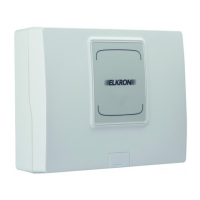

 To Next Page