50
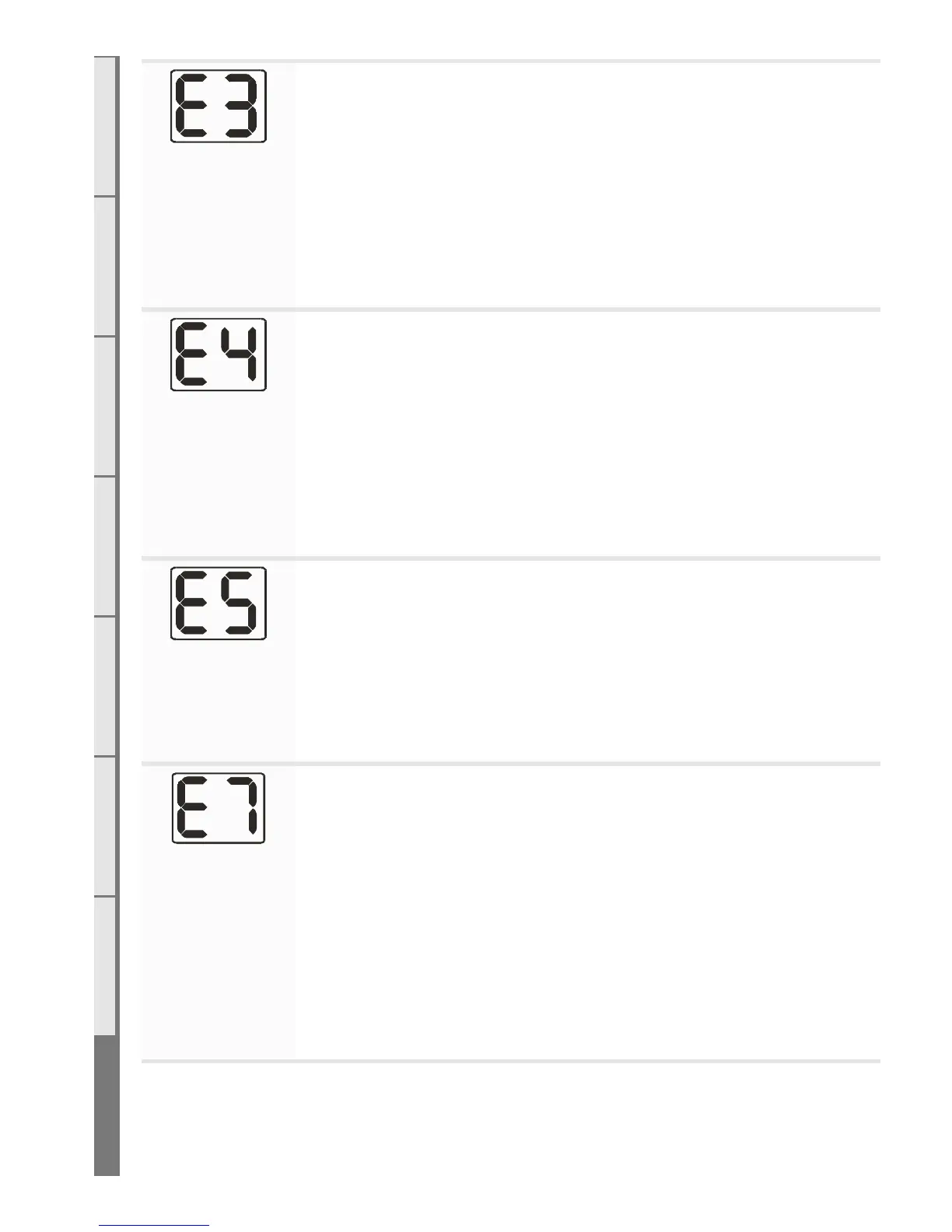
Appliance Over
Temperature
Sensor Trip
The bimetallic snap disk mounted on the exhaust collector box has tripped. The
possible causes for this could include:
• Possibly fascia panels installed incorrectly resulting in restricted air flow.
• Room air fans may be slowed or stalled. Check that fans are plugged in,
cleaned, and free turning
• The regulator being set too high resulting in excess heat build-up.
• The inlet flue not being connected and the appliance drawing warm air
from the cavity. Check flues are securely connected at both ends.
• Incorrect Jetting
• Check the red tabs are in the correct orientation, see section E2, step 2.
Valve Solenoid
Check Failure
The valve solenoids have failed the pre-ignition test. This is to detect a faulty
valve solenoid. However, it is possible a wire has dislodged.
• Check that the connections to each solenoid are secure and in place. It
may be that the connections on the ends of the wires need to be tight-
ened a little (e.g. with a pair of pliers) to ensure a robust connection to
the valve terminal.
• Disconnect and reconnect the firebox connectors ensuring they are
firmly pushed into place.
• It could also be that one of the solenoids on the valve inside the fire has
failed. If this is the case the valve will need to be replaced.
Remote Cannot
communicate with
fire
The remote cannot communicate with the fire. Reasons for this could include:
• The fire being turned o “at the wall” i.e. a loss of power to the fire or the
remote is outside of its eective radio frequency range (too far away from
the fire). Typical remote range is 1m to 10m.
• Ensure there is power to the fire by pressing the auxiliary on/o (red)
button on the fire, then press the on/o button on the remote to clear
the error.
Combustion Air
Flow Error
• Check whether the pressure switch is activating at startup (there is an or-
ange indicator LED in the control tray). If not check the pressure switch
electrical connection is correct.
• Check that the hoses are connected at both ends. Ensure the hoses are
not kinked.
• Ensure the pressure switch is mounted vertically and the diaphragm is
operational. The black hose should be connected to the low pressure port
and the translucent to the high pressure port
• Check that both flues are securely connected at both ends to the appli-
ance and the powerflue wall terminal and that the flue is not damaged
• Check that the fan inside the powerflue wall terminal is running during
startup. This fan may need servicing if it is slowed or stalled.


 To Next Page