ETAS Hardware Description
ES930.1 - User Guide 26
3.7.2 Requests
The sampling or acquisition of the signals and the control of the output of sig
-
nals is done based on requests that can be configured in the application soft-
ware for all input and output channels of the ES930.1. This configuration is
possible independent of each other for all channels.
Requests for a channel of the ES930.1 are executed completely before addi-
tional requests for this channel are processed.
3.7.2.1 Sampling and Raster
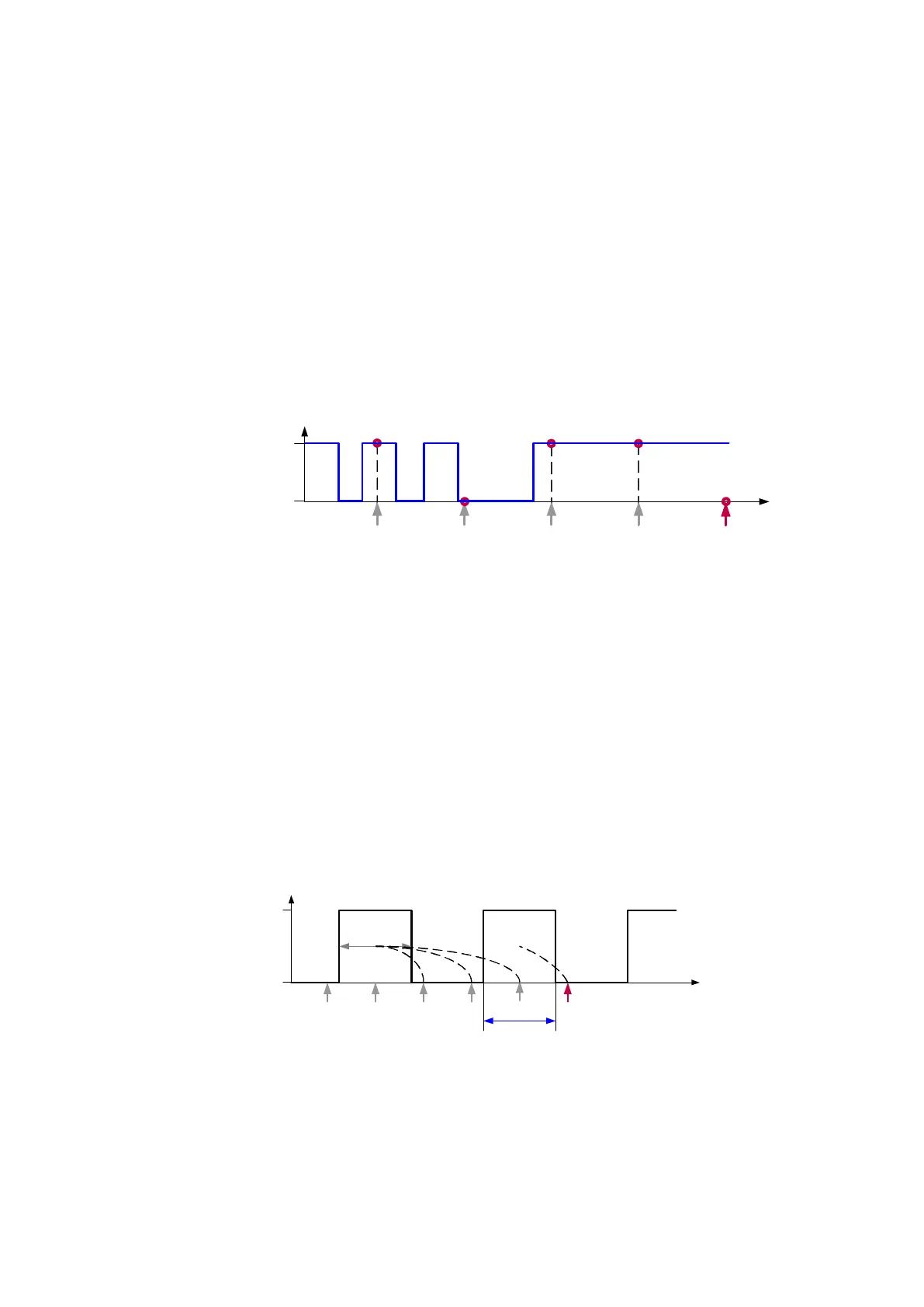
The signal acquisition at the input channels can be initiated independent of
each other in a predefined, equidistant time raster or in the event-triggered
mode by events (event raster).
Fig. 3-6 Sampling of the Data (fixed Raster)
In event-triggered mode, a measured value is acquired only if a certain event
has occurred.
For each ES930.1 module, four events can be defined differently in the applica-
tion software. The source of each of the events is the input signal of any digital
input channel.
For each event, it is possible to define which edge of the digital input signal is
selected for the event (active-inactive edge, inactive-active edge, both edges or
the end of a cycle).
If an event occurs, the signals at all inputs of the ES930.1 are captured.
3.7.2.2 Behavior in Case of Oversampling by the Application Program
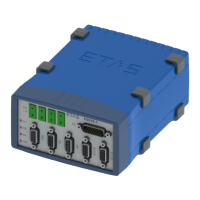
In case of oversampling, a signal with a higher sampling rate than it is actually
required for the transfer of the signal bandwidth is captured.
Fig. 3-7 Oversampling at the digital Input Channel
If the relatively slow input signal is scanned with a high sampling rate (over-
sampling), a new measured value cannot be determined for every sampling, as
shown by the example in
Fig. 3-7 on page 26 (fixed sampling rate, digital input).
In this case, the valid measured value captured last is used again.
Tim e
Input
Si g n a l
Active
Inacti ve
Ti me
Input
Si g n a l
Active
Inactive
ActiveTime n
Timer::Act iveTime
fix raster
Oversampling
ActiveTime n-1


 To Next Page