sition. During cockpit preflight, ensure that the
system is available by checking to see that
the “OXYGEN OFF” CAS message is not dis-
played.
When the oxygen shutoff/regulator valve is
closed, oxygen pressure that is in the distri-
bution lines is bled to ambient. The pressure
switch in the passenger oxygen control valve
(Figure 17-1) also trips, and sends a signal to
the EICAS that displays an amber “OXYGEN
OFF” message in the CAS window (Figure
17-5).
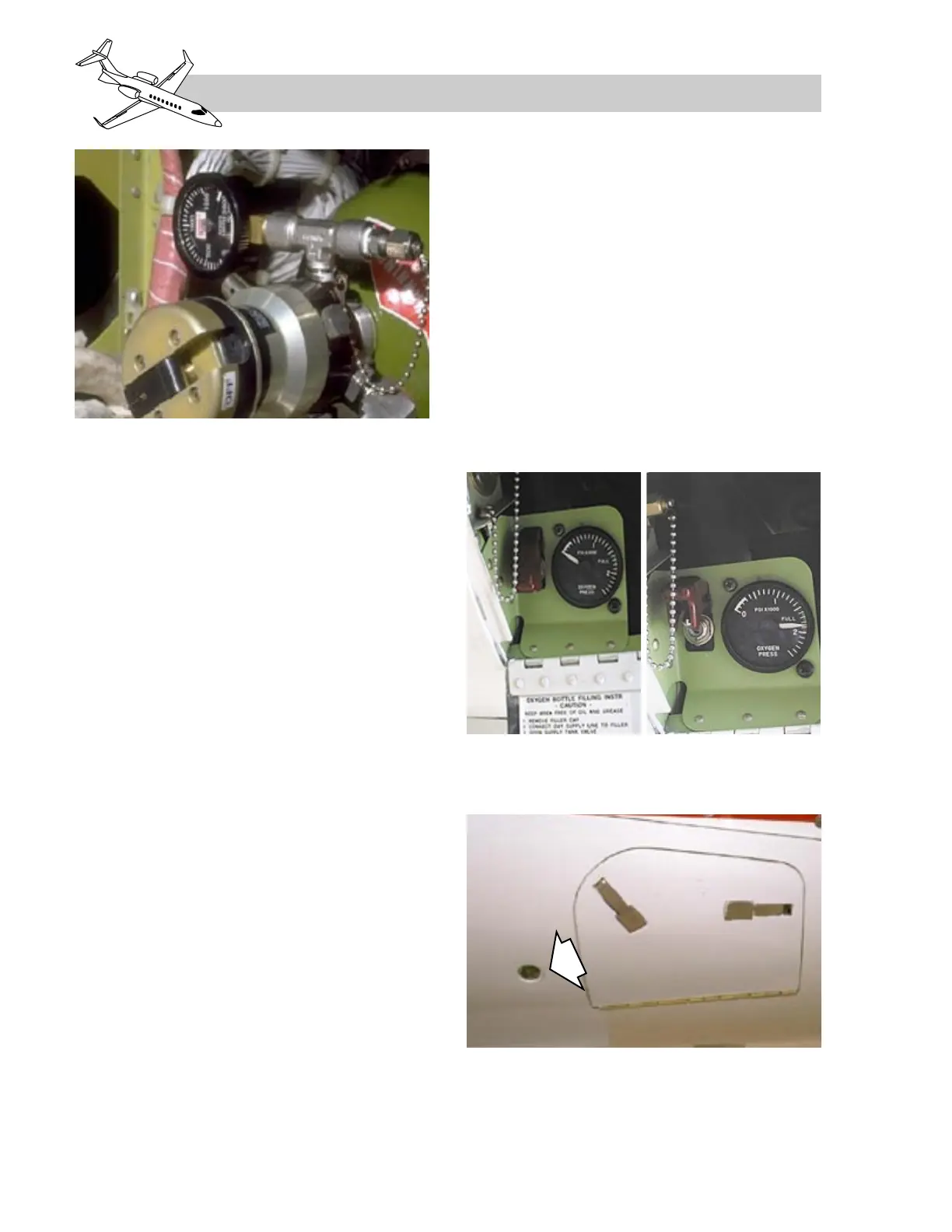
The oxygen cylinder pressure gage (Figure 17-
3) is also connected to the shutoff valve, and
provides a direct reading visual indication
of oxygen pressure. The gage displays pres-
sures between 0 and 2,000 psig.
On aircraft modified with SB 45-12-1, an
oxygen filler valve has been located just in-
side of the oxygen service door on the right
side of the nose (Figure 17-4A). Also located
in this compartment is an electrical remote
reading oxygen pressure gage. Located aft
of the gage is a switch with a red guarded
cover that is used to turn on power to the
gage. This power is supplied by a battery hot
bus.
OVERBOARD DISCHARGE
INDICATOR
The overboard discharge indicator (green
blowout disk) (Figure 17-4B) provides the
crew with a visual indication that there has
been an overpressure condition of the cylin-
der. The green disk is designed to fracture
when the oxygen pressure is between 2,500 to
2,775 psig, releasing all oxygen cylinder con-
tents. The blowout disk is located on the for-
ward right side of the nose section. An amber
CAS message, “OXY PRESS HI” is also dis-
played when pressure exceeds 2,500 psi.
17-4
FOR TRAINING PURPOSES ONLY
LEARJET 45 PILOT TRAINING MANUAL
FlightSafety
international
Figure 17-3. Oxygen Pressure Gage
Figure 17-4B. Overboard Discharge
Indicator and Oxygen Service Door
Figure 17-4A. Remote Filler and
Pressure Indicator



 To Next Page