CAUTION!
The c
onversion of the "ANALYSETTE 3 PRO" to the
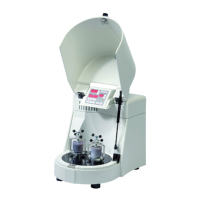
micro mill "PULVERISETTE 0" cannot be recommended,
as the amplitude control is unusable due to the ball col-
lision malfuncons and therefore has no ulity value. In
this case, the "ANALYSETTE 3" SPARTAN is more suit-
able.
However if you are using the PRO version with the PUL-
VERISETTE 0 grinding aachment, note that the ampli-
tude must not be set to > 2 mm, as otherwise damage
will be caused to the device, for which we accept no
responsibility.
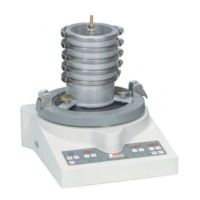
The "ANALYSETTE 3 SPARTAN" is equivalent in design to the PRO model,
except that the range of funcons is limited. The serial interface, elec-
tronic amplitude control, amplitude display, interval me specicaon,
micro sieving opon as well as the standby funcon are not included.
2.2.1 Operang principle
The plasc housing contains a solid cast structure with an electronically
controlled electromagnet. Three permanently exible at springs carry
the pole plate of this magnet together with the vibratory plate, which is
fastened to it. When the magnet is switched on, the pole plate and vibra-
tory plate are aracted and spring back when it is switched o. The cast
structure and magnet on one side and the pole plate, vibratory plate and
sieves on the other side form a vibratory system.
The dierent number of sieves and sieving stocks or grinding aach-
ments changes the natural frequency of the vibratory system. For this
reason, it is not always possible to set the amplitude of the sieve shaker
opmally e.g. with a constant 50 Hz mains frequency present. The pro-
cessor-controlled electronics of the ANALYSETTE 3 PRO sieve shaker
ensures a precisely adjustable, reproducible sieve amplitude. This is ach-
ieved by bringing the frequency to smulate oscillaon closer to the nat-
ural frequency of the system or farther away from it. The desired oscilla-
on amplitude of the sieve stack between 0.1 mm and 3.0 mm can
always be achieved - and with relavely low energy input. Therefore,
connuous operaon is possible without heang the sample material
and the overall sieve system.
2.2.2 Amplitude control
An electronic control circuit guides the sieve frequency of the ANALY-
SETTE 3 PRO from a high to a low frequency range. In the meanme, a
measuring system records the amplitude and reports it to the control cir-
cuit unl the preselected amplitude is reached.
Safety
informaon and use
- 10 -


 To Next Page