7.5.1 Conducng a grinding operaon
7.5.1.1 Fing and clamping the mortar
1. Mo
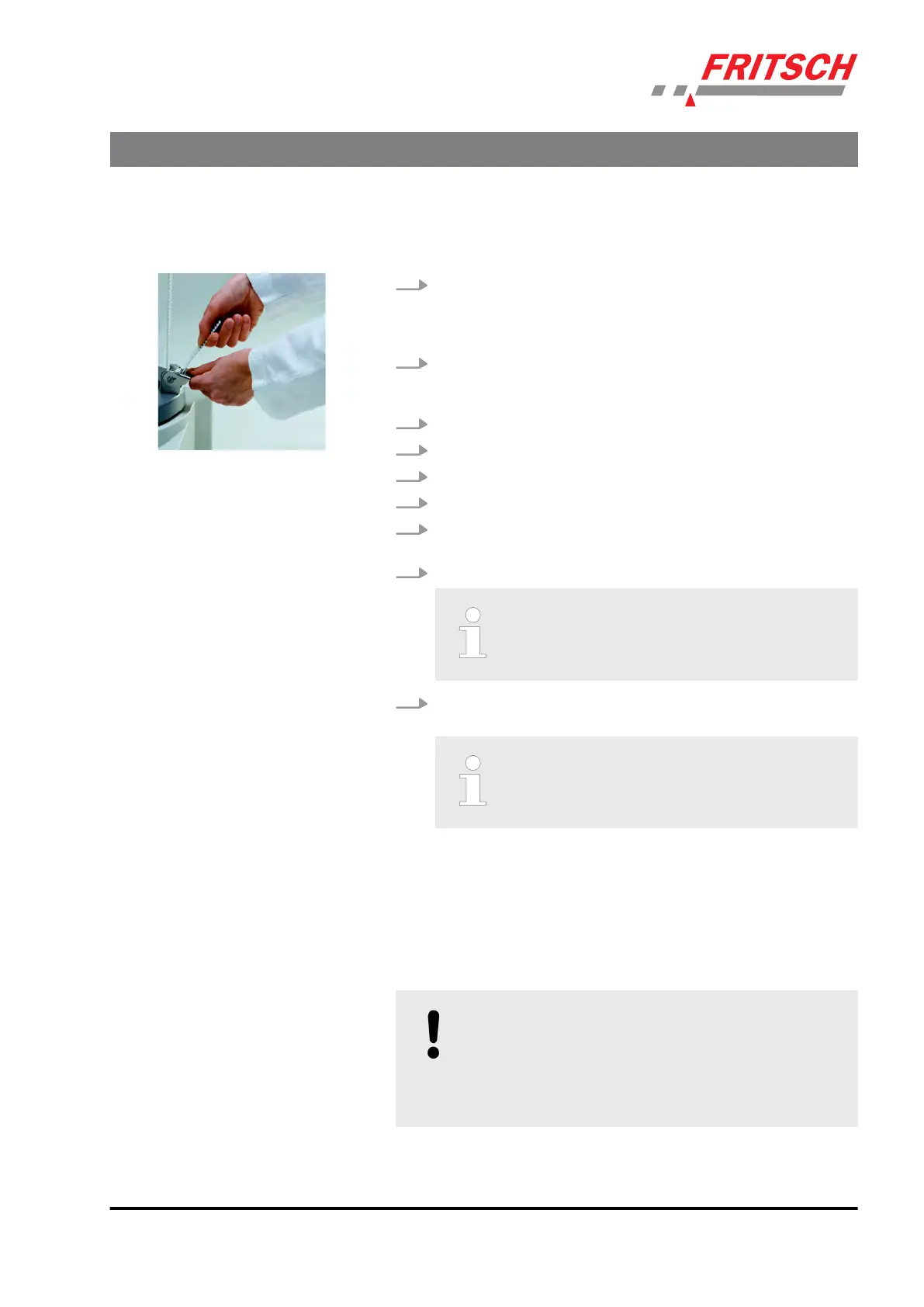
ve the clamping lever on the belt clamping device downwards
and insert the toothed belt through the holder from the inside to
the outside. (See
Ä
Chapter 6.1.1 „Fing and clamping the
sieves“ on page 23).
2. Place the mort
ar and the ball on the vibratory plate. The mortar
must be posioned in the round gap of the vibratory plate without
being wedged.
3. Unscr
ew the knurled knob on the toothed belt as far as possible.
4. P
our in the grinding stock.
5. Put on the clamping lid.
6. Aach the knurled knob to the lid
7. Ligh
tly pull the toothed belt ght and move it upwards unl its
teeth interlock with the teeth of the belt clamping device.
8. Mo
ve the clamping lever upwards.
Make sure that the teeth of the toothed belt
in
terlock with the teeth of the belt clamping
device!
9. B
y turning the knurled knobs to the right, ghten the mortar
evenly unl the toothed belts are ghtly clamped!
If the two toothed belts are not evenly clamped,
it is possible that the grinding s
tock will escape
from the mortar.
Select an amplitude for grinding at which the ball vibrates. The best
grinding r
esults can be achieved at a medium amplitude (1 mm to max. 2
mm), as the impact frequency of the grinding ball is then highest.
Similar to the ANALYSETTE 3 SPARTAN, the amplitude is set manually
with the Plus and Minus key on the control panel and viewed on the lid.
(See
Ä
Chapter 6.7.1 „Displaying the amplitude“ on page 32).
NOTICE!
Do not allo
w the grinding balls to jump too high. This
can cause damage to the lid!
Start grinding at low a amplitude and increase it slowly
- do not select an amplitude that is too high! (≤ 2 mm)
Accessories
- 39 -


 To Next Page